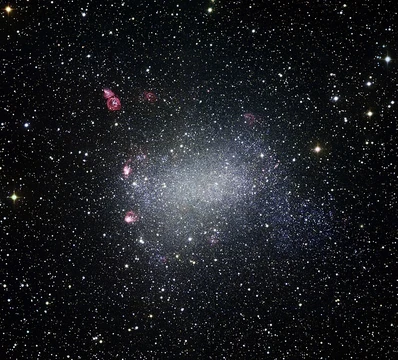
NGC 1052
Elliptical galaxy with twin jets and a powerful black hole.

NGC 1052 is an elliptical galaxy in the constellation Cetus, discovered by William Herschel on January 10, 1785. It belongs to the group that shares its name.
Located about 63 million light-years from the Milky Way, the galaxy has a LINER-type active galactic nucleus, indicating intense starburst activity at its center. Higher-resolution observations have confirmed numerous star-forming regions and young star clusters there. Two small jets emerge from the nucleus, and a very large disc of neutral hydrogen extends far beyond the galaxy itself. The stars and ionized gas rotate along different axes. These features suggest that a gas-rich galaxy collided and merged with NGC 1052 about 1 billion years ago.
The galaxy’s shape is thought to be a triaxial ellipsoid, with its longest axis probably aligned at a position angle of −41°, around which the ionized gas rotates.
NGC 1052 hosts a rapidly rotating supermassive black hole with a mass of 154 million solar masses and a large magnetic field of 2.6 tesla. According to astronomer Anne-Kathrin Baczko, who led the team that made this discovery, this magnetic field provides enough energy to power the twin relativistic jets. The black hole is a promising target for the Event Horizon Telescope. As of 2016, its location was the most precisely known in the universe, aside from Sagittarius A* at the center of our own galaxy.
Two galaxies assumed to be associated with NGC 1052—NGC 1052-DF2 and NGC 1052-DF4—appear to contain little or no dark matter.
Quick Facts
- Epoch
- J2000
- Ra
- 02 · 41 · 04.79851
- Dec
- -08 · 15 · 20.7517
- H Radial V
- 1474 ± 26 km/s
- Z
- 0.004930
- Dist Ly
- 19.00 Mpc
- Group Cluster
- NGC 1052 Group
- Appmag V
- 10.47
- Appmag B
- 11.41
Facts from the source article.
Lore & Background
NGC 1052 was discovered on January 10, 1785 by astronomer William Herschel. It is a member of the eponymous NGC 1052 Group. The galaxy is located at a distance of around 63 million light years from the Milky Way. Its shape is thought to be a triaxial ellipsoid, with the longest axis probably aligned at a position angle of −41°, which is the axis around which the ionized gas rotates.
The galaxy hosts a LINER-type active galactic nucleus that signals intense starburst activity in its center, confirmed by observations showing star-forming regions and young star clusters. Two small jets emerge from the nucleus, and a very extended disc of neutral hydrogen, far larger than the galaxy itself, surrounds it. The stars and the ionized gas rotate along different axes. These features suggest a gas-rich galaxy collided and merged with it 1 billion years ago, producing the observed characteristics.
NGC 1052 hosts a rapidly rotating supermassive black hole with a mass of 154 million solar masses and a large magnetic field of 2.6 tesla. According to astronomer Anne-Kathrin Baczko, leader of the team that made this discovery, this magnetic field provides enough energy to power the twin relativistic jets. The black hole is a promising target for imaging by the Event Horizon Telescope. As of 2016, its location was the most precisely known in the universe, with the exception of Sagittarius A*.
Reader's Guide
NGC 1052 is significant for its active galactic nucleus and the detailed study of its supermassive black hole. The black hole's rapid rotation and large magnetic field of 2.6 tesla are key to powering the twin relativistic jets observed emerging from the nucleus. The galaxy's features—including a triaxial ellipsoid shape, misaligned rotation of stars and ionized gas, and an extended hydrogen disc—point to a major merger with a gas-rich galaxy about 1 billion years ago. This merger likely triggered the starburst activity and the formation of young star clusters in the center. The black hole's precisely known location, second only to Sagittarius A*, makes NGC 1052 a prime candidate for Event Horizon Telescope imaging, offering insights into jet formation and black hole physics. Additionally, the galaxy is associated with NGC 1052-DF2 and NGC 1052-DF4, galaxies that appear to have little or no dark matter, adding to its importance in cosmological studies.
Did You Know?
- Its supermassive black hole has a mass of 154 million solar masses and a magnetic field of 2.6 tesla.
- The galaxy's black hole location was the most precisely known in the universe as of 2016, after Sagittarius A*.
- NGC 1052 is associated with two galaxies that appear to have little or no dark matter: NGC 1052-DF2 and NGC 1052-DF4.
More in NGC Objects, Part 2 1-24
Spotted an error? Know more?
Reader corrections go straight into our review queue. Suggest an edit · How this site is sourced