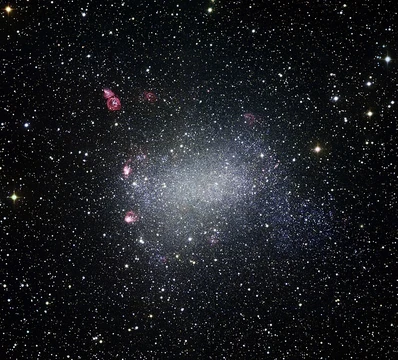
NGC 1024
A large Sab spiral galaxy in Aries, a motley galaxy.

NGC 1024 is a large Sab-type spiral galaxy in the constellation Aries. It was discovered by William Herschel in 1786. Relative to the cosmic microwave background, the galaxy moves at 3,306 ± 16 km/s, giving a Hubble distance of about 159 million light-years (48.8 ± 3.4 Mpc). Five non-redshift measurements place it at roughly 151 million light-years (46.260 ± 3.155 Mpc), which falls within the Hubble distance range.
This galaxy appears in the Atlas of Peculiar Galaxies as an example of a motley galaxy. Its luminosity class is I-II, and it has a broad HI line. With a surface brightness of 14.02 mag/arcmin², NGC 1024 qualifies as a low surface brightness (LSB) galaxy—meaning it is more diffuse than the ambient night sky by at least one magnitude.
NGC 1024 is the largest and brightest member of a small group of three galaxies named after it. The other two are NGC 990 and NGC 1029. Together, NGC 1024 and NGC 1029 also form a galaxy pair.
Quick Facts
- Epoch
- J2000
- Ra
- 02h 39m 11s
- Dec
- +10° 50 48
- Sbrightness
- 23.61 mag/arcsec^2
- Constellation Name
- Aries
- Names
- ARP 333, PGC 10048, MCG 2-7-20, UGC 2142, CGCG 439-22, IRAS 02365+1037
- Z
- 0.011801
- H Radial V
- 3,538 km/s
- Dist Ly
- 159 Mly (48.7 Mpc)
Facts from the source article.
Lore & Background
NGC 1024 was discovered by German-British astronomer William Herschel in 1786. It has a broad HI line and a surface brightness of 14.02 mag/am^2, qualifying it as a low surface brightness (LSB) galaxy. LSB galaxies are diffuse galaxies with a surface brightness less than one magnitude lower than that of the ambient night sky. The galaxy's luminosity class is I-II. Five non-redshift measurements yield a distance of 46.260 ± 3.155 Mpc, which falls within the range of its Hubble distance of 48.8 ± 3.4 Mpc. NGC 1024 was used in the Atlas of Peculiar Galaxies as an example of a motley galaxy.
Reader's Guide
NGC 1024 holds significance as the largest and brightest galaxy in the NGC 1024 Group, a small trio that also includes NGC 990 and NGC 1029. Additionally, NGC 1024 and NGC 1029 form a pair of galaxies. Its classification as a low surface brightness galaxy, with a surface brightness of 14.02 mag/am^2, places it among diffuse galaxies that are fainter than the ambient night sky. The galaxy's inclusion in the Atlas of Peculiar Galaxies as a motley galaxy highlights its irregular or patchy appearance, contributing to the study of galaxy morphology and peculiar structures. The consistency between its Hubble distance and non-redshift measurements reinforces its position in the cosmic distance scale. As the dominant member of its group, NGC 1024 serves as a reference point for understanding galaxy interactions and group dynamics within the local universe.
More in NGC Objects, Part 2 1-24
Spotted an error? Know more?
Reader corrections go straight into our review queue. Suggest an edit · How this site is sourced