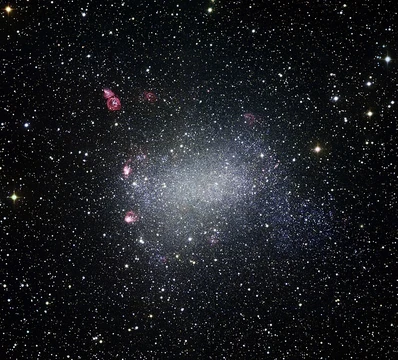
NGC 1023
A barred lenticular galaxy in Perseus with a rich globular cluster system.

NGC 1023 is a barred lenticular galaxy located in the northern constellation of Perseus, also known as the Perseus Lenticular Galaxy. It is notable for being a member of the NGC 1023 group of galaxies within the Local Supercluster and for its inclusion in Halton Arp's Atlas of Peculiar Galaxies under the category 'Galaxies with Nearby Fragments' as number 135.
Quick Facts
- Epoch
- J2000
- Constellation Name
- Perseus
- Ra
- 02 · 40 · 24.0
- Dec
- +39 · 03 · 48
- Z
- 0.002125
- H Radial V
- 637 ± 4 km/s
- Dist Ly
- ~19 Mly (Light Travel-Time redshift-based) / 30 to 64 Mly (measured)
- Appmag V
- 10.35
- Absmag V
- −21.2
Facts from the source article.
Lore & Background
NGC 1023 is a barred lenticular galaxy in the northern constellation of Perseus, sometimes called the Perseus Lenticular Galaxy. Distance measurements vary from 9.3 to 19.7 million parsecs (30 to 64 million light-years). It is a member of the NGC 1023 group of galaxies in the Local Supercluster. The galaxy is included in Halton Arp's Atlas of Peculiar Galaxies under the category 'Galaxies with Nearby Fragments' as number 135.
NGC 1023 has been estimated to contain about 490 globular clusters, consistent with similar early-type galaxies. At its core lies a supermassive black hole, discovered by analyzing the dynamics of the galaxy. A number of small galaxies surround NGC 1023, collectively labeled the NGC 1023 Group. The shape and motion of neutral hydrogen gas around NGC 1023 suggest a past tidal interaction with one of its dwarf companions.
NGC 1023 has a satellite galaxy named NGC 1023A, a Magellanic spiral galaxy with a much smaller globular cluster system estimated at around six individuals. A bridge of neutral hydrogen extends from NGC 1023 to NGC 1023A, which may indicate a possible interaction between the two galaxies.
Reader's Guide
NGC 1023 holds significance as a prominent barred lenticular galaxy in the Local Supercluster, serving as the central member of the NGC 1023 group. Its inclusion in Halton Arp's Atlas of Peculiar Galaxies highlights its structural interest, specifically under the category of galaxies with nearby fragments. The galaxy's estimated 490 globular clusters place it in line with other early-type galaxies, offering a comparative benchmark for studies of globular cluster systems. The discovery of a supermassive black hole at its core, derived from dynamical analysis, adds to its importance for understanding black hole demographics in lenticular galaxies. The presence of a neutral hydrogen bridge connecting NGC 1023 to its satellite NGC 1023A provides evidence of a possible past tidal interaction, making the system a valuable case study for galaxy interactions and their effects on gas dynamics and satellite evolution. The NGC 1023 group itself, with its collection of small galaxies, offers a local laboratory for examining group-scale processes and the influence of a dominant galaxy on its companions.
Did You Know?
- NGC 1023 is also known as the Perseus Lenticular Galaxy.
- It is listed as Arp 135 in Halton Arp's Atlas of Peculiar Galaxies.
- The galaxy has an estimated 490 globular clusters.
- A bridge of neutral hydrogen connects NGC 1023 to its satellite NGC 1023A.
More in NGC Objects, Part 2 1-24
Spotted an error? Know more?
Reader corrections go straight into our review queue. Suggest an edit · How this site is sourced