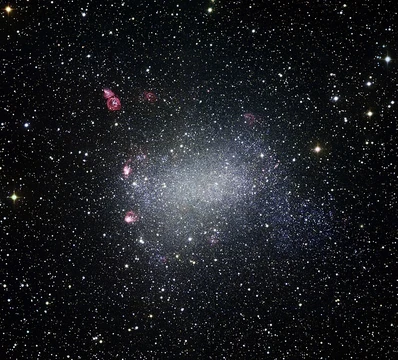
NGC 1003
Unbarred spiral galaxy in Perseus with a warped eastern disk.

NGC 1003 is a spiral galaxy located at the western edge of the Perseus constellation, approximately 36 million light years from the Milky Way. It is a member of the NGC 1023 group of galaxies and is notable for its unbarred spiral structure and a substantial warp in its eastern disk.
Quick Facts
- Epoch
- J2000
- Constellation Name
- Perseus
- Ra
- 02 · 39 · 16.893
- Dec
- +40 · 52 · 20.25
- Z
- 0.002090
- Dist Ly
- 9.486 ± 0.429 Mpc
- Group Cluster
- NGC 1023 group
- Mass Light Ratio
- 0.70 · 0.16 · 0.15
- Appmag B
- 12.1
- Notes
- Warped disk
Facts from the source article.
Lore & Background
NGC 1003 was discovered by the Anglo-German astronomer William Herschel on October 6, 1784. He described it as 'pretty faint, large, extended 90°±, much brighter middle, mottled but not resolved'. The galaxy is classified as SAcd, indicating an unbarred spiral with loosely wound arms. It is inclined at an angle of 70° to the line of sight from Earth, with its major axis aligned along a position angle of 276°. The visual disk of the galaxy shows a substantial warping in the eastern side, turning it almost face on. One supernova has been observed in NGC 1003: SN 1937D, a Type Ia event of magnitude 10.5, discovered by Fritz Zwicky on 9 September 1937.
Reader's Guide
NGC 1003 holds significance as a member of the NGC 1023 group, offering insight into the dynamics of galaxy groups. Its morphological classification as SAcd places it among unbarred spirals with loosely wound arms, a structure that aids in understanding spiral arm formation and evolution. The substantial warp in its eastern disk, which turns the galaxy almost face on, provides a natural laboratory for studying disk warps and their causes, such as tidal interactions or accretion events. The observation of SN 1937D, a Type Ia supernova, contributes to the calibration of cosmic distance scales and the study of stellar explosions. The galaxy's heliocentric radial velocity and mass-to-light ratio of 0.7 offer constraints on its dark matter content and stellar population. Its discovery by William Herschel in 1784 places it within the rich history of deep-sky cataloging, and its continued study helps refine models of spiral galaxy structure and evolution.
Did You Know?
- NGC 1003 was discovered by William Herschel on October 6, 1784.
- One supernova, SN 1937D (Type Ia, mag. 10.5), was observed in this galaxy.
- The galaxy's eastern disk shows a substantial warp, turning it almost face on.
More in NGC Objects, Part 2 1-24
Spotted an error? Know more?
Reader corrections go straight into our review queue. Suggest an edit · How this site is sourced