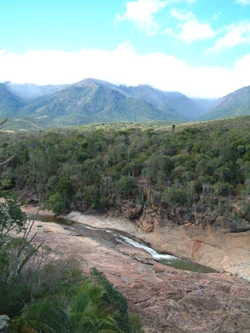
Zombitse-Vohibasia National Park
A transitional forest park in southwest Madagascar, home to endemic lemurs.

Zombitse-Vohibasia National Park is a protected area in the Atsimo-Andrefana region of south-west Madagascar, located approximately 140 kilometers east of Toliara, with National road 7 running north-south through the region. Established as a national park in 2002, it comprises three non-contiguous forest sections—Zombitse, Vohibasia, and Isoky-Vohimena—covering 36,308 hectares. The park lies within the Madagascar succulent woodlands ecoregion, a transitional zone between spiny thicket and dry deciduous woodland, and is recognized as an Important Bird Area and a critical habitat for several endemic species.
Quick Facts
- Iucn Category
- II
- Location
- Atsimo-Andrefana, Madagascar
- Nearest City
- Sakaraha, Tulear
- Established
- First protected 1962, parcels added 18 December 1997, upgraded to National Park 2002
- Governing Body
- Madagascar National Parks Association
Facts from the source article.
Lore & Background
The park's history began in 1962 when the Zombitse forest was first set aside as a protected area. The Vohibasia and Isoky-Vohimena forests were added in 1997, and the full site was formally established as a national park in 2002. The Bara and Mahafaly peoples are the main ethnic groups in the area. The park is crossed by National road 7, with the nearest airport in Toliara and the park office in Sakaraha, 10 kilometers from the entrance.
Reader's Guide
Zombitse-Vohibasia National Park is significant as a biological reservoir straddling the western and southern domains of Madagascar, meeting Birdlife International criteria as an Important Bird Area. It hosts 90 bird species (38 endemic), 20 mammal species (including eight lemur species), 33 reptile species, and eight amphibian species. The park is the only protected area for the endangered Hubbard's sportive lemur, also known as the Zombitse sportive lemur. Nearly 300 plant species are recorded, with two species found only here. The park faces conservation challenges from deforestation due to slash-and-burn agriculture, with forested areas declining significantly between 1949 and 1994. Its climate is relatively dry, averaging 724 mm of rain annually, with a rainy season from November to March.
Did You Know?
- The park is the only protected area where the endangered Hubbard's sportive lemur (Lepilemur hubbardorum) is known to occur.
- Ninety species of birds have been documented in the park, including 38 endemic species.
- The park covers 36,308 hectares across three non-contiguous forest sections: Zombitse, Vohibasia, and Isoky-Vohimena.
- Two plant species—Ampelosycios bosseri and Ivodea trichocarpa—have been found only in Zombitse-Vohibasia National Park.
More in National parks of Madagascar 1-24
Spotted an error? Know more?
Reader corrections go straight into our review queue. Suggest an edit · How this site is sourced