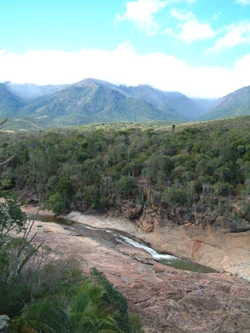
Baie de Baly National Park
Only known natural habitat of the critically endangered Angonoka tortoise.

Baie de Baly National Park is a protected area in northern Madagascar, located in Soalala District within the region of Boeny. It is notable as the only known natural habitat of the critically endangered Angonoka tortoise (Astrochelys yniphora), also known as the ploughshare tortoise.
Quick Facts
- Iucn Category
- II
- Location
- Soalala District, Boeny, Madagascar
- Nearest City
- Sakaraha, Tulear
- Established
- 18 December 1997
- Governing Body
- Madagascar National Parks Association
Facts from the source article.
Lore & Background
Baie de Baly National Park is situated close to the towns of Soalala and Ambohipaky, approximately 150 kilometers from the major city of Mahajanga. Its southern border is formed by the Kapiloza River, and the Andranomavo River crosses the park. To the north lies the Mozambique Channel, and to the east the Bay of Marambitsy. The park's vegetation includes dry deciduous forests, scrub-shrub or bamboo shrub, mangroves, lakes, and swamps mixed with savanna.
Reader's Guide
Baie de Baly National Park holds exceptional conservation significance as the sole known natural habitat of the critically endangered Angonoka tortoise (Astrochelys yniphora). This species is found nowhere else in the wild. The park also shelters other rare animals, including the Madagascan sideneck turtle (Erymnochelys madagascariensis), the dugong (a marine mammal), and the Madagascar fish eagle. In total, the park hosts thirteen species of mammals (including six primates), 37 reptile species, eight amphibian species, and 122 bird species. The endemic bamboo Perrierbambus madagascariensis grows here, as does the poisonous tree Erythrophleum couminga (locally named komanga), whose wood is very hard but cannot be used for cooking because its fumes contain a poison. The park's diverse habitats—dry forests, mangroves, lakes, swamps, and savanna—support this unique assemblage of life. Its legacy lies in its role as a critical refuge for species found only in this region of Madagascar.
Did You Know?
- The park contains the poisonous tree Erythrophleum couminga, whose wood cannot be used for cooking because its fumes contain a poison.
- The park is bordered by the Mozambique Channel to the north and the Bay of Marambitsy to the east.
- The endemic bamboo Perrierbambus madagascariensis is found in the park.
Geography & Setting
Baie de Baly National Park occupies a distinctive stretch of northern Madagascar, nestled within the Soalala District of the Boeny region. The park sits in the vicinity of the small settlements of Soalala and Ambohipaky, while the nearest major urban center, Mahajanga, lies roughly 150 kilometres (about 93 miles) to the south. Its position is defined by a remarkable convergence of land and water: the Mozambique Channel forms its northern boundary, the Bay of Marambitsy wraps around its eastern edge, and the Kapiloza River traces the southern limit. The Andranomavo River cuts across the park's interior, adding a further layer of hydrological character. To the west, the park shares a border with the Tsingy de Namoroka National Park, creating a contiguous protected landscape. The terrain itself is a mosaic of dry deciduous forests, scrub-shrub and bamboo thickets, mangrove stands, freshwater lakes, swamps, and open savanna, giving the area a strikingly varied ecological profile.
Sole Refuge of the Angonoka Tortoise
Perhaps no single fact elevates Baie de Baly above all other protected areas in Madagascar: it is the only known natural habitat on Earth for the Angonoka tortoise, also called the ploughshare tortoise (Astrochelys yniphora), a species classified as critically endangered. The survival of this remarkable reptile is tied entirely to the ecosystems preserved within the park's borders, making the site a matter of global conservation urgency. Beyond the tortoise, the park shelters the Madagascan sideneck turtle (Erymnochelys madagascariensis), another rare chelonian whose range is vanishingly small. In the waters along the park's northern and eastern margins, the dugong—a gentle marine mammal—grazes on seagrass beds, while overhead the Madagascar fish eagle patrols the skies. Together, these flagship species underscore why the park's protection is not merely a local concern but a critical node in the broader web of Madagascan biodiversity.
A Rich Tapestry of Wildlife
The park supports a surprisingly dense assemblage of animal life for a site of its size. Thirteen mammal species call the area home, six of which are primates, indicating a forested environment capable of sustaining diverse arboreal communities. Reptiles are particularly well represented, with 37 distinct species recorded across the park's varied habitats. Amphibians, numbering eight species, thrive in the lakes, swamps, and riparian zones shaped by the Andranomavo and Kapiloza rivers. The avian community is the most numerous, with 122 bird species documented, including the Madagascar fish eagle and a host of smaller forest and wetland dwellers. The dugong adds a marine dimension to the park's fauna, while the Madagascan sideneck turtle and the critically endangered Angonoka tortoise lend the reptile list an extraordinary conservation weight. In total, the park functions as a compact yet remarkably complete cross-section of Madagascan terrestrial and coastal wildlife.
Endemic Flora & the Poisonous Komanga
The plant life of Baie de Baly is as varied as its animal community, spanning dry deciduous forests, scrub-shrub and bamboo thickets, mangrove fringes, and open savanna interspersed with lakes and swamps. Two plant species stand out for their endemism. The first is Perrierbambus madagascariensis, a bamboo found nowhere else on the planet, which forms part of the park's characteristic bamboo-shrub vegetation. The second is the komanga tree, Erythrophleum couminga, a species endemic to this region of northern Madagascar and present both inside and outside the park boundaries. The komanga produces an exceptionally hard wood, yet it carries a deadly caveat: the fumes released when the wood is burned contain a potent poison, rendering it entirely unsuitable for cooking. This combination of remarkable hardness and lethal toxicity makes the komanga one of the most distinctive and cautionary botanical features of the region.
Frequently Asked Questions
Where is Baie de Baly National Park located?
It sits in the Soalala District of the Boeny region, in the northern part of Madagascar. The park stretches along the coast, bordered by the Mozambique Channel and the Bay of Marambitsy.
Why is Baie de Baly National Park so important?
It is the sole natural home of the ploughshare tortoise (Astrochelys yniphora), a species classified as critically endangered. No other place on Earth provides a wild habitat for this tortoise, making the park irreplaceable for its survival.
What rare animals can you find in Baie de Baly National Park?
Beyond the ploughshare tortoise, the park shelters other rare species including the Madagascan sideneck turtle, the dugong, and the Madagascar fish eagle. Together these make it one of the most species-rich protected zones on the island's north coast.
What kind of landscape and vegetation can visitors expect in Baie de Baly National Park?
The terrain is a patchwork of dry deciduous forests, scrub-shrub, bamboo thickets, mangrove stands, and open savanna. Wetland features such as lakes and swamps add further ecological diversity to the area.
What other protected areas or water bodies border Baie de Baly National Park?
On one side it meets Tsingy de Namoroka National Park, while its coastline adjoins the Mozambique Channel and the Bay of Marambitsy. This places it at the intersection of terrestrial and marine ecosystems in northern Madagascar.
More in National parks of Madagascar 1-24
Spotted an error? Know more?
Reader corrections go straight into our review queue. Suggest an edit · How this site is sourced