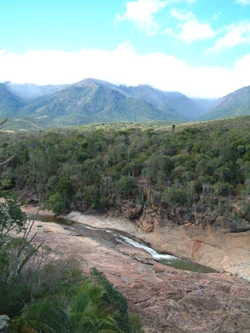
Midongy du sud National Park
Second-largest rainforest in Madagascar, rich in endemic species.

Midongy du sud National Park, also known as Midongy-Befotaka, is a national park in the region of Atsimo-Atsinanana, in south-east Madagascar. It was first protected in 1953 and became a national park in 1997. The park is notable for containing the second largest rainforest on the island and is rich in endemic animals and plants, especially medicinal plants.
Quick Facts
- Iucn Category
- II
- Location
- Midongy-Atsimo District
- Nearest City
- Farafangana, Befotaka
- Area
- 1922 km2
- Established
- 1997
- Governing Body
- Madagascar National Parks Association
Facts from the source article.
Lore & Background
Midongy du sud National Park is divided into two main parts: the Befotaka Forest (43,423 hectares) and the Soarano Forest (24,145 hectares). It lies 42 kilometers from Befotaka and 90 kilometers south-east of Vangaindrano, accessible only by unpaved roads that may be impassable during the wet season from December to June. The park features deep valleys with humid rain forests, steep mountains, and many streams that drain to feed lowland marshes. The ethnic groups living in the area are the Antaisaka people and the Bara people.
The park hosts 348 species of plants, of which 250 are only known to Madagascar. Fourteen endangered plants are listed on the IUCN red list, and the orchids Aeranthes caudata and Bulbophyllum vestitum are listed by CITES on Appendix II. Notable medicinal plants include Mystroxylon aethiopicum, said to help with injuries, and the sap of Medinilla sp., used for coughs. The park also hosts four species of lemurs, including the most endangered Greater bamboo lemur (Prolemur simus), as well as around 80 to 100 species of birds, 56 amphibians, 53 reptiles, 6 carnivores, and 4 bats.
Reader's Guide
Midongy du sud National Park holds significance as a refuge for Madagascar's second largest rainforest and a high concentration of endemic and medicinal plants. Its protection since 1953 and designation as a national park in 1997 underscore its conservation importance. The park's rugged topography and humid climate sustain a unique ecosystem that includes endangered species such as the Greater bamboo lemur and numerous plants listed on the IUCN red list and CITES. The park also serves as an Important Bird Area. Its remote location, accessible only by unpaved roads that are often impassable during the wet season, limits human impact but also challenges management. The presence of the Antaisaka and Bara peoples highlights the cultural context of the region. Overall, Midongy du sud represents a critical site for biodiversity conservation in Madagascar, particularly for endemic flora and fauna.
Did You Know?
- The park contains the second largest rainforest on Madagascar.
- It is divided into two main forests: Befotaka Forest (43,423 ha) and Soarano Forest (24,145 ha).
- The park hosts around 80 to 100 species of birds and 4 species of lemurs, including the Greater bamboo lemur.
Geography & Topography
Stretching across 192,000 hectares in Madagascar's Atsimo-Atsinanana region, Midongy du sud shelters the island's second-largest rainforest, a distinction earned through its rugged terrain and consistently humid climate. The park is split into two principal forest blocks: the larger Befotaka Forest at 43,423 hectares and the Soarano Forest at 24,145 hectares. Elevation within the park swings dramatically, from a low of 689 metres up to the 1,679-metre summit of Mont Papango, creating steep mountain slopes and deep valleys draped in dense, moisture-laden woodland. Numerous streams cascade down these mountains, eventually feeding marshlands in the lower elevations. Annual rainfall ranges widely from 1,600 to 3,600 millimetres, sustaining the lush vegetation. The park sits 42 kilometres from the town of Befotaka and 90 kilometres south-east of Vangaindrano, and its designation as an Important Bird Area underscores the ecological richness of its varied landscapes.
Flora & Medicinal Heritage
Midongy du sud is a botanical treasure, harboring 348 plant species of which a remarkable 250 are found nowhere else on Earth. The park's forests are dominated by a diverse canopy of Brachylaena, Calophyllum, Cryptocarya, Dalbergia, Diospyros, Elaeocarpus, Eugenia, Ocotea, Ravensara, Symphonia, Tambourissa, and Uapaca trees, while lowland marshes are threaded with screw-pine (Pandanus) and various sedges (Carex). Beyond sheer diversity, the park holds profound medicinal significance for local communities. Mystroxylon aethiopicum, a member of the Celastraceae family, is traditionally applied to treat injuries, and the sap of Medinilla species is used to ease coughs. Conservation concerns are acute: fourteen plant species within the park appear on the IUCN Red List of threatened species, and two orchids—Aeranthes caudata and Bulbophyllum vestitum—carry CITES Appendix II protections, reflecting the global recognition of their vulnerability.
Fauna & Biodiversity
Though Madagascar's forests are famous for their lemurs, Midongy du sud's faunal community extends far beyond primates. The park is home to four lemur species, most notably the Greater bamboo lemur (Prolemur simus), which ranks among the most endangered primates in the world. Avian life is extraordinarily rich, with 348 bird species recorded—a figure that earned the park its Important Bird Area designation. The park also supports 56 amphibian species and 53 reptile species, thriving in the humid valleys and mountain streams. Six carnivore species and four bat species round out the mammalian roster. Together, these communities illustrate how the park's varied topography—from lowland marshes to high-altitude forests—creates a mosaic of microhabitats that sustains an impressive concentration of endemic and threatened wildlife in one of Madagascar's most remote corners.
History, Access & Human Context
Midongy du sud, also referred to as Midongy-Befotaka, has a layered history of conservation. The area first received formal protection in 1953, and it was not until 1997 that it was elevated to national park status—a gap of four decades that underscores the long struggle to secure lasting safeguards for the region. Access remains challenging: the park is reached via unpaved roads that can become completely impassable during the wet season, which runs from December through June. The human landscape is shaped by the Antaisaka and Bara ethnic groups, whose communities have long depended on the forest's resources, including its abundant medicinal plants. Just 20 kilometres away lies the Kalambatritra Reserve, suggesting a broader network of protected areas in this part of south-east Madagascar. The park's remoteness, while a barrier to development, has also served as a shield, helping preserve one of the island's most ecologically significant landscapes.
Frequently Asked Questions
Where is Midongy du sud National Park located and what is its alternate name?
It sits in the Atsimo-Atsinanana region of south-east Madagascar and is also widely known by the name Midongy-Befotaka.
When did Midongy du sud first receive protected status?
The area was first set aside for protection back in 1953, and it was later upgraded to full national park designation in 1997.
What makes Midongy du sud National Park ecologically significant?
It shelters Madagascar's second-largest rainforest and harbors a rich assemblage of endemic fauna and flora, with a particularly notable diversity of plants used in traditional medicine.
How large is the park in terms of area?
Midongy du sud spans roughly 192,000 hectares, which is equivalent to about 470,000 acres of protected territory.
What are the terrain and rainfall conditions like inside the park?
Elevation climbs from around 689 meters at the lower reaches up to 1,679 meters at Mont Papango, and the park receives between 1,600 and 3,600 millimeters of rain annually.
More in National parks of Madagascar 1-24
Spotted an error? Know more?
Reader corrections go straight into our review queue. Suggest an edit · How this site is sourced