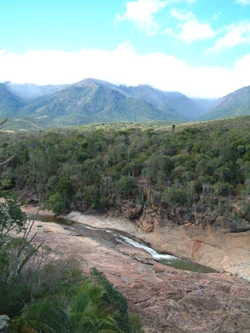
Tsingy de Bemaraha National Park
A UNESCO World Heritage Site of limestone needle forests.

Tsingy de Bemaraha National Park lies in northwestern Madagascar, mostly within Antsalova District and partly in Morafenobe District to the northeast. Its core features are the Great Tsingy and the Little Tsingy, two distinct geological formations. The park, together with the neighboring Tsingy de Bemaraha Strict Nature Reserve, forms a UNESCO World Heritage Site. The Manambolo River runs through the park.
The tsingys are karstic plateaus shaped by groundwater that has eroded the limestone from below, carving out caves and fissures. In parts of western Madagascar, especially around the park and reserve, a mix of vertical and horizontal erosion has produced dramatic "forests" of sharp limestone needles. The word *tsingy* comes from Malagasy and describes these karst badlands; it roughly translates to "where one cannot walk barefoot."
The unusual landscape of the World Heritage Site—which includes both the park and the strict reserve—supports an exceptionally high number of endemic plant and animal species. These species occupy very small, specific niches within the tsingys. For instance, the top, slope, and base of a single limestone needle each host different ecosystems, with distinct species clinging to the steep surfaces.
Quick Facts
- Iucn Category
- II
- Location
- Melaky, Madagascar
- Designation
- National park
- Established
- 1 August 1997
- Visitation Num
- 10,093
- Visitation Year
- 2011
- Governing Body
- Madagascar National Parks
Facts from the source article.
Lore & Background
The Tsingys are karstic plateaus where groundwater has undercut elevated uplands, gouging caverns and fissures into the limestone. In several regions of western Madagascar, centering on the park and adjacent Nature Reserve, the superposition of vertical and horizontal erosion patterns has created dramatic 'forests' of limestone needles. 'Tsingy' is a Malagasy word describing the karst badlands, translatable as 'where one cannot walk barefoot.'
Reader's Guide
The unusual geomorphology of the Tsingy de Bemaraha World Heritage Site, which encompasses both the National Park and the adjacent Strict Nature Reserve, means the site is home to an exceptionally large number of endemic species of plants and animals found only within extremely small niches within the tsingys. For example, the summit, slope, and base of a tsingy's limestone needle form different ecosystems with different species clinging to their exceptionally steep slopes. The park is crossed by the Manambolo River. Its significance lies in its unique karst landscape and the high endemism it supports, making it a key site for biodiversity conservation in Madagascar.
Did You Know?
- The word 'tsingy' can be translated as 'where one cannot walk barefoot.'
- The park centers on two geological formations: the Great Tsingy and the Little Tsingy.
More in National parks of Madagascar 1-24
Spotted an error? Know more?
Reader corrections go straight into our review queue. Suggest an edit · How this site is sourced