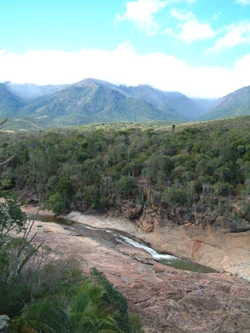
Tsimanampetsotsa National Park
A dry spiny-forest park with a hypersaline lake and unique fossils.

Tsimanampetsotsa National Park, also written as Tsimanampetsotse and once called Tsimanampetsotsa Nature Reserve, covers 432 square kilometers on Madagascar’s southwestern coast, in the Atsimo-Andrefana region. It lies 90 kilometers south of Toliara and 950 kilometers south of the capital, Antananarivo. Route Nationale 10, heading toward Faux Cap, runs past the park, and the closest airport is in Toliara. The park takes its name from Lake Tsimanampetsotsa, which sits within its boundaries.
The park sits on the western edge of the limestone Mahafaly Plateau. It was first set aside in 1927 to protect its native plants and animals, and it was upgraded to a national park in 1966. It lies in the Madagascar spiny forests, often called the “spiny desert,” a globally unique ecoregion. This area has the highest rate of plant endemism in Madagascar—48 percent of its plant genera and 95 percent of its species are found nowhere else—and it is ranked among the world’s 200 most important ecological regions. The vegetation is dominated by drought-tolerant, woody plants from the spurge family (Euphorbiaceae) and the subfamily Didiereoideae, which is narrowly limited to southwestern Madagascar. Beyond its plant life, the park hosts six primate species, representing four of the five families unique to Madagascar. Several animals restricted to the dry south also live here, including the recently described Grandidier’s mongoose (Galidictis grandidieri) and the Madagascar radiated tortoise, or sokake (Geochelone radiata). Lake Tsimanampetsotsa, an important wetland, was designated a Ramsar Wetland of International Importance in 1998. In the 1930s, Henri Perrier de la Bâthie uncovered subfossil remains of giant tortoises, crocodiles, and eggshell fragments from elephant birds. More recent surveys confirm the park is rich in fossils.
In July 2018, Tsimanampesotse – Nosy Ve Androka became Madagascar’s fifth Biosphere Reserve. It belongs to the intertropical marine biogeographic system of the Southwest Indian Ocean and includes five large Malagasy ecoregions: the South Terrestrial, the Aquatic Ecoregion of the southern basins, the Aquatic Ecoregion of the West Basins, the Mozambique Channel Marine Ecoregion, and the South Marine Ecoregion.
Quick Facts
- Iucn Category
- II
- Location
- South-west Madagascar
- Nearest City
- Efoetsy, Toliara
- Area
- 432 km2
- Established
- 1927
Facts from the source article.
Lore & Background
Tsimanampetsotsa National Park encompasses the westernmost escarpment of the limestone Mahafaly Plateau. The park contains and is named after Lake Tsimanampetsotsa, a shallow, highly mineralized lake with salt concentrations near that of sea water. No fish live in the lake, but invertebrates from four taxonomic groups have been documented. The lake is an important wetland registered as a Ramsar Wetland of International Importance in 1998. In the 1930s, Henri Perrier de la Bâthie discovered subfossil remains of giant tortoise, crocodiles, and eggshell fragments of elephant birds at Mitoho Grotto within the park. Recent surveys confirm the park is rich in fossils.
Reader's Guide
Tsimanampetsotsa National Park is significant for its extreme aridity—the driest area in Madagascar with less than 300 mm of rainfall annually—and its exceptional biodiversity. The park's vegetation is characterized by xerophytic species of the Spurge family and the subfamily Didiereoideae, narrowly endemic to southwest Madagascar. It is home to six species of primates representing four of the five families endemic to Madagascar, as well as endemic animals like Grandidier's mongoose and the Madagascar radiated tortoise. The park's four distinct landscapes—the lake and shore zone, the Mahafaly Plateau edge, the limestone plateau itself, and the eastern zone—support a range of habitats, from hypersaline flats to dry forest. Mitoho Grotto, a sacred site, contains a permanent lake with a blind fish species and is a significant fossil location. In July 2018, the park became part of Madagascar's 5th Biosphere Reserve, Tsimanampesotse – Nosy Ve Androka, which includes five large Malagasy ecoregions. The park's legacy lies in its role as a refuge for endemic species and a key site for paleontological research.
Did You Know?
- Lake Tsimanampetsotsa has no fish, but supports invertebrates from Annelida, Gastropoda, Crustacea, and Insecta.
- The park contains the Mitoho Cave Giant Pill-Millipede (Zoosphaerium mitoho), endemic to the dry spiny forests.
- In the 1930s, subfossil remains of giant tortoise, crocodiles, and elephant bird eggshells were discovered at Mitoho Grotto.
- The park is the driest area in Madagascar, with annual rainfall less than 300 mm.
More in National parks of Madagascar 1-24
Spotted an error? Know more?
Reader corrections go straight into our review queue. Suggest an edit · How this site is sourced