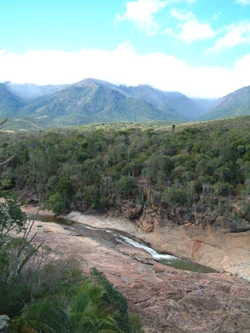
Ranomafana National Park
Madagascar's fourth national park, home to rare lemurs and rainforest.

Ranomafana National Park is a national park in southeastern Madagascar, located in the Haute Matsiatra and Vatovavy regions. Established as Madagascar's fourth national park in 1991, it was created following the rediscovery of the greater bamboo lemur (Hapalemur simus) and the discovery of the golden bamboo lemur (Hapalemur aureus) by primatologist Dr. Patricia Wright. The park protects more than 41,600 hectares of tropical rainforest and is part of the UNESCO World Heritage Site Rainforests of the Atsinanana.
Quick Facts
- Iucn Category
- II
- Nearest City
- Fianarantsoa, Ranomafana
- Area
- 416 km2
- Established
- 1991
- Governing Body
- Madagascar National Parks Association
Facts from the source article.
Lore & Background
The park's name comes from the Malagasy words 'rano mafana' meaning 'hot water,' referencing the hot springs in the nearby town of Ranomafana. It was established in 1991 after Dr. Patricia Wright rediscovered the greater bamboo lemur and discovered the golden bamboo lemur. The park was later integrated into the UNESCO World Heritage Site Rainforests of the Atsinanana. The Centre ValBio research station, created in 2003 by Stony Brook University, is adjacent to the park and supports biodiversity research, community health and education, environmental arts, and reforestation.
Reader's Guide
Ranomafana National Park is significant for its role in lemur conservation, particularly the greater bamboo lemur and golden bamboo lemur, which prompted its establishment. The park's elevation range of 800 to 1,200 meters creates diverse forest types, including lowland rainforest and cloud forest, supporting high biodiversity. It hosts 118 bird species (30 endemic), 112 frog species, and numerous other animals. The park has four main research sites: Talatakely, Vatoharanana, Valohoaka, and Mangevo, with Talatakely accessible to tourists and the only site where Prolemur simus can be seen. Tourism requires a local guide, with seven hiking trails (10–20 km), birdwatching, lemur viewing, and waterfalls. Kayaking, canoeing, and a hot springs pool are available. Lodging includes ecolodges, hotels in Ranomafana village, a campsite, and researcher accommodations at Centre ValBio. The park is 65 km northeast of Fianarantsoa and 139 km west of Mananjary, crossed by National Roads 25 and 45.
Did You Know?
- The park's name means 'hot water' in Malagasy, from the hot springs in Ranomafana town.
- It was established in 1991 after the rediscovery of the greater bamboo lemur and discovery of the golden bamboo lemur.
- Centre ValBio research station was created in 2003 by Stony Brook University.
Frequently Asked Questions
What is Ranomafana National Park?
It is a protected tropical rainforest in southeastern Madagascar, covering more than 41,600 hectares across the Haute Matsiatra and Vatovavy regions. Designated in 1991, it is the fourth national park to be established on the island.
How did Ranomafana National Park come to exist?
The park's creation was triggered by primatologist Dr. Patricia Wright rediscovering the greater bamboo lemur and identifying the golden bamboo lemur in the area. Those landmark findings led the Malagasy government to formally protect the habitat in 1991.
What lemurs is Ranomafana National Park most famous for?
The park is best known as the home of the greater bamboo lemur and the golden bamboo lemur, two rare species that rely heavily on bamboo for food. Its dense rainforest also shelters a wide range of other lemur species.
Where is Ranomafana National Park located and how big is it?
It sits in southeastern Madagascar, straddling the Haute Matsiatra and Vatovavy regions at elevations between roughly 800 and 1,200 meters above sea level. The protected area spans about 41,600 hectares (around 161 square miles) of tropical rainforest.
Why is Ranomafana National Park important for conservation?
It forms a key component of the UNESCO World Heritage Site called the Rainforests of the Atsinanana, which highlights the extraordinary biodiversity of Madagascar's eastern forests. The park safeguards critical habitat for numerous endemic and endangered species, especially the bamboo-dwelling lemurs.
More in National parks of Madagascar 1-24
Spotted an error? Know more?
Reader corrections go straight into our review queue. Suggest an edit · How this site is sourced