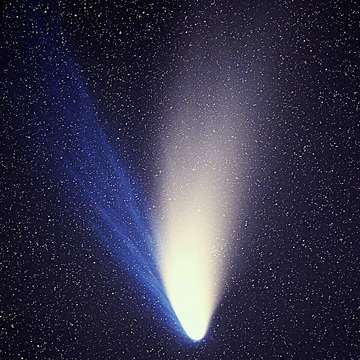
85D/Boethin
A lost Jupiter-family comet discovered under unusual circumstances.

85D/Boethin was a periodic Jupiter-family comet discovered in 1975 by Leo Boethin, a Catholic priest in the Philippines. It was notable as the first comet discovered by an observer in the Philippines and as a target of NASA's EPOXI mission before it was lost.
Quick Facts
- Discovery Ref
- Boethin_1975 · IAUC_2745
- Discoverer
- Leo Boethin
- Discovery Date
- 4 January 1975
- Mpc Name
- D/1975 A1 / D/1985 T2
- Designations
- 1975 I, 1986 I · 1975a, 1985n
- Orbit Ref
- jpldata · MPC
- Epoch
- 1 June 2007 (JD 2454252.5)
- Observation Arc
- 11.07 years / (Not observed in 1986 · 03 · 01 years)
- Obs
- 51
- Perihelion
- 1.135 AU
- Aphelion
- 9.235 AU
- Semimajor
- 5.185 AU
Facts from the source article.
Lore & Background
The comet was discovered under unusual circumstances. Leo Boethin, a Catholic priest of the Society of the Divine Word assigned to the Abra province in 1949, had taken advantage of the exceptionally dark skies of Luzon to observe comets and meteor showers. In January 1973, he found his first suspected comet at magnitude 9.5, but it faded after a few nights to magnitude 13 before he could send a telegram to Brian Marsden at the Central Bureau for Astronomical Telegrams. Marsden, skeptical, responded that a short-lived outburst was possible but the discovery could not be confirmed. Following his first observations of comet 85D/Boethin on 4–7 January 1975, Boethin sent a Special Delivery letter to Marsden, reporting a possible new comet of magnitude 12 using his 8-inch telescope. The report took ten days to reach Marsden, and by that time the full Moon made observations impossible. Marsden responded that the delay was unfortunate and that Boethin should cable future reports. Defying the odds, Boethin observed his comet again in late January and early February, and sent a telegram. Using the new report, Marsden calculated an ephemeris, and the comet was quickly confirmed by other observers. Marsden sent congratulations, saying the discovery circumstances were 'quite incredible' and that such a delay was unheard of since World War II. In 2003, Gary Kronk and Brian Marsden noticed that the object Boethin observed in 1973 was actually 104P/Kowal 2, which had not been officially discovered until 1979; from Boethin's report, it was apparent that comet Kowal 2 had been in a short, major outburst in 1973.
Reader's Guide
85D/Boethin was a Jupiter-family comet with an orbital period of 11.81 years and a moderate inclination of 4.3°. It had been captured in a 1:1 orbital resonance with Jupiter for at least the last couple of centuries, making it only the second object known to be in such resonance after 56P/Slaughter–Burnham. It has been suggested that comets in this resonance might originate from the Jupiter trojans. The comet came within 0.63 AU (94 million km) of Jupiter in August 1995. It was to be a target of NASA's EPOXI comet-exploration mission in December 2008, but the comet was not recovered in time to set up the trajectory for the flyby with sufficient accuracy, and EPOXI switched to its backup target, 103P/Hartley. It is thought that 85D/Boethin may have broken into pieces too small for visual detection. As a result, its designation was changed from 85P to 85D on 9 June 2017, signifying that it has been lost and has possibly broken up. The comet was next expected at perihelion in April 1997, but no observations were reported, and it is thought to have disintegrated sometime after it was last observed in March 1986. The comet might have come to perihelion in late July 2020, but the uncertainty in its position is hundreds of millions of km. The old orbit would have the comet next coming to perihelion around November 2031.
Did You Know?
- The comet was discovered by Leo Boethin, a Catholic priest, using an 8-inch telescope from the Abra province.
- It was only the second object known to be in a 1:1 orbital resonance with Jupiter, after 56P/Slaughter–Burnham.
- The comet was a planned target of NASA's EPOXI mission in 2008 but was not recovered in time.
More in Named Comets, Part 6 1-24
Spotted an error? Know more?
Reader corrections go straight into our review queue. Suggest an edit · How this site is sourced