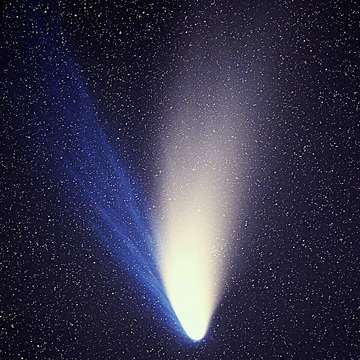
45P/Honda–Mrkos–Pajdušáková
Short-period comet discovered in 1948, known for radar detection and green glow.

45P/Honda–Mrkos–Pajdušáková is a short-period comet first spotted by Minoru Honda on December 3, 1948. Its name honors Honda along with Antonín Mrkos and Ľudmila Pajdušáková. This object follows an elliptical path around the Sun, completing one orbit every 5.25 years, and its nucleus measures 1.3 kilometers across. It earned a place in history as the fifteenth comet ever detected by a ground-based radar telescope, an event that occurred on August 19 and 20, 2011.
By May 2027, the comet is expected to shine at an apparent magnitude of about 14. It will reach perihelion on August 30, 2027, at which point it should brighten to magnitude 5–8. During its 1995 perihelion passage, the Solar and Heliospheric Observatory (SOHO) observed it on January 16, 1996, when the comet was roughly magnitude 7 and sat just 4.3 degrees from the Sun. The green color of this comet comes from diatomic carbon it emits, which glows green in the near vacuum of space.
**2011 passage** For the 2011 perihelion, the comet was recovered on June 5 at magnitude 21. By July 8, it had brightened to about magnitude 18, and as of July 22, nuclear condensation was noted around magnitude 16. Forecasts predicted a peak magnitude near 7.3 in late September, close to perihelion. On August 15, 2011, the comet made a close approach to Earth at just 0.0600 AU (8,980,000 km; 5,580,000 mi), and the Goldstone Deep Space Network studied it. Radar observations on August 19 and 20 picked up echoes from both the nucleus and the coma.
**2017 passage** 45P/Honda–Mrkos–Pajdušáková reached perihelion on December 31, 2016. By February 4, 2017, it was around magnitude 7, with a coma roughly 100,000 kilometers across. Because of its low surface brightness, binoculars were needed to see it. On February 11, 2017—the same day as a lunar eclipse—the comet passed 0.08318 AU (12,444,000 km; 7,732,000 mi) from Earth. The next notable close approach is expected in October 2032, when the comet might brighten to magnitude 7.
**August Delta Capricornids** On August 16, 2022, the global CAMS and Sonotaco network recorded a modest meteor outburst whose orbit matched that of comet 45P. This shower was temporarily labeled M2022-Q1 and later permanently named the August Delta Capricornids.
Quick Facts
- Pronounced
- ' · h · Q · n · d · @ · _ · ' · m · 3r · k · Q · s · _ · , · p · aI · d · u: · S · @ · ' · k · oU · v · @
- Discoverer
- Minoru Honda
- Discovery Date
- December 3, 1948
- Epoch
- 2025-11-21 / (JD 2461000.5)
- Aphelion
- 5.56 AU
- Perihelion
- 0.558 AU
- Semimajor
- 3.06 AU
- Eccentricity
- 0.817
- Period
- 5.34 yr
- Inclination
- 4.32°
- Earth Moid
- 0.06 AU
- Jupiter Moid
- 0.105 AU
Facts from the source article.
Lore & Background
The comet appears green because it emits diatomic carbon, which glows green in the near vacuum of space. During its 1995 perihelion passage, it was visible to the Solar and Heliospheric Observatory (SOHO) on January 16, 1996, when it was around apparent magnitude 7 and 4.3° from the Sun. In 2011, the comet was recovered on June 5 at magnitude 21, and by July 22 nuclear condensation was noticed around magnitude 16. It made a close approach of 0.0600 AU from Earth on August 15, 2011, and was studied by the Goldstone Deep Space Network; radar observations on August 19 and 20 detected echoes from the nucleus and coma. During the 2017 passage, the comet came to perihelion on December 31, 2016, and by February 4, 2017, it was around magnitude 7 with a coma about 100,000 km across. It passed 0.08318 AU from Earth on February 11, 2017, the same day as a lunar eclipse.
Reader's Guide
45P/Honda–Mrkos–Pajdušáková holds significance as the fifteenth comet detected by ground radar telescope, a milestone achieved during its 2011 close approach. Its radar study by the Goldstone Deep Space Network provided echoes from both the nucleus and coma, contributing to understanding of cometary structure. The comet also produced the first confirmed meteor shower from its dust trail: on August 16, 2022, the global CAMS and Sonotaco network detected an outburst of 137 meteors, later named the August Delta Capricornids, originating from the 1980 meteoroid stream of 45P. This event linked the comet directly to a meteor shower, a rare confirmation. The comet's green glow from diatomic carbon emission adds to its observational interest. Its upcoming perihelion on August 30, 2027, when it may brighten to magnitude 5-8, and a close approach in October 2032 with potential magnitude 7, continue to make it a target for amateur and professional observers.
Did You Know?
- The comet's nucleus is 1.3 kilometers in diameter.
- It became the fifteenth comet detected by ground radar telescope on August 19 and 20, 2011.
- The August Delta Capricornids meteor shower originated from the 1980 meteoroid stream of 45P.
- The comet glows green due to emission of diatomic carbon in space.
More in Named Comets, Part 6 1-24
Spotted an error? Know more?
Reader corrections go straight into our review queue. Suggest an edit · How this site is sourced