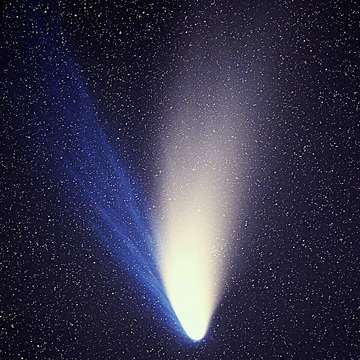
44P/Reinmuth
A Jupiter-family comet strongly perturbed by the gas giant.

44P/Reinmuth, also designated Reinmuth 2, is a Jupiter-family comet whose orbit is strongly influenced by the planet Jupiter. It has an estimated diameter of 3.22 km (2.00 mi) and an absolute magnitude of 14.
Quick Facts
- Discoverer
- Karl Reinmuth
- Discovery Date
- 10 September 1947
- Mpc Name
- P/1947 R1, P/1953 N1
- Designations
- Reinmuth 2 · 1947 VII, 1954 VI · 1960 IX, 1974 VI, 1981 III · 1987 XXVI, 1994 XVII
- Orbit Ref
- jpldata · MPC
- Epoch
- 13 September 2023 (JD 2460200.5)
- Observation Arc
- 76.49 years
- Obs
- 2,443
- Perihelion
- 2.112 AU
- Aphelion
- 5.264 AU
- Semimajor
- 3.688 AU
- Eccentricity
- 0.42726
Facts from the source article.
Lore & Background
Reinmuth was discovered during a survey of small Solar System bodies using the 40 cm Bruce telescope at the LSW-Heidelberg Observatory in Heidelberg, Germany. Karl Reinmuth initially estimated the comet's absolute magnitude at 13, two orders of magnitude smaller than the current estimate of 14. The comet was identified as periodic by Leland E. Cunningham in Berkeley, California, who calculated an elliptical orbit with a 7.12-year orbital period and predicted a perihelion on 3 October 1947. This prediction was later revised to a 6.59-year period and a perihelion date of 19 August 1947; the comet actually reached perihelion nearly one month after the revised date, prompting further orbital refinements.
Reinmuth 2 makes many close approaches to Jupiter, which gradually alter its orbit. On 16 July 2003, it came within 0.74 AU of Jupiter, increasing its perihelion from 1.89 to 2.11 AU and its orbital period from 6.63 to 7.07 years. Future close approaches are predicted: on 11 February 2039, it will pass within 0.52 AU of Jupiter, raising its perihelion to 2.44 AU and its orbital period to 7.78 years. Additional close approaches are expected on 21 July 2063 (0.43 AU) and 1 March 2146 (0.51 AU). Such encounters could raise the comet's perihelion until it ceases to be a comet.
Reader's Guide
44P/Reinmuth is significant as a Jupiter-family comet whose orbit is heavily perturbed by the gas giant Jupiter, making it a valuable object for studying dynamical evolution in the Solar System. Its discovery by Karl Reinmuth during a survey with the 40 cm Bruce telescope at Heidelberg highlights the role of systematic surveys in finding periodic comets. The early orbital calculations by Leland E. Cunningham, though initially inaccurate, demonstrate the iterative process of refining comet orbits as more observations become available. The comet's repeated close approaches to Jupiter—such as the 2003 encounter that altered its perihelion and orbital period—illustrate how gravitational interactions can gradually transform a comet's trajectory. Future predicted approaches in 2039, 2063, and 2146 may further raise its perihelion, potentially ending its cometary activity. This makes Reinmuth 2 a case study in the long-term evolution of Jupiter-family comets and the role of planetary perturbations in shaping their fates.
Did You Know?
- Leland E. Cunningham calculated the comet's orbit and predicted a perihelion on 3 October 1947, later revised to 19 August 1947; the comet arrived nearly one month after the revised date.
- A close approach on 11 February 2039 will bring Reinmuth within 0.52 AU of Jupiter, raising its orbital period to 7.78 years.
More in Named Comets, Part 6 1-24
Spotted an error? Know more?
Reader corrections go straight into our review queue. Suggest an edit · How this site is sourced