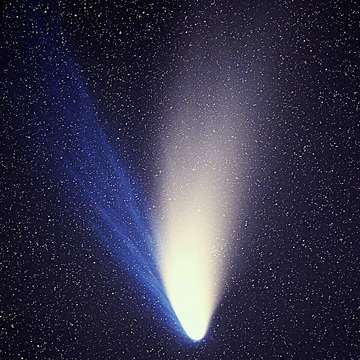
27P/Crommelin
A Halley-type comet named after its orbit calculator, not its discoverers.

27P/Crommelin is a periodic comet with an orbital period of almost 28 years, fitting the classical definition of a Halley-type comet (period between 20 and 200 years). It is one of only five known comets that are not named after their discoverer(s); instead, it is named after British astronomer Andrew C. D. Crommelin, who calculated its orbit in 1930. The comet is also known as Comet Pons-Coggia-Winnecke-Forbes, reflecting its multiple independent discoveries.
Quick Facts
- Discoverer
- Jean-Louis Pons · Andrew C. D. Crommelin · (recognition of periodicity)
- Discovery Date
- 23 February 1818
- Mpc Name
- P/1818 D1, P/1873 V1 · P/1928 W1, P/1956 S1
- Designations
- 1818 I, 1873 VII, 1928 III · 1956 VI, 1984 IV · 1873g, 1928b, 1956g · 1983n
- Orbit Ref
- jpldata · MPC
- Epoch
- 18 July 2011 (JD 2455760.5)
- Observation Arc
- 193.92 years
- Obs
- 497
- Perihelion
- 0.748 AU
- Aphelion
- 17.659 AU
- Semimajor
- 9.204 AU
- Eccentricity
- 0.91874
Facts from the source article.
Lore & Background
The comet was first observed by Jean-Louis Pons in Marseille, France, on February 23, 1818. He followed it until February 27, but bad weather prevented further observations. Johann Franz Encke attempted to calculate the orbit but was left with very large errors. In 1872, John R. Hind produced a rough orbital calculation and noted it was close to that of Comet Biela; based on these observations, Edmund Weiss later speculated it may have been part of Biela's comet.
The next observation came on November 10, 1873, by Jérôme E. Coggia in Marseille, and independently on November 11 by Friedrich A. T. Winnecke in Strasbourg, France. The comet was lost by November 16. Weiss and Hind took up the calculations and tried to match it again with the 1818 appearance. A third discovery was made by Alexander F. I. Forbes in Cape Town, South Africa, on November 19, 1928, confirmed by Harry E. Wood at Union Observatory on November 21. It was Crommelin who eventually established the orbit and linked the 1818 and 1873 appearances to the same comet.
On its latest return, 27P/Crommelin was recovered on May 12, 2011, at apparent magnitude 18.7 and peaked at magnitude 10.7 at perihelion on August 3. It was last observed in January 2012, and passed about 1.5 AU (220 million km) from Saturn on July 11, 2015. The next perihelion will be on May 27, 2039, when the comet will be 0.74 AU from the Sun and 1.73 AU from Earth—about as far from Earth as it can get during perihelion.
Reader's Guide
27P/Crommelin holds a notable place in cometary history as one of only five known comets not named after their discoverer(s), instead honoring the astronomer who linked its disparate appearances. Its observational history spans over two centuries, with three separate discoveries by Pons (1818), Coggia and Winnecke (1873), and Forbes (1928), before Crommelin finally established the orbit in 1930. The comet's early confusion with Comet Biela—Hind's rough calculation showing similarity and Weiss's speculation that it might be part of Biela's comet—illustrates the challenges of 19th-century cometary astronomy. Its status as a Halley-type comet with a nearly 28-year period places it among the intermediate-period comets. The comet's next perihelion in 2039 will be relatively distant from Earth (1.73 AU), but a much closer approach of 0.297 AU (44.4 million km) is predicted for December 22, 2120. The recovery in 2011 at magnitude 18.7 and peak at magnitude 10.7 demonstrate its typical brightness behavior. The comet's multiple independent discoveries and eventual identification through orbital calculation highlight the collaborative and cumulative nature of cometary science.
Did You Know?
- It was first observed by Jean-Louis Pons on February 23, 1818, but bad weather prevented further observations after February 27.
- Edmund Weiss speculated that the comet may have been part of Comet Biela.
- On December 22, 2120, it will pass 0.297 AU (44.4 million km) from Earth.
A Name That Honors the Orbit, Not the Eye
27P/Crommelin stands apart in the vast catalog of known comets because it bears the name of the astronomer who determined its orbit rather than the person who first spotted it. Andrew C. D. Crommelin, a British astronomer, established the comet's orbital parameters in 1930, and the object has carried his name ever since. Its full designation, Pons-Coggia-Winnecke-Forbes, actually honors the four individuals who independently observed it across different decades, yet none of them receives the primary credit in the short name. This makes 27P one of only five known comets in the record that are not named after their discoverer(s). The anomaly reflects a peculiar intersection of observational history and orbital mechanics: the comet was seen multiple times before anyone could prove it was the same object, so the person who finally stitched the sightings together earned the naming rights. It is a small but telling reminder that in celestial taxonomy, understanding an object's path through space can matter as much as first seeing it.
A Century of Near Misses and Broken Threads
The identification of 27P/Crommelin stretched across more than a century of fragmented observations. Jean-Louis Pons first caught sight of the comet from Marseille on February 23, 1818, but poor weather cut his tracking short after just four days. Johann Franz Encke attempted an orbital calculation from those limited data, yet the resulting errors were so large that the object effectively vanished from the catalog. In 1872, John R. Hind produced a rougher orbit and noted a resemblance to Comet Biela, prompting Edmund Weiss to speculate the two might be related. The comet reappeared on November 10, 1873, spotted by Jérôme E. Coggia in Marseille and the next day by Friedrich A. T. Winnecke in Strasbourg, but it was lost again by November 16. Weiss and Hind redid the calculations, still trying to match the 1818 and 1873 apparitions. It was not until Alexander F. I. Forbes observed the comet from Cape Town on November 19, 1928, confirmed by Harry E. Wood at the Union Observatory two days later, that Crommelin could finally establish a reliable orbit and link all three apparitions into a single periodic body.
The 2011 Recovery and a Saturn Flyby
After decades of absence, 27P/Crommelin was recovered on May 12, 2011, at a faint apparent magnitude of 18.7, a testament to how difficult the object remains to track between apparitions. Over the following months the comet brightened steadily, reaching a peak apparent magnitude of 10.7 at perihelion on August 3, 2011. Observers last recorded the comet in January 2012 before it faded beyond detection. The 2011 return also provided a valuable opportunity for amateur and professional astronomers alike to capture imagery and lightcurves; archived photographs from instruments such as a 10-inch GRAS-04 telescope and a 20-inch RCOS reflector document the comet's appearance during that window. The comet's journey did not end at perihelion. On July 11, 2015, it passed approximately 1.5 astronomical units, or roughly 220 million kilometers, from Saturn, a close planetary encounter that offered a brief gravitational interaction before the object continued outward on its nearly 28-year elliptical path.
Future Encounters and the Halley-Type Profile
With an orbital period of almost 28 years, 27P/Crommelin fits squarely within the classical definition of a Halley-type comet, whose periods fall between 20 and 200 years. Its next perihelion passage is expected around May 27, 2039, when it will reach a closest solar distance of 0.74 astronomical units. At that time the comet will sit 1.73 AU from Earth, a distance that represents roughly the maximum separation the object can achieve during a perihelion season, meaning the 2039 apparition will not offer a particularly favorable viewing geometry. Farther ahead, on December 22, 2120, the comet will make a notably closer pass, coming within 0.297 AU, or about 44.4 million kilometers, of Earth. That future encounter will be the closest approach in the known orbital record and could present a significantly brighter and more accessible target for observers. Until then, 27P remains a patient, long-period wanderer, reappearing only once every generation or so to remind the astronomical community that it is still out there.
More in Named Comets, Part 6 1-24
Spotted an error? Know more?
Reader corrections go straight into our review queue. Suggest an edit · How this site is sourced