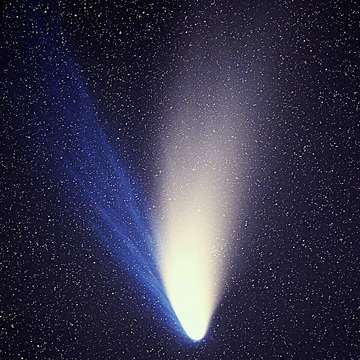
40P/Väisälä
Periodic comet with a nucleus similar in size to Comet Encke.

40P/Väisälä is a periodic comet discovered on February 8, 1939, on photographic plates taken for minor planets. Initially given the asteroid designation 1939 CB, it was later recognized as cometary. Its nucleus, measured in 1994, has a diameter of 4.2 km (2.6 mi), similar in size to that of Comet Encke.
Quick Facts
- Discovery Ref
- Cometography
- Discoverer
- Yrjö Väisälä
- Discovery Site
- University of Turku, Finland
- Discovery Date
- February 8, 1939
- Mpc Name
- P/1939 CB / P/1949 Y1
- Designations
- Väisälä 1 · 1939 IV, 1949 V · 1960 IV, 1971 VII · 1982 V, 1993 VIII
- Orbit Ref
- MPC
- Epoch
- May 5, 2025 (JD 2460800.5)
- Observation Arc
- 86.16 years
- Earliest Precovery Date
- January 18, 1939
- Obs
- 1,243
- Semimajor
- 4.951 AU
Facts from the source article.
Lore & Background
Comet Väisälä was discovered accidentally on photographs exposed for minor planets, with a visual magnitude of 15 at the time. Its orbit was determined on April 26, 1939, showing a period of about 10 years, a perihelion date of April 26, 1939, and a perihelion distance of 1.75 AU (262 million km).
The comet's orbit resembles that of many centaurs and is unstable over thousands of years due to gravitational interactions with Jupiter. A close approach of 0.41 AU (61 million km) on December 31, 1961, increased its perihelion distance from 1.74 AU to 1.87 AU and its orbital period from 10.46 to 11.28 years. Another approach on September 21, 1973, at 1 AU from Jupiter decreased perihelion from 1.87 AU to 1.80 AU and the period from 11.28 to 10.88 years.
In 2026, the comet experienced an outburst, brightening by 2.7 magnitudes between January 19 and 20, from magnitude 17.1 to 14.4, when it was 1.95 AU from the Sun. Its appearance changed, showing a compact source centered at the nucleus instead of the previous coma and nucleus. By January 21, the ejecta had expanded to 5 arcseconds.
Reader's Guide
40P/Väisälä is notable for its discovery as an asteroid-like object later identified as a comet, and for its nucleus size comparable to Comet Encke, a benchmark for cometary studies. Its orbit, influenced by Jupiter, demonstrates the dynamical instability typical of centaur-like objects, with documented orbital changes from close approaches in 1961 and 1973. The comet's 2026 outburst, with a rapid 2.7-magnitude brightening and morphological change from a coma to a compact nuclear source, provides a case study in cometary activity at heliocentric distances near 2 AU. The predicted close approach to Jupiter in 2127 (0.096 AU) will further reduce its perihelion to 1.4 AU, potentially altering its long-term evolution. These characteristics make it a valuable object for understanding cometary nuclei, outburst mechanisms, and orbital dynamics under planetary perturbation.
Did You Know?
- The comet was originally given the asteroid designation 1939 CB before its cometary nature was recognized.
- Its nucleus diameter of 4.2 km is similar in size to that of Comet Encke.
- An outburst on January 19–20, 2026, caused a brightness increase of 2.7 magnitudes.
- In 2127, the comet will make a close approach of only 0.096 AU from Jupiter.
The Schmidt-Väisälä Camera and Optical Craftsmanship
Yrjö Väisälä's most enduring technical legacy lies in his work on optical design and manufacturing. He devised multiple techniques for assessing the quality of lenses and mirrors, alongside practical methods for fabricating them, which together made possible some of the earliest high-quality Schmidt cameras. His relationship with Bernhard Schmidt's design was one of near-simultaneous invention: as early as 1924, Väisälä had sketched an identical concept in his lecture notes, annotating it with a brief remark about the "problematic spherical focal surface." After Schmidt's design was formally published, Väisälä tackled the field-flattening challenge head-on. In the 1930s, when astronomical photography still relied on glass plates, he inserted a doubly convex lens just ahead of the film holder, producing what became known as the Schmidt-Väisälä camera. The solution, while elegant, was not flawless—images of different wavelengths landed at slightly different positions. He also attempted a mosaic of seven mirrors mounted on a rigid steel frame, but the structure proved too unstable for passive use, a problem that would not be solved until active controls arrived with the Multiple Mirror Telescope decades later.
Measuring Finland and the Earth's Rotation
During the 1920s and 1930s, Finland undertook its first precision triangulation surveys, and Väisälä proposed an ambitious solution for establishing long-distance direction observations between survey points that lacked a direct line of sight. His idea involved launching flash-lights on balloons reaching five to ten kilometres in altitude, or even on large fireworks rockets, then photographing the flash against background stars from two separate camera stations to triangulate positions. The plan was ultimately shelved because the wide-field cameras needed did not yet exist. A more successful contribution followed: he developed a white-light interferometry technique to multiply an optical length reference, enabling precise baseline measurements for Finland's second high-precision triangulation campaign in the 1950s and 1960s. The Nummela Standard Baseline he established remains maintained by the Finnish Geodetic Institute for calibrating distance-measuring instruments. He also built zenith telescopes to track the Earth's rotational axis, placing Tuorla Observatory among the world's top stations for North Pole position measurements in the 1960s, and conducted one of the earliest experiments with rotating liquid-mercury mirrors for those instruments.
A Decade of Asteroids and Comets
The large Schmidt-Väisälä telescope he constructed at the University of Turku became the workhorse of a prolific photographic survey. His research group catalogued 807 asteroids and seven comets over the years, and the Minor Planet Center credits Väisälä personally with 128 asteroid discoveries between 1935 and 1944. To make the survey efficient, he devised a clever protocol: two exposures were taken on the same photographic plate roughly two to three hours apart, with the second image slightly offset. Any dot-pairs that did not match the static star background revealed a moving object warranting follow-up. This approach cut film consumption in half compared to the older blink-comparing technique, in which a human operator rapidly alternated between two singly exposed plates—a method that had famously led to the discovery of Pluto. Among his cometary finds were the parabolic C/1944 H1, the Halley-type near-Earth C/1942 EA, and the Jupiter-family 40P/Väisälä. He also co-discovered 139P/Väisälä–Oterma with Liisi Oterma, a Jupiter-family comet initially misclassified as an asteroid under the provisional designation 1939 TN. Väisälä had a personal habit of naming asteroids after friends whose birthdays fell near the discovery date, as with 1548 Palomaa, honouring professor Matti Herman Palomaa.
The Wizard of Tuorla: Legacy and Family
Known affectionately as the "Wizard of Tuorla"—a nickname referencing both the Tuorla Observatory and its optics laboratory—Väisälä left a mark that extends well beyond any single instrument. A Finnish-language book bearing that very title collects and describes his body of work. The University of Turku's astronomy department carries his name as the VISPA: Väisälä Institute for Space Physics and Astronomy, honouring him as its founder. In the wider cosmos, a lunar crater, the minor planets 1573 Väisälä and 2804 Yrjö, and the Jupiter-family comet 40P/Väisälä all preserve his identity. His scientific curiosity also reached into the world of internationalist language: a fervent advocate of Esperanto, he presided over the Internacia Scienca Asocio Esperantista, the International Association of Esperanto Scientists, in 1968. The Väisälä name in Finnish science is a family affair spanning generations. His brothers were the mathematician Kalle (1893–1968) and the meteorologist Vilho (1889–1969), while his daughter Marja (1916–2011) followed in his footsteps as an astronomer and discoverer of minor planets, carrying the tradition of sky-watching into the next generation.
More in Named Comets, Part 6 1-24
Spotted an error? Know more?
Reader corrections go straight into our review queue. Suggest an edit · How this site is sourced