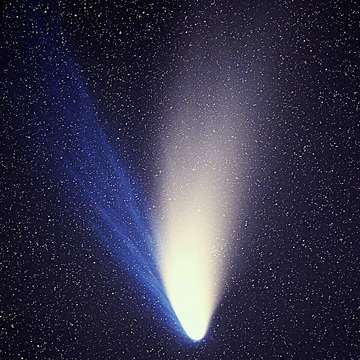
41P/Tuttle–Giacobini–Kresák
Jupiter-family comet known for dramatic outbursts and a small, elongated nucleus.

41P/Tuttle–Giacobini–Kresák is a Jupiter-family comet with a 5.43-year orbit around the Sun. It is notable for its dramatic outbursts, including a double outburst in 1973 that brightened from magnitude 14 to naked-eye visibility at magnitude 4. The comet's nucleus is relatively small, with an effective radius of 440–560 m, and it has exhibited rapid changes in rotation rate due to outgassing torques.
Quick Facts
- Discoverer
- Horace Parnell Tuttle / Michel Giacobini / Ľubor Kresák
- Discovery Date
- May 3, 1858
- Mpc Name
- P/1858 J1, P/1907 O1 · P/1951 H1
- Designations
- 1858 III, 1907 III, 1951 IV · 1962 V, 1973 VI · 1978 XXV, 1990 II
- Orbit Ref
- jpldata · mpc
- Epoch
- September 13, 2023 (JD 2460200.5)
- Observation Arc
- 72.38 years
- Earliest Precovery Date
- April 26, 1951
- Obs
- 5,250
- Perihelion
- 1.051 AU
- Aphelion
- 5.126 AU
- Semimajor
- 3.088 AU
Facts from the source article.
Lore & Background
The comet was discovered by Horace Parnell Tuttle on May 3, 1858, and later independently rediscovered by Michel Giacobini in 1907 and Ľubor Kresák in 1951. It is a member of the Jupiter family of comets. In May and July 1973, the comet underwent two separate outbursts, brightening from magnitude 14 to apparent magnitude 4, making it easily visible to the naked eye. During its 2017 apparition, the comet passed 0.142 AU from Earth on April 1, 2017, and was expected to reach magnitude 7. Observations revealed rapid changes in the nucleus rotation rate, attributed to strong outgassing torques near perihelion.
Reader's Guide
41P/Tuttle–Giacobini–Kresák holds significance as a comet that has been observed to undergo dramatic outbursts, most notably in 1973 when it brightened by 10 magnitudes. Its small nucleus, with an effective radius of 440–560 m, is elongated with an axis ratio of at least 1.4:1, and its rotation period of 14.4 hours has been observed to decelerate rapidly near perihelion due to asymmetric outgassing. Modeling suggests that continued torques could lead to rotational instability on timescales of decades, potentially much shorter than the comet's dynamical lifetime of about 1,000 years, making the nucleus susceptible to rotational breakup. The comet was also the subject of a proposed space probe mission by the European Space Research Organisation in the 1960s, though the proposal was rejected. Its upcoming perihelion passage on February 15, 2028, at a solar elongation of 65 degrees and magnitude approximately 11, will make it observable with small telescopes.
Did You Know?
- The nucleus has an effective radius of 440–560 m and an elongated shape with an axis ratio of at least 1.4:1.
- The European Space Research Organisation investigated sending a probe to the comet in the 1960s, but the proposal was rejected.
More in Named Comets, Part 6 1-24
Spotted an error? Know more?
Reader corrections go straight into our review queue. Suggest an edit · How this site is sourced