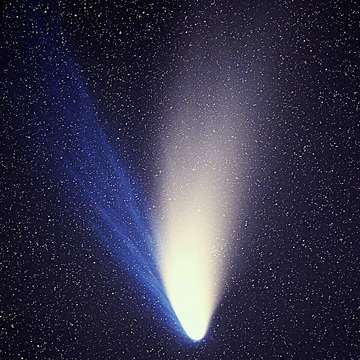
39P/Oterma
Inactive centaur comet first detected in CO₂ emission.

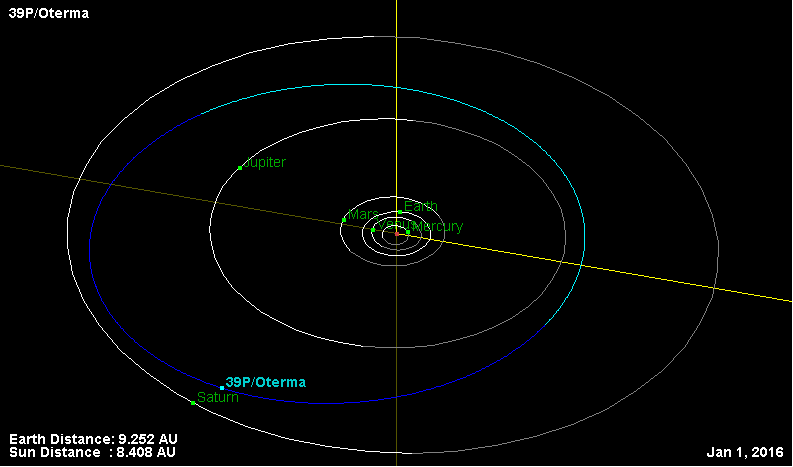
39P/Oterma is a periodic comet currently on an inactive centaur orbit between Jupiter and Saturn, with an orbital period of nearly 20 years. It is notable for having been the first centaur in which carbon dioxide (CO₂) emission was detected, observed by the James Webb Space Telescope in 2022.
Quick Facts
- Discoverer
- Liisi Oterma
- Discovery Date
- 8 April 1943
- Designations
- 1942 VII; 1950 III; 1958 IV; 39P/2001 P3
- Epoch
- 2023-06-25
- Semimajor
- 7.228 AU
- Perihelion
- 5.707 AU
- Aphelion
- 8.75 AU
- Eccentricity
- 0.2105
- Period
- 19.43 yr
- Inclination
- 1.5470°
- Max Speed
- 13.2 km/s
- Min Speed
- 8.6 km/s (2013-Feb-15)
Facts from the source article.
Lore & Background
The comet was discovered by Liisi Oterma on a photo plate taken 8 April 1943 at Turku University Observatory, appearing as a faint 15th-magnitude object in Virgo. Its orbit was initially calculated by L. E. Cunningham and R. N. Thomas, giving a perihelion distance of 3.4 AU and an orbital period of 7.9 years. After perihelia in 1950 and 1958, a close approach to Jupiter on 12 April 1963 (0.095 AU) transformed it onto its current inactive centaur orbit, where it remains faint at about magnitude 22. It was recovered on 13 August 2001 using CCD images from the University of Hawaii 2.2 m reflector at Mauna Kea.
In 2022, the James Webb Space Telescope observed 39P/Oterma and detected CO₂ emission at a production rate of (5.96±0.80)×10²³ mol/s, the lowest of any comet detected up to that time. The effective nucleus radius was calculated to be between 2.21 and 2.49 km. The comet's orbit is classified as Chiron-type, with T_Jupiter > 3 and semi-major axis greater than Jupiter's, and its moderate eccentricity and low inclination allow perturbations by Jupiter and Saturn.
The orbital history includes a temporary satellite capture by Jupiter from early 1935 to early 1939, with a close approach of 0.165 AU on 27 October 1937. This encounter reduced the semi-major axis from 6.9 to 4.0 AU, placing it in a 3:2 mean motion resonance with Jupiter as a quasi-Hilda comet. A second temporary satellite capture occurred from mid-1961 to end of 1965, with an even closer approach on 12 April 1963 (0.095 AU), returning it to a centaur orbit with semi-major axis 7.2 AU and period 19.5 years.
Reader's Guide
39P/Oterma's significance lies in its dynamic orbital history and its role as a bridge between Jupiter-family comets and centaurs. Its detection of CO₂ emission by the James Webb Space Telescope in 2022 marked the first such detection in a centaur, providing insight into the volatile composition of objects in the outer solar system. The comet's orbit is highly unstable over long timescales due to repeated close encounters with Jupiter and Saturn, which have dramatically altered its path multiple times. Statistical modeling using SOLEX 11.0 shows that before the 19th century its orbit could have been anywhere from inside Jupiter's orbit to Saturn-crossing, and future encounters—particularly with Saturn in 2312 and Jupiter around 2429—may again transform it, possibly reactivating it as a quasi-Hilda comet or ejecting it as a Saturn-crosser. Its current inactivity and faintness (magnitude 22) make it a challenging target, but its past temporary captures by Jupiter and its future potential for reactivation underscore the transient nature of cometary orbits in the giant-planet region.
Did You Know?
- The comet underwent a temporary satellite capture by Jupiter from early 1935 to early 1939, approaching to 0.165 AU on 27 October 1937.
- Its nucleus diameter is estimated at 4–5 km, with an effective radius of 2.21 to 2.49 km.
- A close approach to Jupiter on 12 April 1963 (0.095 AU) transformed it from a quasi-Hilda comet to its current inactive centaur orbit.
Gallery
More in Named Comets, Part 6 1-24
Spotted an error? Know more?
Reader corrections go straight into our review queue. Suggest an edit · How this site is sourced