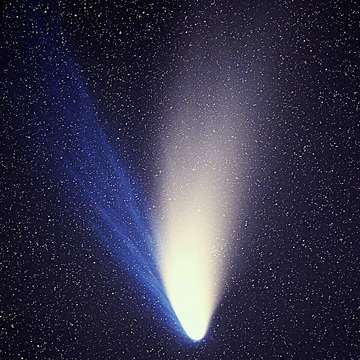
43P/Wolf–Harrington
Jupiter-family comet discovered in 1924 by Max Wolf.

43P/Wolf–Harrington is a Jupiter-family comet first spotted on December 22, 1924, by Max Wolf at the Heidelberg Observatory. A close flyby of Jupiter in 2019, coming within 0.065 AU (about 9.7 million km), raised the comet’s perihelion distance and lengthened its orbital period to nine years. Its most recent perihelion occurred in August 2025, with the next expected in August 2034.
During its 1997 apparition, the comet reached an apparent magnitude slightly brighter than 12. The 2010 apparition was unfavorable: at perihelion, the comet was only 10 degrees from the Sun as seen from Earth, and it did not become more favorably positioned in the sky until mid-October 2010.
Initial estimates from 2004 put the comet’s nucleus diameter at about 3.6 km, later revised to 4.76 km following observations in 2011.
Quick Facts
- Discoverer
- Max Wolf / Robert G. Harrington
- Discovery Site
- Heidelberg, Germany (024)
- Discovery Date
- 22 December 1924
- Mpc Name
- P/1924 Y1, P/1951 T2
- Designations
- 1924 IV, 1952 II, 1958 V · 1965 III, 1971 VI · 1984 XVIII, 1991 V
- Orbit Ref
- jpldata · mpc
- Epoch
- 21 November 2025 (JD 2461000.5)
- Observation Arc
- 100.99 years
- Obs
- 2,924
- Perihelion
- 2.443 AU
- Aphelion
- 6.219 AU
- Semimajor
- 4.331 AU
Facts from the source article.
Lore & Background
43P/Wolf–Harrington was discovered on December 22, 1924, by Max Wolf at the Heidelberg Observatory. It belongs to the Jupiter family of comets, a group whose orbits are strongly influenced by the planet Jupiter. In 2019, the comet passed within 0.065 AU (9.7 million km; 6.0 million mi) of Jupiter, an encounter that lifted its perihelion point and increased its orbital period to 9 years. The comet last came to perihelion in August 2025 and will return to perihelion in August 2034.
During its 1997 apparition, the comet reached an apparent magnitude slightly brighter than 12. The 2010 apparition was unfavorable because at perihelion the comet was only 10 degrees from the Sun as seen from Earth; it was not more favorably positioned in the sky until mid-October 2010. Initial estimates in 2004 placed the nucleus diameter at about 3.6 km, but follow-up observations in 2011 revised this to 4.76 km.
Reader's Guide
43P/Wolf–Harrington is notable as a Jupiter-family comet whose orbit was dramatically reshaped by a close encounter with Jupiter in 2019, a common but significant process for such comets. The encounter lifted its perihelion point and lengthened its orbital period to 9 years, altering its future visibility and trajectory. Discovered by Max Wolf in 1924, the comet has been observed over multiple apparitions, including a relatively bright showing in 1997 when it reached magnitude just above 12. Its 2010 apparition was challenging for observers due to its proximity to the Sun. The comet's nucleus size has been estimated twice, with initial 2004 measurements suggesting 3.6 km and later 2011 observations indicating a larger 4.76 km diameter, reflecting the refinement of observational techniques. The comet's periodic returns and its interaction with Jupiter make it a subject of interest for understanding orbital dynamics and the physical properties of cometary nuclei.
Did You Know?
- In 2019, it passed within 0.065 AU of Jupiter, which lifted its perihelion and increased its orbital period to 9 years.
- Initial nucleus size estimates in 2004 were 3.6 km, later revised to 4.76 km in 2011.
More in Named Comets, Part 6 1-24
Spotted an error? Know more?
Reader corrections go straight into our review queue. Suggest an edit · How this site is sourced