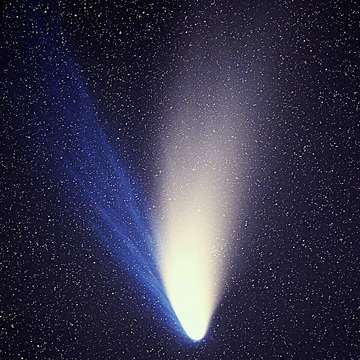
28P/Neujmin
A large, dark periodic comet with an 18-year orbit.

E.E. Barnard · Public domain
28P/Neujmin, also designated Neujmin 1, is a large periodic comet with a nucleus estimated at roughly 21 km in diameter. It orbits the Sun once every 18 years, with a perihelion distance of 1.6 AU (240 million km), and does not approach Earth closer than about 0.571 AU (85.4 million km).
Quick Facts
- Discoverer
- Grigory Neujmin
- Discovery Date
- 3 September 1913
- Mpc Name
- P/1913 R2, P/1931 S1
- Designations
- Neujmin 1 · 1913 III, 1931 I · 1948 XIII, 1966 VI · 1984 XIX
- Orbit Ref
- jpldata · MPC
- Epoch
- 17 October 2024 (JD 2460600.5)
- Observation Arc
- 112.48 years
- Obs
- 1,281
- Perihelion
- 1.585 AU
- Aphelion
- 12.38 AU
- Semimajor
- 6.983 AU
- Eccentricity
- 0.77297
Facts from the source article.
Lore & Background
Initial estimates in 2001 placed the nucleus diameter at 21.4 km with a very low albedo of 0.025. A follow-up study in 2003 revised the diameter to 19.4 km. Because of its large nucleus, the comet became brighter than 20th magnitude in early 2019, about two years before reaching perihelion. At opposition in May 2020, when it was still 3.5 AU from the Sun, its apparent magnitude was around 16.9. During the 2021 perihelion passage, the comet was on the opposite side of the Sun from Earth. The comet is not known for bright outbursts of activity.
Reader's Guide
28P/Neujmin is notable for its large, dark nucleus and its relatively stable, predictable behavior. Its low albedo of 0.025 indicates a very dark surface, and archival data from the Subaru Telescope in 2021 showed that while its measured colors resemble those of D-type asteroids, its surface microstructure likely differs from them. The comet's size allowed it to become observable well before perihelion, reaching magnitude 16.9 at opposition in May 2020 while still 3.5 AU from the Sun. Its 18-year orbital period and perihelion distance of 1.6 AU place it among the larger known periodic comets. The comet does not exhibit bright outbursts, and its 2021 perihelion passage was poorly placed for Earth-based observation, being on the far side of the Sun. The revised diameter estimates from 2001 and 2003 reflect ongoing refinement of its physical properties.
Did You Know?
- 28P/Neujmin has a nucleus diameter estimated at 21.4 km in 2001, later revised to 19.4 km in 2003.
- Its nucleus has a very low albedo of 0.025.
A Giant Among Inner-System Comets
Twenty-one kilometers across, 28P/Neujmin places itself firmly in the upper echelon of cometary bodies that venture into the inner Solar System. The vast majority of known nuclei measure no more than roughly sixteen kilometers in their longest dimension, so Neujmin's girth already sets it apart from the typical population. Among comets that have crossed inside Saturn's orbit, it ranks just behind a handful of true giants: 95P/Chiron at around two hundred kilometers, C/2002 VQ94 and the great Comet of 1729 at roughly one hundred each, and then Hale-Bopp and 29P sharing the sixty-kilometer mark. Even 109P/Swift-Tuttle, at about twenty-six kilometers, edges past Neujmin. Yet for a periodic visitor that returns on a predictable schedule, a twenty-one-kilometer solid core is remarkable. It represents a substantial reservoir of rock, dust, and frozen volatiles being cycled through the inner planetary neighborhood, and its size likely influences how much material it can shed during each perihelion passage, shaping the brightness and extent of the coma and tail that observers track.
What Lies Beneath the Dust Mantle
Strip away the glowing coma and the sweeping tail, and what remains at the heart of 28P/Neujmin is a compact body of rock, dust, and frozen gases. Like most cometary nuclei, its surface is expected to be extraordinarily dark, with an albedo hovering near 0.04—darker than a lump of coal. That near-black appearance is attributed to a thick blanket of refractory dust that has accumulated over countless passages through the inner Solar System, a process astronomers have called dust mantling for more than three decades. Beneath that crust, modern measurements from multiple flyby and rendezvous missions have overturned the old icy-snowball picture. Refractory-to-ice ratios now appear to be at least three to one, and possibly as high as five or six to one. Bulk densities cluster around 0.6 grams per cubic centimeter, revealing a structure that is highly porous and fragile on both microscopic and macroscopic scales. The Rosetta science team even coined the phrase "mineral organices" to capture the reality that minerals and organic compounds dominate, with ices playing a comparatively minor role.
The Engine of Activity
When 28P/Neujmin draws close enough to the Sun, solar heating drives a transformation that turns a quiet, dark nucleus into a spectacular astronomical event. Frozen gases trapped within and beneath the crust sublimate directly into vapor, swelling outward to form the coma—an atmosphere that envelops the solid core. The Sun's radiation pressure and the steady stream of charged particles in the solar wind then push that gas and its entrained dust away from the star, sculpting the familiar tail that always points anti-sunward. The emissions are not perfectly symmetric; the resulting nongravitational forces, first invoked by Fred Whipple in the 1950s to explain why comets sometimes arrive early or late relative to their calculated orbits, act as a gentle but persistent thrust on the nucleus. Whipple's argument also required that the emitter possess cohesive strength, meaning a single, solid body rather than a loose swarm of grains. Observations of other comets, such as Borrelly, confirmed that gas escapes through a limited number of jets where the crust has been breached, exposing buried ice to direct sunlight.
A Fossil of the Proto-Solar Nebula
28P/Neujmin is, in a very real sense, a time capsule from the earliest chapters of our planetary system. The currently favored nebular hypothesis holds that comets are surviving fragments of the original planetesimal building blocks from which the planets themselves accreted. Three-dimensional computer simulations suggest that the structural features seen on cometary nuclei can be reproduced by the pairwise, low-velocity collision and sticking of weakly bound cometesimals—small precursor bodies that never fully consolidated. These precursors likely assembled in the cold outer reaches of the Solar System, possibly millions of years before the planets reached their present configurations. Today, astronomers trace the long-term reservoirs of such objects to the Oort cloud, the scattered disk, and the outer Main Belt, though the precise migration pathways remain a subject of active debate. Whatever its exact birthplace, Neujmin's twenty-one-kilometer core preserves a chemical and physical record of conditions that predate the Sun's current state, making every close approach an opportunity to read a page from the Solar System's founding document.
Gallery
More in Named Comets, Part 6 1-24
Spotted an error? Know more?
Reader corrections go straight into our review queue. Suggest an edit · How this site is sourced