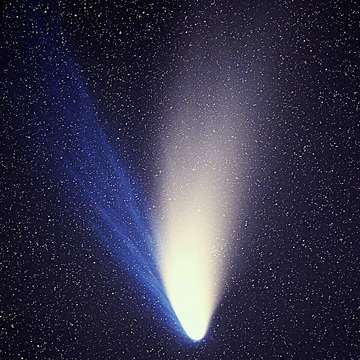
32P/Comas Solà
Jupiter-family comet discovered by Josep Comas Solà in 1926.

Pere López · CC BY-SA 3.0
32P/Comas Solà is a Jupiter-family comet that takes about 9.7 years to orbit the Sun. It is the second of two comets discovered by Spanish astronomer Josep Comas Solà.
Comas Solà found the comet on 4 November 1926 while photographing asteroids for the Fabra Observatory in Barcelona, using a 6-inch (150 mm) telescope. At the time, the comet was in the constellation Cetus. Early on, some astronomers thought it might be the return of the lost periodic comet 113P/Spitaler. By 1935, enough positions had been gathered for P. Ramensky to trace its orbit back to 1911. He found that the comet had passed very close to Jupiter in May 1912, and that before that approach its perihelion distance was 2.15 AU (322 million km) and its orbital period was 9.43 years. This ruled out any link to Comet Spitaler.
In 1933, Danish astronomer Julie Vinter Hansen carried out major new calculations, projecting the comet’s orbit up to 1980 and predicting when it would return near Earth’s orbit. While searching for 32P/Comas Solà in 1969, Soviet astronomers Klim Churyumov and Svetlana Gerasimenko accidentally discovered a new comet on photographic plates, later named 67P/Churyumov–Gerasimenko.
Estimates of the comet’s nucleus size have varied. In 1985, precession models gave an equatorial radius between 0.99 and 1.15 km (0.62–0.71 mi). CCD photometry taken in 1999, when the comet was 3.1 AU (460 million km) from the Sun, suggested a larger upper limit of about 3.2 km (2.0 mi). A 2006 study revised the size to roughly 2.52 km (1.57 mi). Early rotation period estimates ranged from 1.5 to 2.3 days, but forced precession models from 2001, based on the 1999 size estimate, indicated a shorter rotation period of about 7.3 hours.
Quick Facts
- Discovery Ref
- IAUC_122
- Discoverer
- Josep Comas i Solà
- Discovery Site
- Fabra Observatory
- Discovery Date
- 4 November 1926
- Mpc Name
- P/1926 V1, P/1935 P1
- Designations
- 1927 III, 1935 IV, 1944 II · 1961 III, 1969 VIII · 1978 XVII, 1987 XVIII
- Orbit Ref
- jpldata · MPC
- Epoch
- 5 May 2025 (JD 2460800.5)
- Observation Arc
- 98.49 years
- Obs
- 5,507
- Perihelion
- 2.025 AU
- Aphelion
- 7.082 AU
Facts from the source article.
Lore & Background
The comet was discovered on 4 November 1926 by Josep Comas Solà while he was taking photographs with a 6-inch (150 mm) telescope as part of his work on asteroids for the Fabra Observatory. At the time, its position was located within the constellation Cetus. Early on, several astronomers suggested that the comet might be a return of the then lost periodic comet 113P/Spitaler. In 1935, additional positions had been obtained, and P. Ramensky investigated the orbital motion back to 1911. He noted the comet passed very close to Jupiter during May 1912 and that, prior to this approach, the comet had a perihelion distance of 2.15 AU (322 million km) and an orbital period of 9.43 years. The identity with Comet Spitaler was thus disproven.
In 1933, Danish astronomer Julie Vinter Hansen undertook significant new research which calculated the orbit of the comet up to 1980, predicting when it would return to the Earth's orbit. While searching for 32P/Comas Solà in 1969, two Soviet astronomers Klim Churyumov and Svetlana Gerasimenko accidentally discovered a new comet in photographic plates they took, which is now known as 67P/Churyumov–Gerasimenko.
Physical characteristics of the nucleus have been estimated multiple times. In 1985, precession models derived an equatorial radius between 0.99–1.15 km (0.62–0.71 mi). CCD photometry taken while the comet was 3.1 AU from the Sun in 1999 obtained a larger upper limit of about 3.2 km (2.0 mi). Further studies in 2006 revised the size estimate to about 2.52 km (1.57 mi). Initial estimates of the rotation period indicated the comet spins once every 1.5 to 2.3 days, but forced precession models obtained in 2001 indicated a shorter rotation period of around 7.3 hours.
Reader's Guide
32P/Comas Solà holds significance as the second comet discovered by Josep Comas Solà, a Spanish astronomer whose work at the Fabra Observatory contributed to early 20th-century comet and asteroid studies. Its observational history includes a notable early confusion with the lost periodic comet 113P/Spitaler, which was resolved through orbital calculations by P. Ramensky showing a close Jupiter approach in 1912 that altered the comet's orbit. The comet also played an indirect role in the discovery of 67P/Churyumov–Gerasimenko, as two Soviet astronomers searching for 32P/Comas Solà in 1969 instead found that now-famous comet. Danish astronomer Julie Vinter Hansen's 1933 orbital calculations, predicting returns up to 1980, represent an important early computational effort for a periodic comet. The comet's nucleus size estimates have evolved over decades, from precession models in 1985 to CCD photometry in 1999 and a revised figure in 2006, illustrating the challenges of measuring small, distant cometary bodies. Its rotation period also remains subject to revision, with early estimates of 1.5–2.3 days later refined to about 7.3 hours based on forced precession models.
Did You Know?
- The comet was discovered on 4 November 1926 by Josep Comas Solà using a 6-inch telescope at the Fabra Observatory.
- In 1933, Danish astronomer Julie Vinter Hansen calculated the comet's orbit up to 1980, predicting its returns to Earth's orbit.
- The comet's nucleus size was revised to about 2.52 km in 2006, after earlier estimates ranged from 0.99 km to 3.2 km.
Gallery

More in Named Comets, Part 6 1-24
Spotted an error? Know more?
Reader corrections go straight into our review queue. Suggest an edit · How this site is sourced