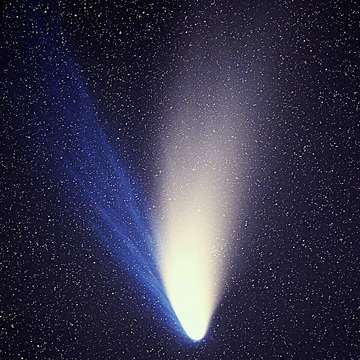
84P/Giclas
Jupiter-family comet discovered by Henry L. Giclas in 1978.

84P/Giclas is a Jupiter-family comet that orbits the Sun once every 6.69 years. It holds the distinction of being the only comet discovered by American astronomer Henry L. Giclas.
The comet was first spotted by Giclas at the Lowell Observatory on September 8, 1978, appearing as a diffuse 15th-magnitude object in the constellation Cetus. He confirmed the sighting about two days later, and Brian G. Marsden quickly calculated its periodic orbit of 6.74 years. During its 1978–1979 apparition, the comet remained largely a photographic object.
Earlier observations were later identified. In 1995, it was announced that Clyde W. Tombaugh had recorded an unknown comet over three nights in September 1931. That object, designated D/1931 R1, was confirmed as an earlier apparition of 84P/Giclas in a 1996 study by Grzegorz Sitarski, who reconstructed its orbit using non-gravitational accelerations.
During its 2020 apparition, the comet remained within 60 degrees of the Sun until September of that year. On June 11, 2033, it will pass just 0.0387 AU (about 5.79 million kilometers) from the asteroid 4 Vesta.
Observations by the Hubble Space Telescope in 1999–2000 revealed that the comet's nucleus has a radius of 0.90 ± 0.05 kilometers, assuming a geometric albedo of 0.04.
Quick Facts
- Discovery Ref
- IAUC_3264
- Discoverer
- Henry L. Giclas
- Discovery Site
- Lowell Observatory, USA
- Discovery Date
- 8 September 1978
- Designations
- 1978 XXII, 1985 XV · 1992 XXV, 1978k, 1985g · 1992l
- Orbit Ref
- jpldata · MPC
- Epoch
- 21 November 2025 (JD 2461000.5)
- Observation Arc
- 89.43 years
- Earliest Precovery Date
- 12 September 1931IAUC_6168
- Obs
- 1,792
- Perihelion
- 1.719 AU
- Aphelion
- 5.381 AU
Facts from the source article.
Lore & Background
The comet was discovered by Henry L. Giclas from the Lowell Observatory on 8 September 1978. At the time it was a diffuse 15th-magnitude object within the constellation Cetus. He confirmed his discovery about two days later, and Brian G. Marsden soon determined that it follows a 6.74-year periodic orbit around the Sun. Throughout its 1978–1979 apparition, it remained mostly a photographic object.
It was announced in 1995 that Clyde W. Tombaugh had observed a previously unknown comet for three nights in September 1931. Designated as D/1931 R1, it was later confirmed to be an earlier apparition of 84P/Giclas upon reconstructing its orbit using non-gravitational accelerations in a 1996 study by Grzegorz Sitarski.
Based on observations by the Hubble Space Telescope in 1999–2000, the nucleus of the comet has a radius of 0.90±0.05 km, assuming a geometric albedo of 0.04. During the 2020 apparition, it was not more than 60 degrees from the Sun until September 2020. On 11 June 2033, the comet will pass 0.0387 AU (5.79 million km; 3.60 million mi) from the asteroid 4 Vesta.
Reader's Guide
84P/Giclas holds significance as the only comet discovered by Henry L. Giclas, an American astronomer at Lowell Observatory. Its discovery in 1978 added a new member to the Jupiter-family comets, a group characterized by short orbital periods shaped by Jupiter's gravity. The comet's observational history extends back to 1931, when Clyde W. Tombaugh recorded it as an unknown object; this earlier sighting was only confirmed decades later through orbital reconstruction incorporating non-gravitational accelerations. The Hubble Space Telescope provided key physical data in 1999–2000, measuring the nucleus size and albedo. A notable future event is its close approach to the asteroid 4 Vesta in 2033, offering a rare opportunity for study. The comet's legacy lies in its connection to two prominent astronomers—Giclas and Tombaugh—and in the orbital detective work that linked their observations across decades.
Did You Know?
- Clyde W. Tombaugh observed this comet in September 1931, decades before its official discovery.
- On 11 June 2033, 84P/Giclas will pass 0.0387 AU from the asteroid 4 Vesta.
More in Named Comets, Part 6 1-24
Spotted an error? Know more?
Reader corrections go straight into our review queue. Suggest an edit · How this site is sourced