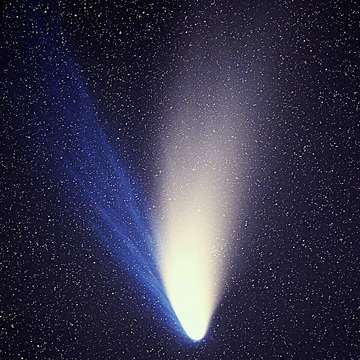
83D/Russell
A lost periodic comet discovered in 1979.

83D/Russell, once designated 83P/Russell, is a periodic comet that has been classified as lost. It orbits the Sun roughly every 7.5 years. The comet has not been observed in years. The comet was first spotted on 16 June 1979 by Kenneth S. Russell at the UK Schmidt Telescope in Australia. He described it as faint and diffuse, with a very low brightness of magnitude 18. Early orbit calculations placed its perihelion on 27 May 1979 and gave it an orbital period of 6.13 years. The predicted return in 1985 was observed by J. Gibson using the 1.5-meter reflector at Palomar Observatory in California, who estimated the nucleus at a very faint magnitude 19.5. On 9 August 1988, the comet passed within 0.05 AU (about 7.5 million km) of Jupiter. This gravitational encounter lifted its perihelion distance from 1.6 AU to 2.1 AU, making the comet fainter, less active, and harder to recover. Its predicted return in 1991 was missed due to unfavourable conditions, and it was missed again in 1998. Although conditions were favourable in 2006, the comet was not relocated, leading to its current classification as lost. In mid-March 2021, the comet was expected to come to opposition in the constellation Crater at around apparent magnitude 20.9. On its post-1988 orbit, the comet probably does not get brighter than about magnitude 21. The comet might reach perihelion in late November 2028, but the uncertainty in its position is a few million kilometres. In early January 2028, it may come to opposition in Monoceros at around magnitude 23.7, and in mid-June 2029, it may come to opposition in Ophiuchus at around magnitude 22.2.
Quick Facts
- Discoverer
- Kenneth S. Russell at the UK Schmidt Telescope, Australia
- Discovery Date
- 16 June 1979
- Epoch
- 2021-05-26
- Observation Arc
- 6 years / (Not observed in 1985 · 06 · 17 years)
- Perihelion
- 2.1 AU
- Aphelion
- 5.5 AU
- Eccentricity
- 0.44
- Period
- 7.5 yr
- Inclination
- 17.8°
- Last P
- 2021-05-23?MPC / (unobserved)
- Next P
- 2028-11-30?Horizons2028 · Yoshida / (lost since 1985)
Facts from the source article.
Lore & Background
The comet was discovered on a photographic plate on 16 June 1979 by Kenneth S. Russell at the UK Schmidt Telescope, Australia, who described it as faint and diffuse, with a very low brightness of magnitude 18. Calculations of its orbit suggested a perihelion date of 27 May 1979 and an orbital frequency of 6.13 years. The predicted 1985 apparition was observed by J. Gibson using the 1.5-m reflector at Palomar Observatory, California, who estimated the brightness of the nucleus at a very faint magnitude 19.5. On 9 August 1988 the comet passed 0.05 AU (7.5 million km) from Jupiter, lifting perihelion from 1.6 AU to 2.1 AU. This greater distance from the Sun makes the comet fainter, less active, and more difficult to recover. Its predicted appearance in 1991 was not observed due to unfavourable conditions, and it was missed again in 1998. In 2006, although conditions were favourable, the comet was not relocated, and hence it is now classified as lost. In mid-March 2021 the comet was expected to come to opposition in the constellation of Crater at around apparent magnitude 20.9. In early January 2028 the comet may come to opposition in the constellation of Monoceros at around magnitude 23.7. In mid-June 2029 the comet may come to opposition in the constellation of Ophiuchus at around magnitude 22.2.
Reader's Guide
83D/Russell is notable as a lost comet whose orbit was significantly altered by a close approach to Jupiter in 1988, increasing its perihelion distance and making it fainter and harder to recover. Despite favourable conditions in 2006, the comet was not relocated, leading to its classification as lost. Its predicted future apparitions in 2021, 2028, and 2029 are expected to be very faint, with magnitudes around 20.9 to 23.7, and the uncertainty in its position is a few million km. The comet has not been observed in 41 years, and its potential return in late November 2028 remains uncertain. The comet's history illustrates the challenges of tracking small, faint bodies in the Solar System, especially after gravitational perturbations.
More in Named Comets, Part 6 1-24
Spotted an error? Know more?
Reader corrections go straight into our review queue. Suggest an edit · How this site is sourced