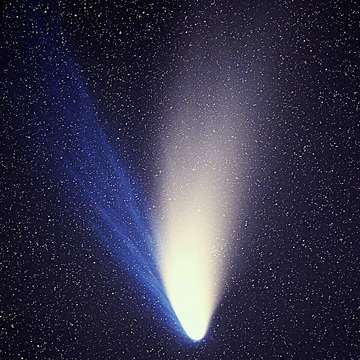
81P/Wild
Comet sampled by NASA's Stardust mission, returning cometary dust to Earth.

Comet 81P/Wild, also known as Wild 2 (pronounced "vilt two"), is a periodic comet with an orbital period of 6.4 years. It was discovered by Swiss astronomer Paul Wild on January 6, 1978, using a 40-cm Schmidt telescope at Zimmerwald, Switzerland. The comet is notable for being the target of NASA's Stardust mission, which collected and returned samples of its coma to Earth.
Quick Facts
- Pronounced
- ' · v · I · l · t
- Discovery Ref
- IAUC_3166
- Discoverer
- Paul Wild
- Discovery Site
- Zimmerwald, Switzerland
- Discovery Date
- 6 January 1978
- Mpc Name
- P/1978 A2; P/1983 S1
- Designations
- 1978 XI; 1984 XIV; / 1990 XXVIII
- Orbit Ref
- jpldata · mpc
- Epoch
- 17 October 2024 (JD 2460600.5)
- Obs
- 7,963
- Perihelion
- 1.597 AU
- Aphelion
- 5.307 AU
Facts from the source article.
Lore & Background
For most of its 4.5 billion-year lifetime, Wild 2 likely had a more distant and circular orbit. In September 1974, it passed within 1.0 million km of Jupiter, whose gravitational pull perturbed the comet into the inner Solar System. Its orbital period changed from 43 years to about 6 years, and its perihelion is now about 1.59 AU. Prior to the encounter, the comet had an aphelion around 25 AU and a perihelion just under 5 AU; after the encounter, aphelion and perihelion became about 5 AU and 1.5 AU, respectively.
NASA's Stardust spacecraft launched on February 7, 1999, flew by Wild 2 on January 2, 2004, and collected particle samples from the comet's coma. Seventy-two close-up shots revealed a surface riddled with flat-bottomed depressions with sheer walls, ranging from very small to up to 2 km across, believed to be impact craters or gas vents. At least 10 gas vents were active during the flyby. The comet has a diameter of 5 km. The sample return canister landed in Utah on January 15, 2006, and grains were distributed to about 150 scientists.
Reader's Guide
The Stardust mission's return of cometary material from Wild 2 provided a direct laboratory analysis of primitive Solar System material. The dust contained a wide range of organic compounds, including two with biologically usable nitrogen, and indigenous aliphatic hydrocarbons with longer chain lengths than those in the diffuse interstellar medium. No hydrous silicates or carbonate minerals were detected, suggesting a lack of aqueous processing of the dust. Very few pure carbon (CHON) particles were found. A substantial amount of high-temperature crystalline silicates such as olivine, anorthite, and diopside were present, materials only formed at high temperature. This was consistent with previous observations of crystalline silicates in cometary tails and circumstellar disks at large distances from stars. A 2008 study revealed an oxygen isotope signature in the dust suggesting unexpected mingling of rocky material between the center and edges of the Solar System, with crystals forged in the hotter interior despite the comet's birth in the icy outer Solar System. In April 2011, evidence of liquid water was discovered from iron and copper sulfide minerals, conflicting with the paradigm that comets never get warm enough to melt their icy bulk. Possible explanations include collisions or radiogenic heating. The comet's spin axis orientation changed by at least 1.7 degrees between its 2009–10 and 2022–23 apparitions. The Zwicky Transient Facility recorded at least two apparent outbursts in October 2022. The James Webb Space Telescope observed the comet in March 2023 at about 1.85 AU from the Sun, detecting molecular emissions of H2O, CH4, C2H6, CH3OH, CO, CO2, 13CO2, OCS, HCN, and CN.
Did You Know?
- The comet's orbit was dramatically altered by a close pass within 1.0 million km of Jupiter in September 1974.
- NASA's Stardust mission returned samples of Wild 2's coma to Earth in 2006.
- Evidence of liquid water on Wild 2 was reported in April 2011, based on iron and copper sulfide minerals.
More in Named Comets, Part 6 1-24
Spotted an error? Know more?
Reader corrections go straight into our review queue. Suggest an edit · How this site is sourced