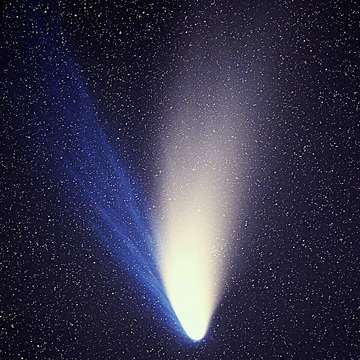
80P/Peters–Hartley
A lost comet recovered after 136 years by Malcolm Hartley.

80P/Peters–Hartley is a Jupiter-family comet that orbits the Sun once every 8.06 years. It holds the distinction of being the first of two comets found by German–American astronomer Christian Heinrich Friedrich Peters. After its discovery, the comet was lost and later recovered by Australian astronomer Malcolm Hartley.
Christian Heinrich Friedrich Peters first spotted the comet from the Capodimonte Observatory in Naples, Italy. However, astronomers could not gather enough data to calculate its orbit accurately, and the comet remained lost for more than 136 years. Malcolm Hartley accidentally rediscovered it on a photographic plate taken on 11 July 1982 at the UK Schmidt Telescope Unit in Siding Spring, Australia, estimating its brightness at magnitude 15. The Perth Observatory confirmed the sighting, and Michael P. Candy calculated the orbit, concluding that Hartley had indeed found the lost comet. Ichiro Hasegawa and Syuichi Nakano independently reached the same conclusion. At its next appearance in 1990, Robert H. McNaught of Siding Spring Observatory observed the comet, describing it as diffuse with a magnitude of 14, suggesting it had faded over the previous 150 years. Since its recovery, the comet has been observed at every subsequent apparition.
Quick Facts
- Discovery Ref
- Peters_1846 · IAUC_3715
- Discoverer
- Christian H. F. Peters / Malcolm Hartley
- Discovery Site
- Capodimonte Observatory, Italy
- Discovery Date
- 26 June 1846 / 11 July 1982
- Mpc Name
- P/1846 M1 / P/1982 N1
- Designations
- 1846 VI, 1982 III, 1990 IX · 1982h, 1990d
- Orbit Ref
- jpldata · MPC
- Epoch
- 21 November 2025 (JD 2461000.5)
- Obs
- 186
- Perihelion
- 1.618 AU
- Aphelion
- 6.424 AU
- Semimajor
- 4.021 AU
Facts from the source article.
Lore & Background
The comet was originally discovered by Christian Heinrich Friedrich Peters at the Capodimonte Observatory in Naples, Italy. Insufficient data prevented accurate computation of its orbit, and the comet was lost for well over 136 years. It was accidentally rediscovered by Malcolm Hartley at the UK Schmidt Telescope Unit, Siding Spring, Australia, on a photographic plate exposed on 11 July 1982. Hartley estimated its brightness at a magnitude of 15. The sighting was confirmed from the Perth Observatory, where Michael P. Candy calculated the orbit and concluded that Hartley had indeed relocated the lost Peters' Comet. Ichiro Hasegawa and Syuichi Nakano had simultaneously reached the same conclusion. At its next apparition in 1990, Robert H. McNaught of the Siding Spring observatory observed the comet, describing it as diffuse with a brightness of magnitude 14, indicating that the comet had faded over the last 150 years. It was subsequently observed on every apparition since its recovery.
Reader's Guide
80P/Peters–Hartley holds significance as a case study in the recovery of lost comets, demonstrating the persistence of astronomical observation across more than a century. Its initial loss due to insufficient orbital data highlights the challenges of 19th-century cometography, while its recovery by Malcolm Hartley in 1982 underscores the role of systematic photographic surveys in modern astronomy. The simultaneous independent confirmation by Ichiro Hasegawa and Syuichi Nakano further validates the recovery. The comet's observed fading from magnitude 15 at recovery to magnitude 14 in 1990, as noted by Robert H. McNaught, suggests a gradual dimming over its orbital history. As a Jupiter-family comet with an 8.06-year period, it remains regularly observable, contributing to ongoing studies of cometary evolution and orbital dynamics. Its legacy is tied to both its original discoverer, Christian Heinrich Friedrich Peters, and its recoverer, Malcolm Hartley, marking a bridge between 19th-century and late 20th-century astronomy.
Did You Know?
- 80P/Peters–Hartley is the first of two comets discovered by Christian Heinrich Friedrich Peters.
- Robert H. McNaught described the comet as diffuse with a brightness of magnitude 14 in 1990.
More in Named Comets, Part 6 1-24
Spotted an error? Know more?
Reader corrections go straight into our review queue. Suggest an edit · How this site is sourced