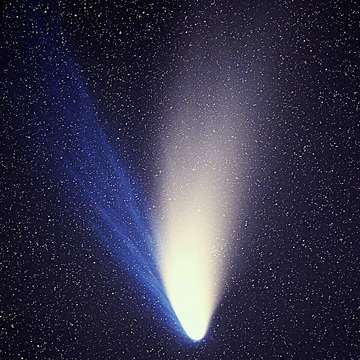
78P/Gehrels
A highly active Jupiter-family comet discovered by Tom Gehrels.

78P/Gehrels, also called Gehrels 2, is a Jupiter-family comet about 8 kilometers across that currently orbits the Sun once every 7.2 years. It was the second periodic comet found by American astronomer Tom Gehrels. At its closest approach to the Sun on June 25, 2026, it will have a solar elongation of 33 degrees and an apparent magnitude near 15. Its nearest pass to Earth will occur on December 31, 2026, at a distance of 1.56 AU (233 million kilometers). In September 2029, the comet will pass extremely close to Jupiter—within 0.018 AU (2.7 million kilometers)—which will push its orbit outward. After that, its next perihelion will be on January 9, 2032, at a distance of 4.1 AU from the Sun.
Tom Gehrels discovered the comet on photographic plates taken between September 29 and October 5, 1973, at Palomar Observatory, when it shone at magnitude 15. Brian G. Marsden initially calculated a parabolic orbit and an elliptical one suggesting a period of 8.76 years, later revising the data to give a perihelion date of November 30, 1963, and an orbital period of 7.93 years. The comet’s predicted return was first observed by W. and A. Cochran at McDonald Observatory in Texas on June 8, 1981. It was seen again in 1989 and in 1997, when favorable conditions boosted its brightness to magnitude 12. Since then, it has been observed at every apparition. The first polarimetric observations of the comet were made at the Girawali Observatory in 2012.
Early CCD observations in 2003 suggested a small nucleus only about 1.54 kilometers across. Photometry from the Isaac Newton Telescope in 2006 instead indicated an effective radius of roughly 4.21 kilometers, though this may represent an upper limit. During its 2019 apparition, the comet’s maximum dust production rate was measured at Afρ = 1028.1 ± 13.3 cm, making it one of the most active Jupiter-family comets ever recorded.
The comet’s dynamical history shows it has been within the planetary region for about a million years, but its migration into the inner Solar System is relatively recent—its first encounter with Jupiter occurred only about 500 years ago. Its aphelion lies at 5.4 AU (810 million kilometers), so its orbit is frequently disturbed by Jupiter. On September 15, 2029, it will pass just 0.018 AU from Jupiter, slightly outside the orbit of Callisto, and be strongly perturbed.
Quick Facts
- Discovery Ref
- IAUC_2589
- Discoverer
- Tom Gehrels
- Discovery Site
- Palomar Observatory, Arizona, USA
- Discovery Date
- 29 September 1973
- Mpc Name
- P/1973 S1, P/1981 L1
- Designations
- Gehrels 2 · 1973 XI, 1981 XVII · 1989 XVII · 1973n, 1981f, 1989n
- Orbit Ref
- jpldata · MPC
- Epoch
- 9 June 2026 / (JD 2461200.5)
- Observation Arc
- 52.247 years
- Obs
- 8,640
- Perihelion
- 2.004 AU / 4.121 AU (2032)Horizons2032
- Aphelion
- 5.459 AU / 7.091 AU (2038)Horizons2038
Facts from the source article.
Lore & Background
The comet was discovered by Tom Gehrels on photographic plates exposed between 29 September and 5 October 1973 at the Palomar Observatory, at an apparent magnitude of 15. Brian G. Marsden computed parabolic and elliptical orbits, initially suggesting an orbital period of 8.76 years, later revising the data to give a perihelion date of 30 November 1963 and an orbital period of 7.93 years. The comet's predicted next appearance was observed by W. and A. Cochran at the McDonald Observatory, Texas on 8 June 1981. It was observed again in 1989 and in 1997, when favorable conditions increased brightness to magnitude 12. It has subsequently been observed on every apparition since, with the first polarimetric observations conducted at the Girawali Observatory in 2012.
Initial CCD observations in 2003 indicated a small nucleus of only around 1.54 km, but photometry from the Isaac Newton Telescope in 2006 revealed an effective radius of about 4.21 km, though this may represent its upper limit. The maximum dust production rate during its 2019 apparition was measured at Afρ = 1028.1±13.3 cm, making it one of the most active Jupiter-family comets ever known. The dynamical history indicates it has resided within the planetary region for about a million years, but its migration to the inner Solar System is relatively recent, with its first encounter with Jupiter occurring only about 500 years ago.
At perihelion on 25 June 2026 the solar elongation was 33 degrees at an apparent magnitude of approximately 15. The closest approach to Earth will be on 31 December 2026 at a distance of 1.56 AU. The comet will make a very close approach to Jupiter in September 2029, passing within 0.018 AU of the planet, which will move the orbit outwards. The comet will next come to perihelion on 9 January 2032 at a distance of 4.1 AU from the Sun. By the year 2200, the comet will have a centaur-like orbit with a perihelion near Jupiter, and this outward migration could cause the comet to go dormant.
Reader's Guide
78P/Gehrels holds significance as a well-observed Jupiter-family comet with a long observational history spanning from its 1973 discovery through every apparition since 1981. Its high dust production rate, measured during the 2019 apparition, places it among the most active comets of its class, providing valuable data on cometary activity and dust emission. The comet's orbit is frequently perturbed by Jupiter due to its aphelion at 5.4 AU, and the upcoming extremely close approach in September 2029—passing within 0.018 AU of Jupiter—will dramatically alter its trajectory, moving its perihelion outward from 2.01 AU to 5.057 AU by the year 2200. This transformation into a centaur-like orbit and potential dormancy offers a rare opportunity to study the dynamical evolution of a comet from a Jupiter-family orbit to a more distant, inactive state. The comet's legacy includes contributions from multiple observatories and researchers, including the first polarimetric observations in 2012, and it continues to be monitored for its changing orbital and physical characteristics.
Did You Know?
- 78P/Gehrels is the second periodic comet discovered by American astronomer Tom Gehrels.
- The comet will pass within 0.018 AU of Jupiter in September 2029, slightly outside the orbit of Callisto.
- Its maximum dust production rate in 2019 was measured at Afρ = 1028.1±13.3 cm, one of the highest for a Jupiter-family comet.
- By the year 2200, the comet is expected to have a centaur-like orbit with a perihelion near Jupiter.
More in Named Comets, Part 6 1-24
Spotted an error? Know more?
Reader corrections go straight into our review queue. Suggest an edit · How this site is sourced