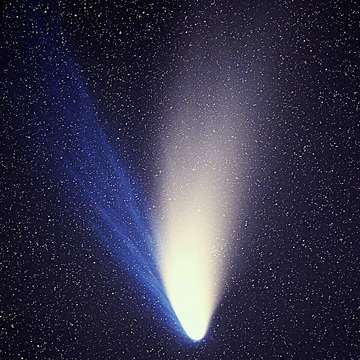
76P/West–Kohoutek–Ikemura
A Jupiter-family comet with a dramatically shortened orbit after a close Jovian encounter.

76P/West–Kohoutek–Ikemura is a Jupiter-family comet that currently takes about 6.47 years to orbit the Sun. Its most recent perihelion occurred on 13 April 2026, and the next is predicted for 22 September 2032.
The comet was first detected in January 1975 by Richard M. West on a photographic plate taken at the European Southern Observatory Sky Atlas Laboratory in Geneva, at which time it shone at magnitude 12. Because only a single image was available, its path could not be predicted, and the comet was considered lost. Later that February, Lubos Kohoutek accidentally rediscovered it at the Hamburg Observatory in Germany, and Toshihiko Ikemura independently spotted it on 1 March from Shinshiro, Japan. With additional observations, a parabolic orbit was calculated, yielding a perihelion date of 23 March 1975. It was then confirmed that all three sightings were of the same object, which received the designation 76P/West–Kohoutek–Ikemura. The comet has since been observed at its returns in 1987, 1993, 2000, 2006, and 2013.
Further orbital calculations by Brian G. Marsden revealed that the comet had passed just 0.012 AU (about 1.8 million km) from Jupiter on 22 March 1972. That close encounter shortened its orbital period from roughly 30 years to the current 6.48 years and reduced its perihelion distance from 4.78 AU to 1.60 AU.
The comet’s nucleus has an estimated effective radius of 0.31 ± 0.01 km (0.1926 ± 0.0062 mi), and its rotation period is thought to be 6.6 ± 1.0 hours.
Quick Facts
- Discoverer
- Richard M. West / Lubos Kohoutek / Toshihiko Ikemura
- Discovery Site
- Geneva, Switzerland / Hamburg, Germany / Shinshiro, Japan
- Discovery Date
- January–March 1975
- Mpc Name
- P/1975 D1, P/1980 V2
- Designations
- 1975 IV, 1981 VIII · 1987 XV, 1993 XXI · 1975b, 1980r · 1987x, 1993o
- Orbit Ref
- jpl · MPC
- Epoch
- 21 January 2022 (JD 2459600.5)
- Observation Arc
- 48.44 years
- Earliest Precovery Date
- 15 October 1974
- Obs
- 1,281
- Perihelion
- 1.603 AU
- Aphelion
- 5.341 AU
Facts from the source article.
Lore & Background
The comet was initially spotted on a photographic plate by Richard M. West at the European Southern Observatory Sky Atlas Laboratory, Geneva in January 1975, when it had a brightness of magnitude 12. Inability to predict its movement from a single image meant the comet had to be presumed lost. In late February it was accidentally rediscovered by Lubos Kohoutek at the Hamburg Observatory, Germany and independently on 1 March by Toshihiko Ikemura in Shinshiro, Japan. After further observations the comet's parabolic orbit was computed, which gave a perihelion date of 23 March 1975. It was demonstrated that all three sightings were of the same object, which was accordingly designated 76P/West–Kohoutek–Ikemura.
Further calculations by Brian G. Marsden determined the comet's elliptical orbit and revealed that it had passed only 0.012 AU (1.8 million km) from Jupiter on 22 March 1972. This close approach had reduced its orbital frequency from some 30 years to the current 6.48 years and its perihelion distance from 4.78 AU to 1.60 AU. Its nucleus is estimated to have an effective radius of 0.31 ± 0.01 km and its rotational period is estimated to be 6.6 ± 1.0 hours.
Reader's Guide
The significance of 76P/West–Kohoutek–Ikemura lies in its dramatic orbital transformation due to a close encounter with Jupiter. Before 1972, the comet had a long orbital period of about 30 years and a perihelion far beyond the asteroid belt at 4.78 AU. The 1972 approach to within 0.012 AU of Jupiter reduced its period to 6.48 years and brought its perihelion inward to 1.60 AU, making it a regular visitor to the inner solar system. This event illustrates the powerful gravitational influence Jupiter exerts on comets, reshaping their orbits and altering their observational accessibility. The comet's discovery story—independently found by three astronomers after being initially lost—also highlights the challenges of tracking faint objects from single observations. Its nucleus, with an estimated radius of about 0.31 km and a rotation period of roughly 6.6 hours, is typical of small Jupiter-family comets. The comet has been observed at successive returns in 1987, 1993, 2000, 2006 and 2013, providing a record of its behavior under its new orbital regime.
Did You Know?
- The comet was discovered independently by three astronomers: Richard M. West, Lubos Kohoutek, and Toshihiko Ikemura.
- A close approach to Jupiter on 22 March 1972 reduced its orbital period from about 30 years to 6.48 years.
- Its perihelion distance decreased from 4.78 AU to 1.60 AU after the Jovian encounter.
More in Named Comets, Part 6 1-24
Spotted an error? Know more?
Reader corrections go straight into our review queue. Suggest an edit · How this site is sourced