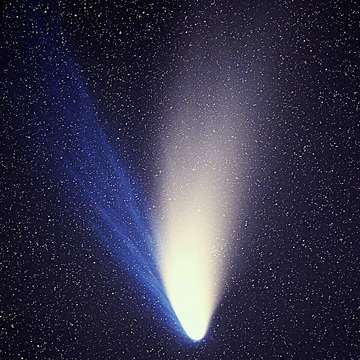
73P/Schwassmann–Wachmann
A disintegrating periodic comet with a 5.4-year orbit.

73P/Schwassmann–Wachmann, often shortened to Schwassmann–Wachmann 3 or SW3, is a periodic comet that orbits the Sun every 5.4 years. Since 1995, it has been steadily breaking apart. The comet is the source of the Tau Herculids meteor shower.
The comet was discovered on 2 May 1930 by astronomers Arnold Schwassmann and Arno Arthur Wachmann at the Hamburg Observatory in Bergedorf, Germany, while they were photographing the sky for new asteroids. On 31 May 1930, it passed about 0.062 AU (9.3 million km) from Earth. After that appearance, the comet was lost; the 1935 return was poorly placed for viewing, and it was not recovered until 1979. During its 1985 perihelion, it went unobserved because it was on the far side of the Sun, 1.9 AU from Earth. In 1990, it reached apparent magnitude 9, its brightest showing since 1930.
In September 1995, as the comet re-entered the inner Solar System, solar heating triggered its disintegration. It split into four large pieces, labeled 73P-A, B, C, and D. By March 2006, at least eight fragments (B, C, G, H, J, L, M, and N) were known. On 18 April 2006, the Hubble Space Telescope recorded dozens of pieces from fragments B and G. The comet may eventually break apart completely and become unobservable, like 3D/Biela in the 19th century; if so, its designation would change from 73P to 73D. By May 2006, at least 66 separate objects had been identified. Fragment C was the largest and considered the main remnant of the original nucleus.
In May 2006, the fragments passed near Earth. The comet made its closest approach on 12 May at 0.078 AU (11.7 million km). Fragment 73P-T, with a 34-day observation arc, was predicted to pass about 0.059 AU (8.8 million km) from Earth on 16 May. In 1930, when the comet passed Earth at a similar distance, a meteor shower on 9 June produced up to 100 meteors per hour, but analysis by P. A. Wiegert and colleagues suggested a repeat was unlikely.
Over many decades, the fragments from 1995 and 2006 will spread out along the comet's orbital path because they travel at slightly different speeds. Known fragments have orbital periods ranging from 4.7 years (73P-AJ) to 6.1 years (73P-Y). The main fragment reached perihelion on 25 August 2022, when it was 1 AU from Earth. Fragment 73P-Y, with a short 34-day observation arc, was best-fit to be near Jupiter's orbit, about 6.0 ± 0.5 AU from Earth.
Quick Facts
- Discoverer
- Arnold Schwassmann / Arno Arthur Wachmann
- Discovery Date
- May 2, 1930
- Designations
- 1930 VI; 1979 VIII; / 1990 VIII; 1994w
- Epoch
- 2017-Feb-16 / (JD 2457800.5)
- Earth Moid
- 0.014 AU
- Dimensions
- 2.2 km (pre-1995 breakup) / ~1 km (73P-C)
- Aphelion
- 5.211 AU
- Perihelion
- 0.9722 AU / (0.9187 AU after 2025 Jupiter approach)
- Semimajor
- 3.092 AU
- Eccentricity
- 0.6855
- Period
- 5.44 yr
- Inclination
- 11.237°
Facts from the source article.
Lore & Background
Comet Schwassmann–Wachmann 3 was discovered on 2 May 1930 by astronomers Arnold Schwassmann and Arno Arthur Wachmann at the Hamburg Observatory in Bergedorf, Germany, while they were exposing photographic plates for a minor planet survey. On 31 May 1930, the comet passed about 0.062 AU from Earth. It was lost after its 1930 apparition due to poor viewing geometry in 1935, but was recovered in 1979. During perihelion in 1985, the comet was unobserved as it was on the far side of the Sun 1.9 AU from Earth. In 1990, it reached apparent magnitude 9, its best appearance since 1930.
In September 1995, the comet began disintegrating as it re-entered the inner Solar System, triggered by the Sun's heating. It broke into four large pieces labeled 73P-A, B, C, and D. By March 2006, at least eight fragments were known, and on 18 April 2006, the Hubble Space Telescope recorded dozens of pieces of fragments B and G. In May 2006, it had split into at least 66 separate objects. Fragment C was the largest and presumed principal remnant. The fragments passed Earth in May 2006, coming nearest on 12 May at a distance of 0.078 AU. In 1930, a similar close pass produced a meteor shower on 9 June with up to 100 meteors per hour, but analysis suggested a recurrence was unlikely.
Over many decades, the fragments from 1995 and 2006 will disperse along the orbital path. Known fragments have orbital periods ranging from 4.7 years (73P-AJ) to 6.1 years (73P-Y). During the 2011 perihelion passage, the primary component 73P-C was recovered on 28 November 2010 near apparent magnitude 21.3 and came to perihelion on 16 October 2011. In 2022, fragments 73P-BT, 73P-BU, and 73P-BV were detected, along with additional fragments BW, BX, and BY announced on 2 September 2022.
Reader's Guide
73P/Schwassmann–Wachmann holds significance as a comet that has been actively disintegrating since 1995, providing a rare opportunity to study the breakup process of a cometary nucleus. Its fragmentation into dozens of pieces, observed by the Hubble Space Telescope and ground-based telescopes, has offered insights into the structural integrity and composition of comets. The comet's close approaches to Earth, such as in 1930 and 2006, have allowed detailed observations of its fragments and their orbits. The 1995 breakup also generated a modest meteor shower around 31 May 2022, the Tau Herculids, linking the comet to observable meteor activity. The comet's eventual complete disintegration, possibly leading to a designation change from 73P to 73D, underscores its transient nature. The planned CONTOUR probe visit in 2006 was lost due to contact failure in 2002, leaving a gap in direct exploration. The comet's orbital dynamics, including its 5.4-year period and approaches to Jupiter, highlight its role in the evolution of short-period comets. Its legacy lies in the ongoing monitoring of its fragments, which continue to disperse and provide data on cometary decay over decades.
Did You Know?
- The comet was discovered on 2 May 1930 by Arnold Schwassmann and Arno Arthur Wachmann during a minor planet survey.
- It began disintegrating in September 1995, breaking into four large pieces labeled A, B, C, and D.
- In May 2006, the comet had split into at least 66 separate objects.
- The comet is a parent body of the Tau Herculids meteor shower.
More in Named Comets, Part 6 1-24
Spotted an error? Know more?
Reader corrections go straight into our review queue. Suggest an edit · How this site is sourced