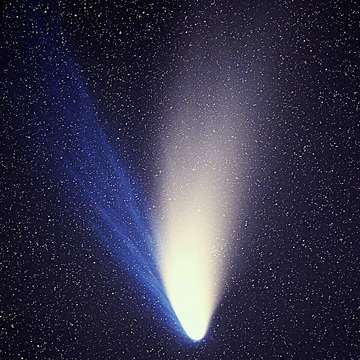
72P/Denning–Fujikawa
A transitional periodic comet with sporadic brightening and long lost periods.

72P/Denning–Fujikawa is a periodic comet discovered on 4 October 1881 by William Frederick Denning. It was not observed again until its recovery by Shigehisa Fujikawa in 1978, after which it was lost again from 29 December 1978 until 17 June 2014, when Hidetaka Sato recovered it at apparent magnitude 16 while it was 50 degrees from the Sun. The comet is notable for its irregular activity and classification as a transitional comet, having been missed during several perihelion passages when it was expected to be brighter.
Quick Facts
- Discoverer
- William Frederick Denning
- Discovery Date
- 4 October 1881
- Epoch
- 2014-07-02 / (JD 2456840.5)
- Semimajor
- 4.334 AU (a)
- Perihelion
- 0.7842 AU (q)
- Aphelion
- 7.884 AU (Q)
- Eccentricity
- 0.8191
- Period
- 9.02 yr
- Inclination
- 9.17°
- Earth Moid
- 0.085 AU
- Last P
- 2023-Jun-15 / 2014-Jul-11 / 2005-Jun-20
- Next P
- 2032-May-14
Facts from the source article.
Lore & Background
The comet was first sighted by William Frederick Denning on 4 October 1881, and in August 1881 it had passed 0.116 AU (17.4 million km) from Earth. After its discovery, the comet was not seen again until Shigehisa Fujikawa recovered it in 1978, when it appeared at around magnitude 10. Following that apparition, the comet was lost from 29 December 1978 until 17 June 2014, when Hidetaka Sato recovered it at apparent magnitude 16 while it was 50 degrees from the Sun.
The comet has a history of being missed during perihelion passages even when estimates suggested it should have been around magnitude 8, as occurred in 1960 and 1969. It was also missed in 1987, 1996, and 2005, as it is now expected that the comet only brightened to about magnitude 13–14 during those passages. This pattern of weak or absent activity has led to its classification as a transitional comet, suggesting it is only occasionally active.
Between 1855 and 2059, the comet's perihelion distance will gradually increase from 0.79 AU to 0.82 AU. The comet came to perihelion in June 2023 and will next come to perihelion in May 2032.
Reader's Guide
72P/Denning–Fujikawa holds significance as a transitional comet, a class of objects that exhibit intermittent activity and are difficult to predict. Its long periods of being lost—from its discovery in 1881 until 1978, and again from 1978 until 2014—underscore the challenges of tracking comets with weak or sporadic outgassing. The fact that it was missed during several perihelion passages when it was expected to be as bright as magnitude 8, yet only reached magnitude 13–14 in later returns, highlights the variability that defines transitional comets.
The comet's legacy also includes potential meteor shower activity. The 1834 trail of 72P may come close to Earth on 7 January 2024, though detection would require radio or radar methods because the radiant lies near the Sun and Beta Capricorni. Meteor showers from this comet are more likely in August or December, with December being a daytime event. These characteristics make 72P/Denning–Fujikawa a subject of interest for studies of cometary evolution and the transition between active and dormant states.
More in Named Comets, Part 6 1-24
Spotted an error? Know more?
Reader corrections go straight into our review queue. Suggest an edit · How this site is sourced