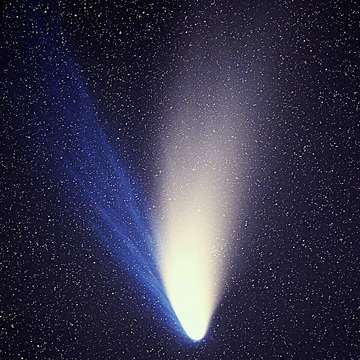
70P/Kojima
Periodic comet discovered by Nobuhisa Kojima in Japan.

70P/Kojima is a periodic comet that orbits the Sun once every 7.05 years. It was the first of two comets found by Japanese astronomer Nobuhisa Kojima.
Kojima discovered the comet in Ishiki, Aichi, Japan, estimating its brightness at magnitude 14. Kiichirō Furukawa initially calculated a parabolic orbit with a perihelion date of 1 November 1970, but later observations revised this to an elliptical orbit with a perihelion of 7 October and an orbital period of 6.16 years. On 9 December 1977, Hiroki Kosai and Furukawa relocated the comet at its next predicted apparition using the 105 cm Schmidt telescope at the Kiso Station of the Tokyo Astronomical Observatory, estimating its brightness at magnitude 16. The comet was later observed by Spacewatch in 1985/1986 and 1992/1994, with magnitudes of 20 and 22.1, respectively. After a close pass by Jupiter, its perihelion distance decreased from 2.4 AU to 1.97 AU, its eccentricity increased from 0.39 to 0.46, and its orbital period shortened from 7.85 to 6.99 years.
The comet’s nucleus has an estimated effective radius of 1.82 ± 0.09 kilometers, and its rotational period is estimated at 22 ± 5 hours.
Quick Facts
- Discovery Ref
- IAUC_2298
- Discoverer
- Nobuhisa Kojima
- Discovery Site
- Ishiki, Aichi, Japan
- Discovery Date
- 27 December 1970
- Designations
- 1970 XII, 1978 X · 1986 VII, 1994 VI · 1970r, 1977r, 1985o · 1992z
- Orbit Ref
- jpl · mpc
- Epoch
- 13 September 2023 (JD 2460200.5)
- Observation Arc
- 51.47 years
- Obs
- 2,122
- Perihelion
- 2.007 AU
- Aphelion
- 5.347 AU
- Semimajor
- 3.677 AU
Facts from the source article.
Lore & Background
The comet was discovered at Ishiki, Aichi, Japan by Nobuhisa Kojima, who estimated its brightness at magnitude 14. Kiichirō Furukawa initially calculated a parabolic orbit with a perihelion date of 1 November 1970, but further observations revised this to an elliptical orbit with a perihelion of 7 October and an orbital period of 6.16 years. Hiroki Kosai and Furukawa relocated the comet on 9 December 1977 at its next predicted apparition using the 105 cm Schmidt telescope at the Kiso Station of the Tokyo Astronomical Observatory, estimating its brightness at magnitude 16. It was subsequently observed in 1985/1986 and 1992/1994 by Spacewatch with magnitudes of 20 and 22.1, respectively. The comet then passed close to Jupiter, which reduced the perihelion distance from 2.4 AU to 1.97 AU, increased the eccentricity from 0.39 to 0.46, and reduced the orbital period from 7.85 to 6.99 years. Its nucleus is estimated to have an effective radius of 1.82±0.09 kilometers and its rotational period is estimated to be 22±5 hours.
Reader's Guide
70P/Kojima holds significance as the first comet discovered by Nobuhisa Kojima, a Japanese astronomer, and as a periodic comet with a well-documented observational history. Its discovery in 1970 at Ishiki, Aichi, Japan, and subsequent recovery in 1977 by Hiroki Kosai and Kiichirō Furukawa demonstrate the collaborative efforts in tracking periodic comets. The comet's orbital evolution, particularly the close approach to Jupiter that altered its perihelion distance, eccentricity, and orbital period, provides insight into the gravitational influences that shape comet orbits. The physical characteristics of its nucleus, including an estimated radius of 1.82±0.09 kilometers and a rotational period of 22±5 hours, contribute to the understanding of comet nuclei properties. The comet's observations across multiple apparitions, with brightness ranging from magnitude 14 to 22.1, illustrate the challenges of observing faint periodic comets over time. Its inclusion in the list of numbered comets underscores its established status in the catalog of periodic comets.
Did You Know?
- 70P/Kojima is the first of two comets discovered by Japanese astronomer Nobuhisa Kojima.
- Its initial parabolic orbit was calculated by Kiichirō Furukawa with a perihelion date of 1 November 1970.
- The comet passed close to Jupiter, reducing its perihelion distance from 2.4 AU to 1.97 AU.
More in Named Comets, Part 6 1-24
Spotted an error? Know more?
Reader corrections go straight into our review queue. Suggest an edit · How this site is sourced