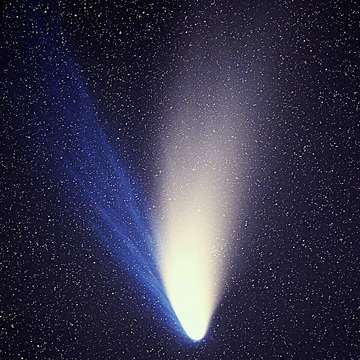
68P/Klemola
A young Jupiter-family comet discovered in 1965.

68P/Klemola, often called Klemola's Comet, belongs to the Jupiter-family group of comets. It was first spotted in 1965 by American astronomer Arnold Richard Klemola while he was working at the Yale-Columbia Southern Station in Argentina.
The comet was next seen at its predicted return in 1976, when Gérard Sause observed it on August 6 from the Observatoire de Haute Provence in France, noting a brightness of magnitude 12. In 1987, J. Gibson captured images of it on February 16 using the 1.5-meter reflector at Palomar Observatory in California; the comet appeared essentially star-like at a faint magnitude 19. Later, on March 29, 1997, Carl W. Hergenrother observed it from the F. L. Whipple Observatory, with its perihelion occurring on May 1, 1998. During its 2019 apparition, 68P reached opposition on June 14 and perihelion on November 9, displaying an intermediate level of activity compared to other known Jupiter-family comets like 78P/Gehrels.
Orbital reconstructions performed in 2024 indicate that 68P/Klemola only entered the Jupiter-family comet region about a thousand years ago, making it a relatively young comet.
Quick Facts
- Discovery Ref
- IAUC_1940
- Discoverer
- Arnold R. Klemola
- Discovery Site
- Yale-Columbia Southern Station, Argentina
- Discovery Date
- 28 October 1965
- Designations
- 1965 VI, 1976 X · 1987 XIV, 1965j, 1976j · 1987i
- Orbit Ref
- jpldata · MPC
- Epoch
- 21 November 2025 (JD 2461000.5)
- Observation Arc
- 55.19 years
- Obs
- 1,978
- Perihelion
- 1.809 AU
- Aphelion
- 8.119 AU
- Semimajor
- 4.964 AU
Facts from the source article.
Lore & Background
The comet was first observed at its next predicted apparition by Gérard Sause at the Observatoire de Haute Provence, France, on 6 August 1976, when it appeared at magnitude 12. In 1987, J. Gibson of Palomar Observatory, California, obtained images with the 1.5-meter reflector on 16 February, showing the comet as essentially stellar with a faint magnitude of 19. It was observed again on 29 March 1997 by Carl W. Hergenrother at the F. L. Whipple Observatory, with perihelion occurring on 1 May 1998.
During its 2019 apparition, 68P came to opposition on 14 June and reached perihelion on 9 November. That apparition revealed the comet exhibited an intermediate level of activity relative to other known Jupiter-family comets such as 78P/Gehrels. Orbital reconstruction in 2024 indicated that 68P/Klemola entered the Jupiter-family comet region only a thousand years ago, making it a relatively young comet.
Reader's Guide
68P/Klemola holds significance as a relatively young Jupiter-family comet, having entered the JFC region only about a thousand years ago according to orbital reconstruction performed in 2024. This youth distinguishes it from many other comets in its class, which have typically spent much longer in the inner solar system. Its discovery in 1965 by Arnold Richard Klemola at the Yale-Columbia Southern Station in Argentina added a new member to the Jupiter-family group, and subsequent observations across multiple apparitions—1976, 1987, 1997, and 2019—have allowed astronomers to track its behavior and activity levels. During the 2019 apparition, the comet displayed an intermediate level of activity compared to other Jupiter-family comets like 78P/Gehrels, providing a useful benchmark for understanding the range of activity among such objects. The comet's legacy lies in its contribution to the study of cometary evolution, particularly the early stages of a comet's life after entering the Jupiter-family region, and in the continued monitoring of its brightness and physical characteristics over decades.
Did You Know?
- The comet was observed at magnitude 12 on 6 August 1976 by Gérard Sause at the Observatoire de Haute Provence, France.
- Orbital reconstruction in 2024 showed that 68P/Klemola entered the Jupiter-family comet region only about a thousand years ago.
More in Named Comets, Part 6 1-24
Spotted an error? Know more?
Reader corrections go straight into our review queue. Suggest an edit · How this site is sourced