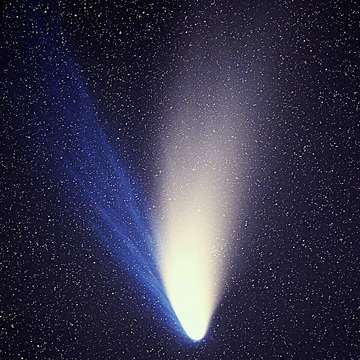
61P/Shajn–Schaldach
Jupiter-family comet discovered in 1949 by Shajn and Schaldach.

61P/Shajn–Schaldach is a Jupiter-family comet that orbits the Sun once every 7.09 years. It holds the distinction of being the only comet discovered by both Pelageja F. Shajn and Robert D. Schaldach.
The comet was first spotted on a photographic plate taken on 18 September 1949 by Pelageja F. Shajn at the Simeiz Observatory in Crimea, part of the Crimean Astrophysical Observatory. Robert D. Schaldach independently found it two days later on a photographic plate at the Lowell Observatory in Arizona. Shajn later located the comet on earlier plates from August 28 and September 4 of that year.
Initial orbital calculations placed the comet's perihelion between December 1949 and October 1950, with a period of 7.76 years. After accounting for gravitational perturbations from a close pass by Jupiter, the next perihelion was predicted for 15 March 1957, but the comet was not observed that year. It also went unseen during its next expected return in 1964, likely because it was too faint.
The comet was finally relocated on 29 September 1971 by Charles T. Kowal at the California Institute of Technology, using the 122 cm Palomar Schmidt telescope. He estimated its brightness at a faint magnitude of 16, and other astronomers confirmed the sighting. Subsequent returns were successfully observed in 1979, 1986, 1993, 2001, and 2008.
Observations by the Hubble Space Telescope indicate that the comet's nucleus has an effective radius of 0.61 ± 0.03 kilometers (0.379 ± 0.019 miles).
Quick Facts
- Discoverer
- Pelageja F. Shajn / Robert D. Schaldach
- Discovery Site
- Simeiz Observatory, USSR / Lowell Observatory, USA
- Discovery Date
- 18–20 September 1949
- Orbit Ref
- jpldata · MPC
- Epoch
- 2014-Dec-9
- Semimajor
- 3.5769 AU
- Perihelion
- 2.1080 AU
- Aphelion
- 5.2458 AU
- Eccentricity
- 0.4267
- Period
- 7.49 yr
- Inclination
- 6.0097°
- Physical Ref
- Lamy_2011 · Mueller_2018
Facts from the source article.
Lore & Background
The comet was discovered on 18 September 1949 on a photographic plate by Pelageja F. Shajn at the Simeiz Observatory in Crimea, part of the Crimean Astrophysical Observatory. Two days later, Robert D. Schaldach independently discovered it on a photographic plate at the Lowell Observatory in Arizona, US. Shajn subsequently found evidence of the comet on earlier photographs taken on August 28 and September 4 of that year.
Initial orbital computations gave a perihelion date between December 1949 and October 1950 with a periodicity of 7.76 years. After accounting for perturbations from a close approach to Jupiter, the next perihelion was calculated to be on 15 March 1957, but the comet was not found that year. It was also not detected on its next predicted return in 1964, likely due to its faintness.
The comet was relocated on 29 September 1971 by Charles T. Kowal of the Department of Astrophysics, California Institute of Technology, using the 122 cm Palomar Schmidt telescope, who estimated its brightness at a faint magnitude of 16. Other astronomers confirmed the sighting. Subsequent returns were successfully observed in 1979, 1986, 1993, 2001, and 2008.
Based on observations by the Hubble Space Telescope, the nucleus has an effective radius of 0.61 ± 0.03 km.
Reader's Guide
61P/Shajn–Schaldach holds significance as a Jupiter-family comet whose discovery involved two independent observers on different continents, highlighting the collaborative nature of early photographic comet hunting. Its early orbital calculations were complicated by a close approach to Jupiter, leading to missed returns in 1957 and 1964 due to faintness. The comet's recovery in 1971 by Charles T. Kowal using the Palomar Schmidt telescope demonstrated the challenges of tracking small, dim periodic comets. The successful observations of its subsequent returns through 2008 provided a consistent record of its orbit and activity. Hubble Space Telescope measurements of its nucleus size contribute to the understanding of the physical properties of Jupiter-family comets. The comet is also notable as the only comet discovered by Pelageja F. Shajn, a pioneering female astronomer, and Robert D. Schaldach.
Did You Know?
- The comet was independently discovered two days apart by Shajn in Crimea and Schaldach in Arizona.
- It was not found on its predicted returns in 1957 and 1964, likely due to its faintness.
More in Named Comets, Part 6 1-24
Spotted an error? Know more?
Reader corrections go straight into our review queue. Suggest an edit · How this site is sourced