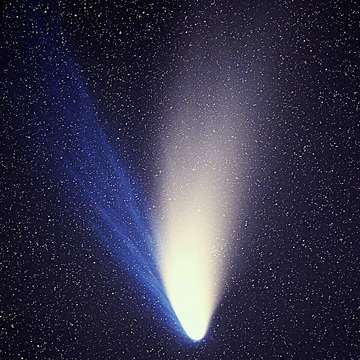
60P/Tsuchinshan
Jupiter-family comet discovered at Purple Mountain Observatory in 1965.

60P/Tsuchinshan, also known as Tsuchinshan 2, is a Jupiter-family comet with an orbital period of approximately 6.63 years. Its name derives from the Wade-Giles transliteration of Zǐjīn Shān (紫金山), Mandarin Chinese for 'Purple Mountain,' the site of its discovery. The comet is notable for its relatively small nucleus and for exhibiting unusually high dust production levels during certain apparitions compared to other Jupiter-family comets.
Quick Facts
- Discovery Site
- Purple Mountain Observatory
- Discovery Date
- 11 January 1965
- Mpc Name
- P/1965 A2, P/1971 S1
- Designations
- Tsuchinshan 2 · 1965 II, 1971 X, 1978 XVI · 1985 X, 1992 XII
- Orbit Ref
- jpldata · MPC
- Epoch
- 21 November 2025 (JD 2461000.5)
- Observation Arc
- 59.59 years
- Obs
- 1,656
- Semimajor
- 3.529 AU
- Perihelion
- 1.646 AU
- Aphelion
- 5.143 AU
- Eccentricity
- 0.53369
Facts from the source article.
Lore & Background
The comet was discovered on 11 January 1965 at the Purple Mountain Observatory in Nanjing, China, with an estimated magnitude of 15. Its elliptical orbit was computed to give a perihelion date of 9 February 1965 and an orbital period of 6.69 years. Revised calculations predicted the next perihelion would occur on 28 November 1971, and Elizabeth Roemer of the University of Arizona successfully relocated the comet using the 154-cm reflector at Catalina. Subsequent observations were made in 1978, 1985, 1991–1992, and 1998–1999.
Initial estimates of the nucleus radius placed it between 0.5 and 0.8 km, later revised to 0.69 km in 2006 based on photometric data of its absolute nuclear magnitude. During its 2018–2019 apparition, dust production levels at perihelion were significantly greater than those of other Jupiter-family comets such as 21P/Giacobini–Zinner, 41P/Tuttle–Giacobini–Kresak, and 103P/Hartley, though slightly lower than that of 67P/Churyumov–Gerasimenko. The comet's activity increased by a factor of 1.3 after its perihelion distance was reduced by 0.15 AU following a close encounter with Jupiter in 2008.
Reader's Guide
60P/Tsuchinshan holds significance as a Jupiter-family comet with a well-documented observational history spanning over five decades. Its discovery at the Purple Mountain Observatory ties it to a historically important astronomical institution in China. The comet's nucleus size, initially uncertain but later refined, provides a useful data point for understanding the physical properties of small cometary bodies. Notably, its dust production during the 2018–2019 apparition was found to be substantially higher than several other Jupiter-family comets, suggesting that Tsuchinshan 2 may be a particularly active object relative to its size. The increase in activity following its 2008 close encounter with Jupiter demonstrates how gravitational perturbations can alter a comet's outgassing behavior. The predicted close approach to Mars in 2077 offers a rare opportunity for future study. The comet's legacy lies in its contribution to comparative studies of cometary activity and the long-term monitoring of Jupiter-family comets, as well as its role in refining orbital mechanics through repeated observations across multiple apparitions.
Did You Know?
- Its name comes from the Wade-Giles transliteration of Zǐjīn Shān, meaning 'Purple Mountain' in Mandarin Chinese.
- The comet's nucleus radius was initially estimated at 0.5–0.8 km, later revised to 0.69 km in 2006.
- On 29 December 2077, it will pass 0.068 AU (10.2 million km) from Mars.
More in Named Comets, Part 6 1-24
Spotted an error? Know more?
Reader corrections go straight into our review queue. Suggest an edit · How this site is sourced