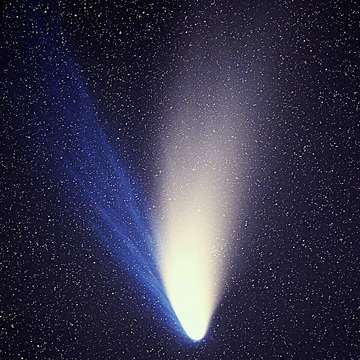
58P/Jackson–Neujmin
Periodic comet with a history of difficult recoveries.

58P/Jackson–Neujmin is a periodic comet that orbits the Sun once every 8.19 years. Its history of observation has been particularly difficult. Cyril Jackson first spotted it on a photographic plate on 20 September 1936 from the Union Observatory in South Africa, noting it was faint and diffuse at magnitude 12. The next day, Grigory N. Neujmin independently found it at the Simeis Observatory in Crimea, and Fernand Rigaux later identified it on a plate taken 9 September 1936 at the Royal Observatory in Uccle, Belgium. The comet was not seen during its predicted 1945 return because its position and timing were too uncertain; even Elizabeth Roemer failed to locate it in 1953. The 1961 apparition also proved extremely challenging, but Charles Kowal successfully relocated it in September 1970. A more favorable appearance in 1995 brought its brightness to magnitude 10. The comet went unobserved during its 2004 and 2012 returns, leading astronomers to consider it potentially lost. It was finally recovered in April 2020 at magnitude 12 by the SWAN camera aboard the SOHO spacecraft, following an outburst in late March 2020 that briefly boosted its magnitude from 12 to 10.
Quick Facts
- Discoverer
- Cyril Jackson / Grigory N. Neujmin
- Discovery Site
- Union, South Africa / Simeis, Crimea
- Discovery Date
- 20–21 September 1936
- Mpc Name
- P/1936 S1, P/1970 R1
- Designations
- 1936 IV, 1970 IX · 1978 XXVI, 1987 VIII
- Orbit Ref
- jpldata · MPC
- Epoch
- 13 September 2023 (JD 2460200.5)
- Observation Arc
- 50.16 years
- Obs
- 508
- Perihelion
- 1.379 AU
- Aphelion
- 6.798 AU
- Semimajor
- 4.089 AU
Facts from the source article.
Lore & Background
The comet was discovered on a photographic plate on 20 September 1936 by Cyril Jackson at the Union Observatory in South Africa, who described it as faint and diffuse with a brightness of magnitude 12. The following day Grigory N. Neujmin of the Simeis Observatory in Crimea independently discovered it. Fernand Rigaux of the Royal Observatory in Uccle, Belgium then also found it on an earlier photographic plate exposed on 9 September 1936.
The predicted 1945 apparition was not observed due to uncertainty about its position and appearance date, and even Elizabeth Roemer was unable to find it in 1953. The 1961 apparition was again very difficult, but Charles Kowal managed to relocate it in September 1970. The 1995 appearance was more favourable, and brightness reached a magnitude of 10. The comet was not observed during its 2004 or 2012 apparitions and was thought to be potentially lost until it was successfully recovered in April 2020 at magnitude 12 by the Solar Wind Anisotropies (SWAN) camera on the Solar Heliospheric Observer (SOHO) spacecraft. Due to an outburst event, the magnitude increased from 12 to 10 in late March 2020.
Reader's Guide
58P/Jackson–Neujmin holds significance as a periodic comet whose observational history illustrates the challenges of tracking small, faint bodies in the Solar System. Its discovery involved three independent astronomers across two continents within a span of days, highlighting the collaborative nature of early 20th-century comet hunting. The comet's repeated difficulties in being observed—missing its 1945 apparition, eluding Elizabeth Roemer in 1953, and proving elusive in 1961—underscore how orbital uncertainties can render a comet effectively lost for decades. Its relocation by Charles Kowal in 1970 and eventual recovery in 2020 by the SWAN camera on the SOHO spacecraft demonstrate the evolving capabilities of astronomical instrumentation, from ground-based photographic plates to space-based solar observatories. The 2020 recovery was particularly notable because the comet had not been seen since 1995 and was considered potentially lost; its reappearance at magnitude 12, followed by an outburst that brightened it to magnitude 10, provided a rare opportunity to study its activity. The comet's legacy lies in its role as a case study in the persistence required to maintain knowledge of periodic comets over long timescales.
Did You Know?
- The comet was discovered independently by three astronomers: Cyril Jackson, Grigory N. Neujmin, and Fernand Rigaux.
- The comet was recovered in April 2020 by the SWAN camera on the SOHO spacecraft.
- An outburst event in late March 2020 increased its magnitude from 12 to 10.
More in Named Comets, Part 6 1-24
Spotted an error? Know more?
Reader corrections go straight into our review queue. Suggest an edit · How this site is sourced