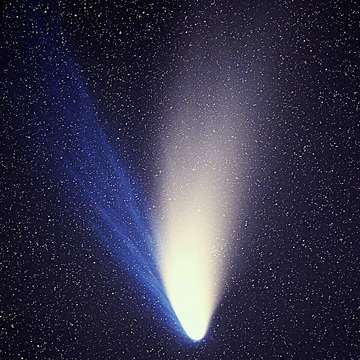
55P/Tempel–Tuttle
Parent body of the Leonid meteor shower.

55P/Tempel–Tuttle, also called Comet Tempel–Tuttle, is a retrograde periodic comet that orbits the Sun once every 33 years. Its period places it in the Halley-type category, which includes comets with orbits between 20 and 200 years. Wilhelm Tempel first spotted it on 19 December 1865, and Horace Parnell Tuttle independently found it on 6 January 1866. This comet is the source of the Leonid meteor shower.
The comet was seen earlier, in 1699, by Gottfried Kirch, but astronomers did not recognize it as periodic until Tempel and Tuttle’s discoveries during its 1866 approach to the Sun. In 1933, S. Kanda proposed that a comet observed in 1366 was Tempel–Tuttle, a link Joachim Schubart confirmed in 1965. On 26 October 1366, the comet passed within 0.0229 AU (about 3.43 million km) of Earth. A possible sighting in October 1234 comes from a single Japanese record, and a Chinese observation from January 1035 might also be this comet, though it would have been too faint to see without a major outburst.
J. Schubart recovered Tempel–Tuttle in images taken by Michiel John Bester on 30 June 1965, using the 10-inch telescope at Boyden Observatory in South Africa. At that time, its apparent magnitude was 16. Plates from Palomar Observatory on the same day confirmed the sighting, and these were the only two observations from the 1965 apparition. The comet was recovered again on 4 March 1997 by Karen Meech, Olivier Hainaut, and James "Gerbs" Bauer at the University of Hawai`i. It was very faint then, at magnitude 22.5, but the recovery showed it was on schedule and its orbit was well known. During the 1998 apparition, it brightened more than expected, reaching magnitude 7.4–7.8 in late February and becoming visible in binoculars. It was last seen on 5 July 1998.
The Hubble Space Telescope observed the comet’s nucleus during the 1998 apparition. Assuming an albedo of 0.04, its mean radius was estimated at 1.8 km. Spectrometric data gave it a reddish color, with B−V of 0.75±0.05 and V−R of 0.51±0.05. A jet was seen coming from the nucleus, and its movement suggested a rotation period between 14.79±0.02 and 15.31±0.03 hours. The comet’s spectrum showed diatomic carbon, NH₂, and [O i]. Its relative production rates indicated it is depleted in diatomic carbon, and its gas-to-dust ratio was higher than that of Halley’s Comet.
Quick Facts
- Discoverer
- Wilhelm Tempel / Horace Parnell Tuttle
- Discovery Date
- 19 December 1865
- Mpc Name
- P/1366 U1, P/1699 U1 · P/1865 Y1, P/1965 M2 · P/1997 E1
- Designations
- 1699 II, 1866 I, 1965 IV
- Orbit Ref
- jpldata · MPC
- Epoch
- 25 February 2023 (JD 2460000.5)
- Observation Arc
- 631.69 years
- Obs
- 471
- Perihelion
- 0.975 AU
- Aphelion
- 19.732 AU
- Semimajor
- 10.354 AU
- Eccentricity
- 0.90587
Facts from the source article.
Lore & Background
The comet was independently discovered by Wilhelm Tempel on 19 December 1865 and by Horace Parnell Tuttle on 6 January 1866. Earlier observations include one by Gottfried Kirch in 1699, though it was not recognized as periodic until the 1866 discoveries. In 1933, S. Kanda deduced that a comet observed in 1366 was Tempel–Tuttle, a finding confirmed by Joachim Schubart in 1965. On 26 October 1366, the comet passed 0.0229 AU from Earth. Possible earlier sightings include a brief mention in a Japanese source from October 1234 and a Chinese observation in January 1035, though the latter would have been too dim for naked-eye viewing unless it underwent a major outburst.
The comet was recovered by J. Schubart in images taken by Michiel John Bester on 30 June 1965 using the 10-inch telescope of Boyden Observatory, South Africa, at an apparent magnitude of 16. Confirmation came from Palomar Observatory plates on the same date. During the 1998 apparition, the comet brightened more than predicted, reaching magnitude 7.4–7.8 in late February and becoming visible in binoculars; it was last observed on 5 July 1998.
Physical characteristics include a nucleus observed by the Hubble Space Telescope in 1998, with a reddish color (B−V 0.75±0.05, V−R 0.51±0.05). A jet was observed, and the rotation period was calculated between 14.79±0.02 and 15.31±0.03 hours. The spectrum showed diatomic carbon, NH₂, and [O i], with the comet depleted in diatomic carbon and gas-rich compared to Halley’s Comet. Its infrared spectrum resembled a black body at 330 K and lacked silicate emission. William Huggins obtained the comet’s spectrum in January 1866, the second time spectrographic observations of a comet were made.
Reader's Guide
Tempel–Tuttle’s primary significance lies in its role as the parent body of the Leonid meteor shower. Its retrograde orbit causes meteoroids to impact Earth at 70 km/s, and because the comet’s orbit intersects Earth’s nearly exactly, material ejected during perihelion passages remains dense when encountering Earth. This produces the 33-year cycle of Leonid meteor storms—for example, the 1833 storm originated from the 1800 perihelion passage. Between 2021 and 2030, Earth will pass through debris from the 1733 orbit. The comet’s orbit was altered about 5,000 years before discovery by a close encounter with Uranus, reducing its period from that of a long-period comet to its current 33-year retrograde orbit, though this remains unconfirmed. The comet’s nucleus mass is estimated at 1.2×10¹³ kg, with its meteoroid stream totaling 5×10¹² kg. Its well-determined orbit and predictable returns have made it a key object for studying comet–meteor shower connections.
Did You Know?
- It is the parent body of the Leonid meteor shower, which produces storms on a 33-year cycle.
- The nucleus has a mean radius of 1.8 km and a reddish color.
- William Huggins observed its spectrum in January 1866, the second time a comet's spectrum was recorded.
More in Named Comets, Part 6 1-24
Spotted an error? Know more?
Reader corrections go straight into our review queue. Suggest an edit · How this site is sourced