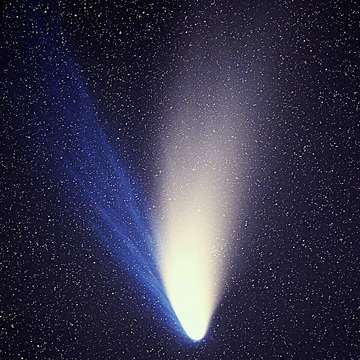
54P/de Vico–Swift–NEAT
A periodic comet lost and rediscovered multiple times since 1844.

54P/de Vico–Swift–NEAT is a periodic comet that was first spotted by Father Francesco de Vico in Rome, Italy, on 23 August 1844. Over time, it has been lost and rediscovered multiple times. The comet frequently passes close to Jupiter. Its most recent observation was on 3 December 2024.
After its initial discovery, independent sightings came from Melhop in Hamburg, Germany, on 6 September, and from Hamilton Lanphere Smith in Cleveland, Ohio, on 10 September. Paul Laugier and Felix Victor Mauvais calculated an orbit on 9 September 1844, noting similarities to earlier comets; by including 289P/Blanpain from 1819, they estimated an orbital period between 4.6 and 4.9 years. Hervé Faye in Paris computed the first elliptical orbit on 16 September 1844, giving a period of 5.46 years. The comet was then considered lost when later predicted returns after 1844 went unobserved.
Edward D. Swift rediscovered it on 21 November 1894 from Echo Mountain, California. Adolf Berberich suggested it was the same as de Vico's comet based on its location and motion. After 1894, the comet was again lost when the 1901 and 1907 returns were unseen, largely due to a close approach to Jupiter in 1897.
In 1963, Brian G. Marsden used a computer to link the 1844 and 1894 sightings, predicting a favorable return in 1965. Arnold Klemola recovered it on 30 June 1965 at the Yale-Columbia Southern Observatory in Argentina, at magnitude 17. Another close approach to Jupiter in 1968 increased its perihelion distance and orbital period, making future apparitions no brighter than magnitude 18. By 1995, it was again considered lost.
The Near-Earth Asteroid Tracking (NEAT) program rediscovered the comet on 11 October 2002. The LINEAR program in New Mexico found prediscovery images from 4 October, and Kenji Muraoka in Kochi, Japan, confirmed it as a return of 54P/de Vico–Swift. On 17 August 2009, the comet was recovered while 2.3 AU (340 million km) from the Sun.
Quick Facts
- Discoverer
- Francesco de Vico / Edward D. Swift / NEAT
- Discovery Site
- Rome, Italy
- Discovery Date
- 23 August 1844
- Mpc Name
- P/1844 Q1, P/1894 W1 · P/1965 M1, P/2002 T4
- Designations
- 1844 I, 1894 IV · 1965 VII, 1894e, 1965e
- Orbit Ref
- jpl · MPC
- Observation Arc
- 130.01 years
- Obs
- 406
- Epoch
- 17 October 2024 (JD 2460600.5)
- Semimajor
- 3.786 AU
- Perihelion
- 2.171 AU
- Aphelion
- 5.40 AU
Facts from the source article.
Lore & Background
The comet was first discovered by Father Francesco de Vico on 23 August 1844. Independent discoveries followed by Melhop on 6 September and by Hamilton Lanphere Smith on 10 September. Paul Laugier and Felix Victor Mauvais calculated an orbit on 9 September 1844, noting a similarity with comets seen in previous years; including 289P/Blanpain of 1819, they derived an orbital period between 4.6 and 4.9 years. Hervé Faye computed the first elliptical orbit on 16 September 1844, with a period of 5.46 years. The comet was considered lost after subsequent predicted returns were not observed.
Edward D. Swift rediscovered the comet on 21 November 1894 from Echo Mountain, California. Adolf Berberich suggested it might be the same as de Vico's comet based on location and direction of motion. After 1894, the comet was again considered lost when the 1901 and 1907 returns went unseen, mainly due to perturbations from a close approach to Jupiter in 1897.
In 1963, Brian G. Marsden used a computer to link the 1844 and 1894 sightings and calculated a favorable return in 1965. Arnold Klemola recovered the comet on 30 June 1965 at magnitude 17 from the Yale-Columbia Southern Observatory in Argentina. Another close approach to Jupiter in 1968 increased its perihelion distance and orbital period, making future apparitions no brighter than magnitude 18. The comet was not observed for subsequent predictions, and by 1995 it was again considered lost. The Near-Earth Asteroid Tracking (NEAT) program rediscovered it on 11 October 2002; the LINEAR program found several prediscovery images from 4 October, and Kenji Muraoka confirmed it as a return of comet 54P/de Vico–Swift. The comet was recovered on 17 August 2009 while 2.3 AU from the Sun, and was last observed on 3 December 2024.
Reader's Guide
54P/de Vico–Swift–NEAT is notable for its repeated cycles of discovery, loss, and rediscovery over 180 years, illustrating the challenges of tracking periodic comets whose orbits are strongly perturbed by Jupiter. Its history involves multiple independent discoverers and the application of early orbital calculations by Laugier, Mauvais, and Faye, as well as later computer-assisted linking by Brian G. Marsden. The comet's numerous close approaches to Jupiter have repeatedly altered its orbit, causing it to become lost after the 1844, 1894, and 1965 apparitions. Each rediscovery—by Swift in 1894, Klemola in 1965, and the NEAT program in 2002—required either serendipitous observation or careful prediction based on earlier data. The comet's last observed return in 2024 continues this legacy of intermittent visibility. Its naming reflects contributions from de Vico, Swift, and the NEAT survey, and its study has provided insight into the dynamical evolution of Jupiter-family comets.
More in Named Comets, Part 6 1-24
Spotted an error? Know more?
Reader corrections go straight into our review queue. Suggest an edit · How this site is sourced