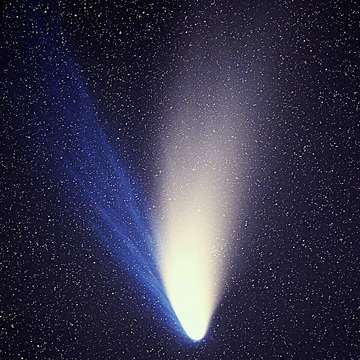
50P/Arend
Periodic comet discovered in 1951 by Sylvain Arend.

50P/Arend is a periodic comet in the Solar System discovered on October 4, 1951, by astronomer Sylvain Julien Victor Arend at the Royal Observatory of Belgium in Uccle. It has been observed at every subsequent apparition since its discovery, with the most recent occurring in 2024, and its next perihelion is predicted for 2032.
Quick Facts
- Discoverer
- Sylvian Arend
- Discovery Date
- 4 October 1951
- Mpc Name
- P/1951 T1, P/1959 N1
- Designations
- 1951 X, 1959 V, 1967 VI · 1975 VI, 1983 VIII · 1991 VIII
- Epoch
- 21 November 2025 (JD 2461000.5)
- Earliest Precovery Date
- 1 October 1951
- Obs
- 1,984
- Aphelion
- 6.252 AU
- Perihelion
- 1.922 AU
- Semimajor
- 4.087 AU
- Eccentricity
- 0.5297
- Period
- 8.26a
Facts from the source article.
Lore & Background
At its discovery in 1951, 50P/Arend was observed at a maximum magnitude of 14, with a nucleus within a coma 14 arc seconds across. During its next apparition on September 1, 1959, the comet did not exceed magnitude 17 until an outburst in November raised its brightness to magnitude 15.5. The comet's orbital period was 7.8 years at discovery, but an approach to Jupiter in 1969 at 0.64 AU increased the period to 8.0 years and made subsequent apparitions less favorable for observation, though its maximum magnitude reached 15.
Long-term motion studies by Brian G. Marsden determined the comet's orbital eccentricity at 0.5, indicating it is relatively undisturbed by Jupiter over 200-year cycles despite passing as close as 0.49 AU. In observations at Palomar Observatory in May 2000 and March 2001, visible coma activity was detected only from 50P/Arend and 4P/Faye among nine comets studied. The nucleus has a radius of 0.95 ± 0.03 kilometers, assuming a geometric albedo of 0.04.
Reader's Guide
50P/Arend holds significance as a regularly observed periodic comet that has been tracked at every apparition since its 1951 discovery, providing a long baseline for studying its orbital evolution. Its close approach to Jupiter in 1969 altered its orbital period from 7.8 to 8.0 years, a change documented through continued observations. The comet's relatively stable orbit over 200-year cycles, as shown by Brian G. Marsden's studies, makes it a useful object for understanding long-term dynamics in the inner Solar System. Its detection of visible coma activity in 2000–2001, alongside only one other comet in a survey of nine, highlights its ongoing activity. With 1,069 observations recorded from October 8, 1951, to February 19, 2008, and a mean residual of 0.60 arcseconds, the comet's astrometric data contribute to precise orbital modeling. The measured nucleus radius of 0.95 km provides a physical benchmark for comparing similar periodic comets.
Did You Know?
- The comet's orbital period increased from 7.8 to 8.0 years after a close approach to Jupiter in 1969 at 0.64 AU.
- Visible coma activity was detected from 50P/Arend in May 2000 and March 2001, one of only two comets out of nine observed at Palomar Observatory.
More in Named Comets, Part 6 1-24
Spotted an error? Know more?
Reader corrections go straight into our review queue. Suggest an edit · How this site is sourced