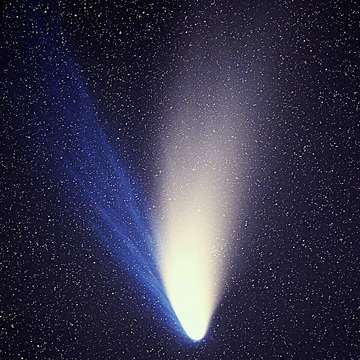
49P/Arend–Rigaux
A dark, periodic comet discovered in 1951 by Arend and Rigaux.

49P/Arend–Rigaux is a periodic comet that takes 6.75 years to orbit the Sun. It was the first of three comets found by Belgian astronomer Sylvain Arend and the only one co-discovered by Fernand Rigaux.
The comet was spotted on the night of 5 February 1951 during a routine search for new asteroids. At the time, it appeared as a diffuse 11th-magnitude object in the constellation Canis Minor.
Measurements of its nucleus taken in 1985 showed it has a geometric albedo of 0.028, making it one of the darkest objects in the Solar System, comparable to D-type asteroids and comet C/1983 H1. Those early measurements suggested an elongated nucleus with an effective radius between 3.8 and 5.1 km. Photometry of thermal emission from the same year gave a radius of 4.8 ± 0.4 km. A later analysis in 2004, drawing on previous studies, settled on a diameter of 4.24 km.
CCD photometry during the 1984/1985 apparition revealed a brightness variation that implied a rotation period between 6.78 and 9.78 hours. This was later revised to 13.47 hours after reanalysis of narrow-band visible and near-ultraviolet data. Observations during the 2012 apparition showed a double-peaked lightcurve, indicating a retrograde synodic rotation period of 13.452 hours.
Infrared observations from the Spitzer Space Telescope in 2006, combined with ground-based data from 2012, revealed a broad tail-like feature and a narrow jet. These structures are driven by subsurface volatiles—specifically amorphous water ice—that have been exposed by the comet’s repeated passes near the Sun.
As of 2025, the comet orbits the Sun at distances ranging from 1.43 AU to 5.71 AU, with an inclination of about 19 degrees to the ecliptic. The first orbital calculations were made by Joseph L. Brady and Nevin Sherman on 19 February 1951. Leland E. Cunningham noted that the preliminary orbit resembled that of 69P/Taylor, then a lost comet. In 1954, Vitaly A. Bronshten suggested that Arend–Rigaux might be one of two fragments of comet Taylor, with the other returning as D/1952 B1 (Harrington–Wilson) a year later. This connection was later disproven, and comet Taylor itself was not rediscovered until 1977.
On 20 December 2058, the comet will pass 0.0867 AU from Mars.
Quick Facts
- Discovery Ref
- IAUC_1301
- Discoverer
- Sylvain Arend / Fernand Rigaux
- Discovery Site
- Royal Observatory of Belgium
- Discovery Date
- 5 February 1951
- Mpc Name
- P/1951 C2, P/1958 B1
- Designations
- 1950 VII, 1957 VII · 1964 V, 1971 IV · 1978 III, 1984 XXI · 1991 XVII
- Orbit Ref
- jpldata · mpc
- Epoch
- 5 May 2025 (JD 2460800.5)
- Earliest Precovery Date
- 8 January 1951
- Obs
- 4,855
- Perihelion
- 1.431 AU
- Aphelion
- 5.709 AU
Facts from the source article.
Lore & Background
The comet was discovered on the night of 5 February 1951 by Sylvain Arend and Fernand Rigaux during a routine search for new asteroids. It appeared as a diffuse 11th-magnitude object in the constellation Canis Minor. Initial orbital calculations were made by Joseph L. Brady and Nevin Sherman on 19 February 1951. Leland E. Cunningham noted that the comet's preliminary orbit resembled that of 69P/Taylor, then a lost comet. In 1954, Vitaly A. Bronshten hypothesized that Arend–Rigaux was one of two fragments of comet Taylor, with the other returning as D/1952 B1 (Harrington–Wilson), but this connection was later disproven; comet Taylor itself was not rediscovered until 1977.
Physical measurements in 1985 revealed a geometric albedo of 0.028, making it one of the darkest objects in the Solar System, comparable to D-type asteroids and C/1983 H1. The nucleus was initially described as elongated with an effective radius between 3.8 and 5.1 km; thermal emission photometry that same year gave a radius of 4.8 ± 0.4 km. A definitive measurement in 2004 set the radius at 4.24 km. Rotation period estimates varied: initial CCD photometry in 1984/1985 suggested 6.78±0.08 to 9.78±0.08 hours, later revised to 13.47 hours, and finally refined to 13.452 hours from a double-peaked lightcurve during the 2012 apparition.
Infrared observations from Spitzer in 2006 combined with ground observations in 2012 revealed a broad tail-like feature and a narrow jet emitting subsurface volatiles, specifically amorphous water ice, recently exposed by the comet's multiple passes near the Sun. As of 2025, the comet orbits between 1.43 AU and 5.71 AU, inclined about 19 degrees from the ecliptic. On 20 December 2058, it will pass 0.0867 AU (12.97 million km) from Mars.
Reader's Guide
49P/Arend–Rigaux holds significance as one of the darkest known objects in the Solar System, with an albedo of 0.028 that places it among the most light-absorbent cometary nuclei. Its discovery by Arend and Rigaux in 1951 marked the first of three comets found by Arend and the only one co-discovered by Rigaux. The comet's orbital history includes an early hypothesis linking it to comet Taylor, a connection later disproven, illustrating the challenges of early cometary orbit determination. The nucleus size, refined over decades to 4.24 km, and the rotation period, eventually fixed at 13.452 hours, demonstrate the iterative nature of physical characterization. The detection of a jet of amorphous water ice from subsurface volatiles, revealed by Spitzer and ground observations, provides insight into the comet's activity driven by repeated solar passages. Its upcoming close approach to Mars in 2058 adds a future observational milestone. The comet's dark surface and periodic returns make it a subject of continued study in cometary science.
More in Named Comets, Part 6 1-24
Spotted an error? Know more?
Reader corrections go straight into our review queue. Suggest an edit · How this site is sourced