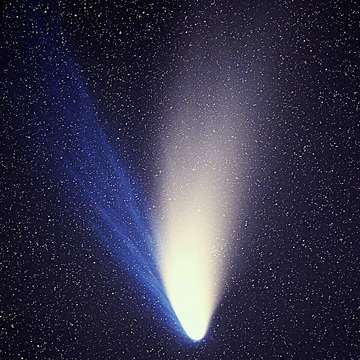
47P/Ashbrook–Jackson
A bright Jupiter-family comet discovered independently in 1948.

47P/Ashbrook–Jackson is a Jupiter-family comet that orbits the Sun once every 8.35 years. It holds the distinction of being the only comet discovered by Joseph Ashbrook, and the third and final one found by Cyril V. Jackson.
The comet was first detected on the night of 26 August 1948. Ashbrook noticed it on a photographic plate taken at Lowell Observatory, which was originally aimed at the asteroid 1327 Namaqua. At the time, it appeared as a diffuse, 12th-magnitude object with a tail roughly a degree long, situated in the constellation Aquarius. Just a few hours later, Cyril V. Jackson independently spotted it from the Yale-Columbia station in Johannesburg. Leland E. Cunningham calculated its orbit in 1948, and Michael P. Candy successfully recovered the comet in April 1955. Since then, Ashbrook–Jackson has been observed at every return, with sightings recorded as recently as 2025.
Despite having a large perihelion distance of 2.81 AU (about 420 million km), the comet typically reaches magnitude 12 on each observed apparition since its discovery. This makes it one of the intrinsically brightest short-period comets known. Its nucleus has an estimated effective radius of about 2.8 km (1.7 mi) and rotates once every 15.6 ± 0.1 hours.
Quick Facts
- Discoverer
- Joseph Ashbrook / Cyril V. Jackson
- Discovery Site
- Lowell Observatory, USA / Johannesburg, S. Africa
- Discovery Date
- 26 August 1948
- Mpc Name
- P/1948 Q1 / P/1955 H1ICQ1
- Designations
- 1948 IX, 1956 II · 1963 VI, 1971 III · 1978 XIV, 1986 II · 1993 XIII
- Orbit Ref
- jpldata · MPC
- Epoch
- 21 November 2025 (JD 2461000.5)
- Obs
- 4,142
- Perihelion
- 2.807 AU
- Aphelion
- 5.43 AU
- Semimajor
- 4.12 AU
- Period
- 8.35 years
Facts from the source article.
Lore & Background
The comet was first spotted by Joseph Ashbrook while examining a photographic plate exposed from the Lowell Observatory during observations of the asteroid 1327 Namaqua on the night of 26 August 1948. At the time it appeared as a diffuse, 12th-magnitude object with a tail about a degree in length, located within the constellation Aquarius. It was independently discovered by Cyril V. Jackson from the Yale-Columbia station at Johannesburg just a few hours later.
Orbital calculations by Leland E. Cunningham in 1948 led to the successful recovery of the comet by Michael P. Candy in April 1955. Since then, comet Ashbrook–Jackson has been observed on every apparition, with the most recent observations recorded as recently as 2025.
Despite a large perihelion distance of 2.81 AU (420 million km), the comet typically reaches magnitude 12 on each observed apparition since 1948, making it one of the intrinsically brightest short-period comets ever known. Its nucleus is estimated to have an effective radius of around 2.8 km (1.7 mi), rotating on its axis once every 15.6±0.1 hours.
Reader's Guide
47P/Ashbrook–Jackson holds significance as a consistently observable Jupiter-family comet that has been recovered at every apparition since its discovery, demonstrating reliable orbital predictability. Its intrinsic brightness, despite a relatively large perihelion distance of 2.81 AU, makes it stand out among short-period comets, as it typically reaches magnitude 12 even when far from the Sun. The comet's discovery story is notable for the independent detections by two astronomers within hours of each other, and for being the only comet found by Joseph Ashbrook and the final one by Cyril V. Jackson. The successful recovery in 1955 based on Cunningham's orbital calculations confirmed the comet's periodic nature, and continued observations through 2025 have provided a long baseline for studying its physical characteristics, including a nucleus radius of about 2.8 km and a rotation period of 15.6 hours. Its legacy lies in its consistent visibility and intrinsic brightness, making it a valuable object for long-term cometary studies.
Did You Know?
- 47P/Ashbrook–Jackson is the only comet discovered by Joseph Ashbrook.
- It was independently discovered by Cyril V. Jackson just a few hours after Ashbrook's sighting.
- The comet has a perihelion distance of 2.81 AU (420 million km) yet typically reaches magnitude 12.
- Its nucleus rotates once every 15.6±0.1 hours and has an effective radius of about 2.8 km.
More in Named Comets, Part 6 1-24
Spotted an error? Know more?
Reader corrections go straight into our review queue. Suggest an edit · How this site is sourced