Yamato Takeru
Semi-legendary prince and folk hero of ancient Japan.

Yamato Takeru (ヤマトタケルノミコト), originally Prince Ousu (小碓命), was a Japanese folk hero and semi-legendary prince of the imperial dynasty, son of Emperor Keikō, who is traditionally counted as the 12th Emperor of Japan. His story is told principally in the Japanese chronicles Kojiki (712) and Nihon Shoki (720), with details differing between the two books. He is known for his military exploits, use of the sacred sword Kusanagi, and his tragic death, and he is worshiped as Otori-sama (The Great Bird) at Otori shrines throughout Japan.
Quick Facts
- Consort
- Miyazu-hime
- Spouse
- Miyazu-hime, / Futaji Irihime, · Ototachibana-hime
- Issue
- Emperor Chūai
- Father
- Emperor Keikō
- Mother
- Harima no Inabi no Ōiratsume
Facts from the source article.
Lore & Background
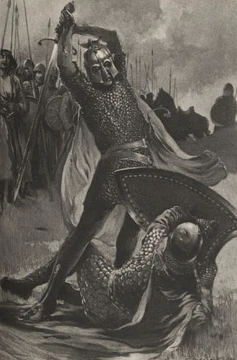
Yamato Takeru, originally Prince Ousu, slew his elder brother Ōusu (大碓命). His father, Emperor Keikō, fearing his brutal temperament, sent him to the land of Kumaso (today Kumamoto Prefecture) and then Izumo Province (today eastern Shimane Prefecture) to defeat rebels. In Kumaso, Takeru cross-dressed as a maid attendant at a drinking party to get close to his targets and slay them; one enemy praised him and gave him the title Yamato Takeru, meaning 'The Brave of Yamato.' In Izumo, he used trickery by exchanging swords with his enemy before a duel, receiving a wooden sword, and slaying him. He also defeated several deities, but Emperor Keikō's mind remained unchanged.
Keikō then sent Yamato Takeru to the eastern land to defeat rebels and savage deities. The prince met his aunt Princess Yamato-hime, the highest priestess of Amaterasu at Ise Grand Shrine, who lent him the holy sword Ame no Murakumo no tsurugi (Kusanagi no tsurugi). During his journey, his wife Ototachibana-hime sacrificed herself to soothe the sea god during a storm. He defeated many enemies, including a treacherous lord who tried to burn him alive in an open grassland; using the sword to control the wind, he turned the fire back on the lord and renamed the sword Kusanagi-no-Tsurugi ('Grass-Cutting Sword'). He also killed the deity of Ashigara pass and composed the first sedōka with a local man.
On his return, Yamato Takeru married Miyazu-hime and challenged the god of Mount Ibuki without his sword. The god cursed him with disease, and he fell ill and died. According to traditional sources, he died in the 43rd year of Emperor Keiko's reign, somewhere in Ise Province. His soul turned into a great white bird and flew away; his tomb in Ise is known as the Mausoleum of the White Plover.
Reader's Guide
Yamato Takeru is a central figure in Japanese mythology and early imperial legend, embodying the archetype of the heroic prince who overcomes enemies through cunning and divine aid. His story, preserved in the Kojiki and Nihon Shoki, reflects the consolidation of Yamato power and the integration of local deities into the imperial mythos. The sword Kusanagi, which he used and renamed, became one of the three Imperial Regalia of Japan, housed at Atsuta Shrine. His worship as Otori-sama (The Great Bird) persists in Otori shrines nationwide, with the annual Tori no Ichi festival held on a day of the Rooster, where worshippers pray for prosperity and vendors sell kumade charms. Anthropologist C. Scott Littleton has noted structural similarities between the Yamato Takeru legend and the King Arthur legend, proposing a common northeast Iranian ancestor, though this is disputed. The legend has also inspired numerous works in popular culture, including anime, video games, and novels, demonstrating its enduring resonance.
Did You Know?
- Yamato Takeru's name appears in the Nihon Shoki as 日本武尊 and in the Kojiki as 倭建命.
- One of his sons became Emperor Chūai according to the Kojiki, but the Nihon Shoki instead makes Chūai his brother—a key discrepancy between the two chronicles.
- He renamed the sword Kusanagi-no-Tsurugi after using it to cut grass and control wind to escape a fire trap.
- After his death, his soul turned into a great white bird, and his tomb is called the Mausoleum of the White Plover.
More in Mythological swordfighters 1-18
Spotted an error? Know more?
Reader corrections go straight into our review queue. Suggest an edit · How this site is sourced