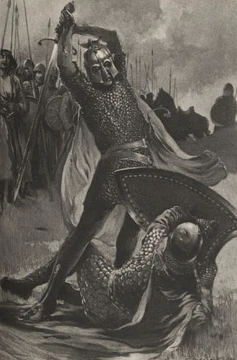
Gawain
Knight of the Round Table, son of Arthur's sister Morgause.

Gawain—pronounced GA(H)-wayn, -win, or gə-WAYN, with numerous spelling variations—is a Knight of the Round Table from the Arthurian legend cycle. His earliest known prototype appears in Welsh sources as Gwalchmei. Over time, he has featured in Arthurian tales written in Welsh, Latin, French, English, Scottish, Dutch, German, Spanish, and Italian. He is best known as the main character of the Middle English poem *Sir Gawain and the Green Knight*. Other stories centered on Gawain include *De Ortu Waluuanii*, *Diu Crône*, *Ywain and Gawain*, *Golagros and Gawane*, *Sir Gawain and the Carle of Carlisle*, *L'âtre périlleux*, *La Mule sans frein*, *La Vengeance Raguidel*, *Le Chevalier à l'épée*, *Le Livre d'Artus*, *The Awntyrs off Arthure*, *The Greene Knight*, and *The Weddynge of Syr Gawen and Dame Ragnell*.
Quick Facts
- Series
- Matter of Britain
- Based On
- Gwalchmei
- Title
- Sir, Prince, King
- Occupation
- Knight of the Round Table
- Weapon
- Caliburn, others
- Family
- Various members of King Arthur's family / Le Morte d'Arthur: Lot and Morgause (parents); Agravain, Gaheris, Gareth and Mordred (brothers)
- Spouse
- Ragnelle, Orguelleuse, Amurfina (in different stories)
- Significant Other
- Many
- Children
- Various, including Gingalain
- Relatives
- King Arthur (uncle)
- Religion
- Christian
- Origin
- Orkney and/or Lothian
Facts from the source article.
Lore & Background
In the Arthurian chivalric romances, Gawain is typically depicted as King Arthur's closest companion and an integral member of the Round Table. He is often the son of Arthur's sister, Morgause, and King Lot of Orkney and Lothian. His younger brothers (or half-brothers) are Agravain, Gaheris, Gareth, and the infamous Mordred, though his familial relations and upbringing vary. They often involve a story of Gawain unknowingly being raised in foster care in Rome before returning to Britain to reunite with his biological relatives. Of his many children from his numerous wives and lovers, Gingalain (the 'Fair Unknown') stands out as a popular Arthurian hero in his own right.
In the early Welsh texts, Gawain is portrayed as a formidable warrior who is courteous, compassionate, and fiercely loyal to both king and kin. He is known as a friend to young knights, a defender of the poor and unfortunate, and a rescuer of women. Variants on the Castle of Maidens often portray him as a 'Maidens' knight'. Other notable recurring motifs include his skills in healing, his weapons (including the famed sword Galatine), and his mighty warhorse Gringolet. In some later versions, such as Le Morte d'Arthur, his strength is tied to a day-and-night cycle, making him an invincible swordsman when at noon.
Gawain's prowess diminishes with the Vulgate Cycle, which elevates Lancelot. His character turns markedly ignoble in the Post-Vulgate Cycle and even outright villainous in the Prose Tristan. Le Morte d'Arthur further complicates his character by presenting him as a symbol of secular knighthood, a departure from his original piety and a major object of criticism from the authors of French prose cycles. Two important plotlines shed light on this redefined Gawain: his leading role in a familial blood feud against the clan of King Pellinore, and the deterioration of his close friendship with Sir Lancelot, which becomes a bitter rivalry when Gawain is consumed by vengeance. In this tradition, Gawain's sinful ways and unforgiving nature inadvertently lead to the fall of Arthur and the Round Table and, ultimately, his own death by Lancelot's hand.
Reader's Guide
Gawain is a central figure in the Arthurian legendary cycle, appearing in numerous works across multiple languages and centuries. His significance lies in his evolution from a courteous, compassionate warrior in early Welsh texts to a more complex, sometimes ignoble character in later French and English prose cycles. As the protagonist of the Middle English poem Sir Gawain and the Green Knight, he remains a key subject of literary study. His role as Arthur's closest companion and his involvement in the blood feud with King Pellinore and the rivalry with Lancelot are pivotal to the narrative of the Round Table's fall. The etymology of his name is debated, with most scholarship supporting a derivation from the Welsh Gwalchmei, though alternative origins have been proposed. His legacy includes his horse Gringolet, his healing skills, and his association with the Castle of Maidens. The character's portrayal varies widely, from a model of chivalry to a symbol of secular knighthood criticized by French prose authors.
Did You Know?
- Gawain's prototype appears under the name Gwalchmei in the earliest Welsh sources.
- His horse is named Gringolet in the works of medieval French authors.
- The meaning of the element 'mei' in Gwalchmei is uncertain; some scholars suggest 'Hawk of May' or 'Hawk of the Plain'.
A Name in Many Tongues
Gawain's name is one of the most linguistically layered in all of Arthurian legend. The character traces back to the Welsh Gwalchmei ap Gwyar, and from that root sprang a bewildering array of forms across medieval Europe: Galvaginus and Gualgunus in Latin, Gavain and Gauvain in Old French, Gâwein in Middle High German, Galván in Old Spanish, Galvão in Old Portuguese, and dozens of Middle English spellings such as Gawaine, Gawayn, and Wawen. The element Gwalch, meaning "hawk," is a common epithet in Welsh poetry, though scholars disagree on the full meaning. Kenneth Jackson proposed an early Common Brittonic *Ualcos Magesos, "Hawk of the Plain," while John T. Koch offered *Wolcos Magesos, "Wolf/Errant Warrior of the Plain." Rachel Bromwich dismissed the popular "Hawk of May" reading as unlikely. A minority view, championed by Roger Sherman Loomis, links the continental names to the epithet Gwallt Avwyn, "bright hair," found in Culhwch and Olwen. Lauran Toorians even argued the Dutch Walewein was the earliest form, carried into Wales by Flemish settlers around 1100. Most scholarship, however, traces the continental variants to a corruption of the Breton Walcmoei.
From Hero to Villain: A Shifting Character
One of the most striking aspects of Gawain's legend is how dramatically his character shifts depending on which tradition you read. In the earliest Welsh sources, Gwalchmei is a formidable warrior who is courteous, compassionate, and fiercely loyal to king and kin. He is a friend to young knights, a defender of the poor, a rescuer of women, and in Castle of Maidens variants, a "Maidens' knight." Recurring motifs include his healing skills, his famed sword Caliburn (also called Excalibur), and his mighty warhorse Gringolet. In some later versions his strength is tied to a day-and-night cycle, making him invincible at noon. But the Vulgate Cycle begins to diminish his standing by elevating Lancelot. The Post-Vulgate Cycle turns him markedly ignoble, and the Prose Tristan casts him as outright villainous. Le Morte d'Arthur complicates things further, recasting him as a symbol of secular knighthood rather than piety. In that tradition, his blood feud against King Pellinore's clan and his bitter rivalry with Lancelot, fueled by vengeance, lead to the fall of the Round Table and his own death at Lancelot's hand.
A Tangled Web of Kinship
Gawain's family tree is among the most tangled in Arthurian lore. In the chivalric romances, he is typically the son of King Arthur's sister Morgause and King Lot of Orkney and Lothian. His younger or half-brothers include Agravain, Gaheris, Gareth, and the infamous Mordred, though exact relationships and upbringing vary by text. A recurring thread has Gawain unknowingly raised in foster care in Rome before returning to Britain to reunite with his biological family. The Welsh tradition complicates matters further: Gwalchmei ap Gwyar suggests Gwyar, meaning "gore" or "spilled blood," is likely his mother, as is standard in the Welsh Triads. Gwyar appears as a daughter of Amlawdd Wledig in the genealogy Bonedd y Saint. The 14th-century Welsh text Birth of Arthur substitutes Gwyar for Anna and names his father Emyr Llydaw, the Emperor of Brittany, identified as Budic II. There, Gwalchmei is given three sisters: Gracia, Graeria, and Dioneta, the last a counterpart of Morgan. Among Gawain's own children from his numerous wives and lovers, Gingalain, the "Fair Unknown," stands out as a popular Arthurian hero in his own right.
A Hero Across Nine Languages
Gawain's footprint across medieval literature is extraordinary in both breadth and depth. He appears in Arthurian tales in Welsh, Latin, French, English, Scottish, Dutch, German, Spanish, and Italian, making him one of the most internationally disseminated figures in the entire legendary cycle. As a central protagonist, he anchors works as diverse as the Middle English poem Sir Gawain and the Green Knight, the Latin De Ortu Waluuanii, the Middle High German Diu Crône, the English Ywain and Gawain, Golagros and Gawane, Sir Gawain and the Carle of Carlisle, The Awntyrs off Arthure, The Greene Knight, and The Weddynge of Syr Gawen and Dame Ragnell. The French tradition contributed L'âtre périlleux, La Mule sans frein, La Vengeance Raguidel, Le Chevalier à l'épée, and Le Livre d'Artus. His popularity in Wales surged after foreign versions, particularly those derived from Geoffrey of Monmouth's Historia Regum Britanniae, became known there. Early Welsh references include the Welsh Triads, the Englynion y Beddau, which lists the site of his burial, and the Trioedd y Meirch.
Frequently Asked Questions
Who is Gawain?
Gawain is one of the most prominent Knights of the Round Table in the Arthurian legend cycle, consistently portrayed as a paragon of courtesy and chivalric virtue. He is King Arthur's nephew, the son of Arthur's sister Morgause, and appears in tales across Welsh, French, English, and several other literary traditions.
What is Gawain's most famous story?
His defining tale is the Middle English alliterative poem *Sir Gawain and the Green Knight*, in which he accepts a beheading challenge from a mysterious Green Knight and then endures a winter-long trial of his honesty and self-control at a lord's castle. The narrative is widely read as an exploration of the gap between idealized chivalry and human weakness.
Who are Gawain's parents?
Gawain is the son of Morgause, Arthur's full sister, which makes him Arthur's nephew. In most versions his father is Lot of Orkney, one of the subsidiary kings who swore fealty to Arthur.
What symbolizes Gawain in Arthurian legend?
The color green is his consistent emblem, appearing in his surcoat, his horse, and the dominion of the Green Knight across virtually every retelling. He is also frequently linked with the boar as a narrative and heraldic symbol of his hunting skill.
More in Mythological swordfighters 1-18
Spotted an error? Know more?
Reader corrections go straight into our review queue. Suggest an edit · How this site is sourced