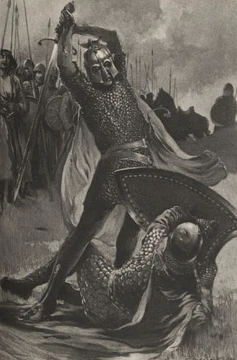
Diarmuid Ua Duibhne
Hero and demigod of the Fenian Cycle, lover of Gráinne.

Diarmuid Ua Duibhne (pronounced roughly "DEER-mid oo-a DIVE-nyuh"), also called Diarmuid of the Love Spot, is a hero and demigod from the Fenian Cycle of Irish mythology, a story cycle usually placed between the 2nd and 4th centuries. His father is Donn, son of Duibhne of the Fianna, and his mother is Cochrann, daughter of Cathaír Mór. He is raised as a foster son by Aengus Óg, a member of the Tuatha Dé Danann often associated with love. Diarmuid grows into a skilled warrior and a popular, valued member of the Fianna. He is most famous as the lover of Gráinne, who was meant to marry the Fianna leader Fionn mac Cumhaill, in the legend *The Pursuit of Diarmuid and Gráinne*. His sons include Donnchadh, Iollann, Ruchladh, and Ioruad. A modern folkloric invention later linked Diarmuid to the Scottish Clan Campbell, whose crest features a boar’s head—a reference to Diarmuid’s geis and death.
- Field
- Irish mythology, Fenian Cycle
- Nationality
- Irish
- Known for
- Lover of Gráinne; central figure in The Pursuit of Diarmuid and Gráinne
- Father
- Donn, son of Duibhne
- Mother
- Cochrann (also Cróchnat or Crochnuit)
- Foster father
- Aengus Óg
- Sons
- Donnchadh, Iollann, Ruchladh, Ioruad
Lore & Background
Diarmuid is a scion of the Fianna in both paternal and maternal lines. His father is Donn, son of Duibhne of the Fianna; his mother is Cochrann, daughter of Cathaír Mór. Diarmuid is taken in by Aengus Óg, one of the Tuatha Dé Danann and the god of love. He grows up to be a skilled warrior and a valued member of the Fianna.
Diarmuid is marked with the ball seirce, a magical love spot that makes him irresistible to any woman who lays eyes on him. He also has a geis and death associated with a boar, referenced on the Campbell crest. In the legend The Pursuit of Diarmuid and Gráinne, he elopes with Gráinne, leading to a long chase by Fionn mac Cumhaill.
Reader's Guide
Diarmuid Ua Duibhne is a central figure in the Fenian Cycle, embodying themes of love, loyalty, and tragic fate. His story, particularly the elopement with Gráinne, is one of the most famous in Irish mythology, illustrating the conflict between personal desire and social obligation. His death, tied to a geis involving a boar, is a classic example of the hero's unavoidable doom. Diarmuid is also significant as the legendary founder of the Scottish Clan Campbell, with the boar's head on the Campbell crest directly referencing his geis and death. His life and adventures, including his rescue of the King Under-Wave's daughter and his encounter with personifications of youth and death, highlight his role as a demigod who interacts with both the mortal and otherworldly realms. The ambiguity in the source regarding the existence of a god of love in the corpus reflects the complex nature of Irish mythological traditions.
Did You Know?
- Diarmuid is said to be the founder of the Scottish Clan Campbell.
- He was marked with a magical love spot called the ball seirce, making him irresistible to women.
- His death is tied to a geis involving a boar, referenced on the Campbell crest.
- He once saved Fionn and his band by single-handedly slaying over three thousand enemies.
Lineage and Divine Patronage
Diarmuid Ua Duibhne — whose name means 'Diarmuid, grandson of Duibne' — holds a singular place in Irish myth as a hero whose blood ties him to the Fianna through both parents. His father is named Donn (in some tellings, Corc), son of Duibhne of the Fianna, while his mother Cochrann, also called Crochnuit, is the daughter of Cathaír Mór and a close kinswoman of Fionn mac Cumhaill. This double Fianna heritage distinguishes him even within the band's ranks. Yet the figure who most shaped his childhood was not mortal. Around the time of his birth, his father was expelled from the Fianna over an unnamed quarrel, and the infant was taken under the wing of Aengus Óg, the Tuatha Dé Danann deity of love. Aengus raised the boy in his dwelling at Brú na Bóinne, effectively becoming his father. This extraordinary arrangement — a mortal hero nurtured by a god — underpins the demigod stature that later legends ascribe to him and sets his origin apart from every other warrior in the Fenian Cycle, traditionally set between the second and fourth centuries.
The Cursed Boar and the Ball Seirce
Two supernatural marks govern Diarmuid's adult existence: a lethal curse and an irresistible charm. The curse springs from a bitter domestic dispute. After his mother Crochnuit bore a child to the commoner Roc Diocain, Donn — resentful that the household at Brú na Bóinne gave the half-brother equal attention — murdered Aengus's own son Congus. Roc, denied immediate revenge by Aengus, later enlisted a druid to resurrect his dead child as a boar, binding the animal to hunt Diarmuid down and kill him. That boar would ultimately claim his life. The charm, by contrast, is a gift. Lost in the woods after a hunting trip, Diarmuid and his companions found a dwelling where an old man, a young girl, and a cat lived. After wrestling a wether — the embodiment of the world's strength, ultimately tamed by the cat, a personification of death — the men retired to sleep. The girl, who personified youth, turned away the other warriors but marked Diarmuid with the ball seirce, a magical love spot that made him irresistible to every woman who beheld him. This mark would ignite the most famous episode of his legend.
The Pursuit, His Heirs, and the Campbell Crest
Diarmuid's most enduring story is The Pursuit of Diarmuid and Gráinne, in which he elopes with Gráinne, the woman betrothed to Fionn mac Cumhaill, leader of the Fianna. The ball seirce that rendered him irresistible to women lies at the heart of this romance, and the couple's flight triggers a long, bitter chase by Fionn and his band. Their union produced several sons, including Donnchadh, Iollann, Ruchladh, and Ioruad, extending the hero's line into the next generation. Beyond the Irish mythological tradition, Diarmuid's influence reaches into Scottish clan history. He is traditionally credited as the founder of Clan Campbell, one of Scotland's most powerful families. The Campbell crest features a boar's head — a direct allusion to the cursed boar that, in the legend, brought about Diarmuid's death. This heraldic device thus compresses an entire mythological narrative into a single emblem, binding the Fenian Cycle's ancient setting to the medieval and modern Scottish aristocracy and testifying to how deeply this Irish hero was woven into the broader Gaelic cultural memory.
The Enchanted Lady and the Land-under-Waves
Among Diarmuid's most elaborate quests is the episode of the enchanted woman. On a snowy winter night she appears at the Fianna's lodge, described as wild and repulsive. Every man in the group turns her away except Diarmuid, who grants her shelter despite her appearance. By dawn she has become young and beautiful, and a grand new house has materialized on a nearby hill, fully provisioned with food and servants. She agrees to live with Diarmuid on one condition: he must never mention her former ugliness three times. The arrangement unravels when members of the Fianna coax the woman into surrendering three pups of Diarmuid's greyhound, one per day. Each time Diarmuid protests, he inadvertently recalls her ugly form. On the third mention, the woman and the house vanish and the greyhound dies. Carrying his dead dog, Diarmuid is borne by an enchanted ship to the otherworldly Land-under-Waves, where he learns the woman is the daughter of King Under-Wave, gravely ill after seven years under enchantment. Her cure demands three draughts from a cup held by the King of Magh an Ionganaidh. Diarmuid journeys to that faraway Plain of Wonder, slays the king's armies in prolonged combat, and — when the king recognizes him as a Fianna warrior fulfilling a prophecy — receives the cup willingly.
Frequently Asked Questions
Who is Diarmuid Ua Duibhne?
He is a hero and demigod from the Fenian Cycle of Irish mythology, a narrative tradition generally set between the second and fourth centuries. He is best remembered as Gráinne's lover and as a respected, popular fighter within the Fianna.
What is the 'Love Spot' on Diarmuid's face?
It is a mark on his cheek that tradition attributes to Aengus Óg, the Tuatha Dé Danann figure tied to love, who served as Diarmuid's foster father. The blemish made him irresistibly attractive to women and sets off the central conflict of his romance with Gráinne.
Why is Diarmuid Ua Duibhne important to Irish mythology?
He anchors 'The Pursuit of Diarmuid and Gráinne,' one of the Fenian Cycle's most celebrated tragic love narratives. His story dramatizes the clash between personal passion and the obligations of a warrior community, making him a defining figure of Irish myth.
More in Mythological swordfighters 1-18
Spotted an error? Know more?
Reader corrections go straight into our review queue. Suggest an edit · How this site is sourced