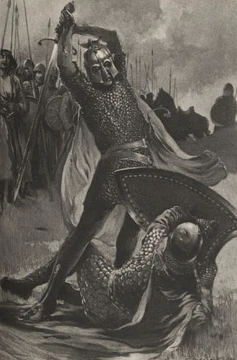
Sir Balin
Knight who drew a cursed sword and struck the Dolorous Stroke.

Sir Balin, also known as Balin the Savage and the Knight with the Two Swords, is a character in Arthurian legend, a late addition to the medieval Arthurian world. His story, as told by Thomas Malory in Le Morte d'Arthur, is based on the continuation of the second book of the Post-Vulgate cycle, the Suite du Merlin. A knight before the Round Table was formed, Balin lives only a few weeks after his release from King Arthur's prison and his slaying of a Lady of the Lake, ultimately dying when he and his brother Sir Balan kill each other in single combat.
- Also known as
- Balin the Savage, Knight with the Two Swords
- Source
- Thomas Malory's Le Morte d'Arthur, based on the Suite du Merlin
- Field
- Arthurian legend
- Known for
- Drawing the cursed sword, inflicting the Dolorous Stroke, killing his brother Balan
- Notable event
- Dolorous Stroke with the Holy Lance
Lore & Background
Balin is a poor knight from Northumberland who has been in King Arthur's prison for six months for killing a knight. Upon his release, a damsel from the lady Lile of Avalon arrives at court with a sword that only the most virtuous knight can draw. After many fail, Balin draws it easily, but the damsel warns him that if he does not return the sword, he will kill his greatest friend and cause his own destruction. Shortly after, the Lady of the Lake demands Balin's head from Arthur; Balin impetuously strikes off her head, claiming she caused his mother's death, and is banished from court. Merlin later explains the damsel was a false traitor and the sword bears a curse.
Reader's Guide
Sir Balin's significance lies in his role as a tragic, impetuous knight whose actions set the stage for the Post-Vulgate version of the Holy Grail quest. His drawing of the cursed sword and his refusal to return it lead to a chain of events culminating in the Dolorous Stroke—a wound inflicted with the Holy Lance that maims King Pellam and turns the Grail kingdom into the Wasteland. This stroke is a direct precursor to the Grail quest. Balin never joins the Round Table, dying before its founding, yet Merlin tells Arthur that had he lived, Balin would have been the best and bravest knight. His story highlights themes of fate, impetuosity, and tragic misunderstanding, as he unknowingly kills his own brother Balan in single combat, fulfilling the prophecy. The tale, preserved by Malory from the French Suite du Merlin, remains a key episode in Arthurian literature.
Did You Know?
- Balin is also known as the Knight with the Two Swords because he wears two swords after drawing the damsel's sword.
- Balin and his brother Balan kill each other in single combat, unaware of each other's identity.
- Merlin prophesied that because of the death of a damsel, Balin would strike the most Dolorous Stroke ever committed by man, except for the stroke that pierced Christ's side.
Literary Origins and Textual Lineage
Sir Balin occupies a peculiar position in Arthurian literature as a relatively late entrant to the medieval legend. His story finds its fullest expression in Thomas Malory's Le Morte d'Arthur, specifically within the lengthy passage called the Booke of Balyne le Saveage in Book II. Malory drew upon the Suite du Merlin, a continuation of the second volume of the French Post-Vulgate cycle, composed around the mid-thirteenth century. The original French text survives in just two fourteenth-century manuscripts, one held at the British Library and another at Cambridge University Library, in which the knight appears under the name Balaain le Sauvage, with his brother rendered as Balaan or Balaam. The English form Balin, sometimes spelled Balyn, and the epithet the Savage became standard through Malory's retelling. Despite his late arrival in the canon, Balin's narrative carries enormous weight, as his actions set in motion the entire Grail quest that defines the Post-Vulgate tradition.
The Cursed Sword and the Damsel's Deception
The pivotal event of Balin's brief life is the appearance of a mysterious damsel at Arthur's court bearing a sword hidden beneath her fur mantle. She declares that only the most virtuous knight can draw it from its scabbard. After Arthur and others fail, the recently freed prisoner Balin succeeds effortlessly, proving himself a man of integrity free from treachery. Yet the damsel's initial reluctance to let a prisoner attempt the trial, followed by her regret and warning, reveals the sword as a trap. Merlin later uncovers the truth: the damsel was a false traitor seeking vengeance for a slain lover, and with the aid of the lady Lily of Avalon, she had engineered the sword's curse so its bearer would kill his own brother. The weapon appears to draw on the Norse myth of Tyrfing, a blade that brings destruction to its wielder. Balin's refusal to return the sword seals his fate, and the damsel's prophecy that he will slay the person he loves most becomes the engine of his tragedy.
The Dolorous Stroke and the Grail's Shadow
Balin's most consequential act is not his death but the Dolorous Stroke he inflicts with the Holy Lance, the very spear that pierced Christ on the Cross. This single blow sets the stage for the Post-Vulgate version of the Grail search, making his brief, violent existence the catalyst for one of the most significant quests in all of Arthurian literature. His life spans only a few weeks after his release from Arthur's prison, yet within that span he slays a Lady of the Lake in a fit of rage over her demand for his head, kills the jealous Sir Lanceor of Ireland, and ultimately meets his brother Balan in a fatal duel. Merlin, speaking to Arthur, delivers a poignant assessment: had Balin lived, he would have been the finest and most courageous knight of the age. The irony is sharp, a man condemned by a cursed blade, driven by impetuosity, and cut down before the Round Table even exists, yet whose single stroke reshapes the entire mythological landscape.
A Knight Before the Table
Perhaps uniquely among the great knights associated with King Arthur, Balin never takes a seat at the Round Table, dying before that institution is established. He is a poor knight from Northumberland, imprisoned for six months over the death of a royal cousin, and his entire active life lasts mere weeks. Malory portrays him as fundamentally impetuous, his defining trait, despite his proven virtue. He strikes down the Lady of the Lake in the king's own court, crying out that she wanted his head so he would take hers, and justifies it by revealing she had his mother burned to death. Arthur, unimpressed, banishes him. Balin then leaves to battle King Rience alongside his brother Balan, both in Arthur's disfavour. Their mutual destruction in single combat, each unaware of the other's identity, fulfills the sword's curse and the damsel's prophecy. Balin's story is one of compressed tragedy: a man of genuine worth undone by a weapon he never chose, a curse he never understood, and a brotherhood he never recognized.
Frequently Asked Questions
Who is Sir Balin?
Sir Balin, nicknamed Balin the Savage or the Knight with the Two Swords, is a pre-Round Table knight in Arthurian legend whose tale appears in Thomas Malory's Le Morte d'Arthur, drawing on the earlier French Suite du Merlin.
What is the Dolorous Stroke?
The Dolorous Stroke is the legendary wound Balin inflicts upon the Holy Lance when he draws his cursed sword, a blow that is said to set in motion the eventual fall of King Arthur's realm.
Why is Sir Balin important in Arthurian legend?
His drawing of the cursed sword and the resulting Dolorous Strike plant the seed of doom for the entire Round Table cycle, making his brief life a pivotal turning point in the saga.
Where does Sir Balin's story originally come from?
The tale derives from the Suite du Merlin, a continuation of the second book of the Post-Vulgate cycle, and was later adapted into English by Thomas Malory in Le Morte d'Arthur.
More in Mythological swordfighters 1-18
Spotted an error? Know more?
Reader corrections go straight into our review queue. Suggest an edit · How this site is sourced