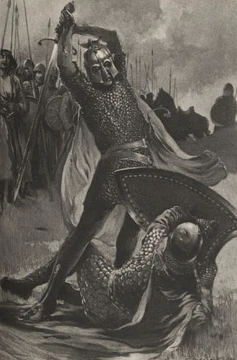
Fergus mac Róich
Irish hero and former king of Ulster betrayed by Conchobar.

Fergus mac Róich—whose name translates to "manliness, son of great stallion"—is a hero from the Ulster Cycle of Irish mythology. He once ruled Ulster but lost the throne through a trick orchestrated by Conchobar mac Nessa. After this betrayal, he sided with Queen Medb of Connacht, becoming both her ally and lover, and joined her campaign against Ulster in the Táin Bó Cúailnge. Fergus is consistently portrayed as enormous in size and exceptionally virile, a trait that repeatedly lands him in trouble, as seen in the tale Táin Bó Flidhais.
Fergus became king of Ulster after his predecessor, Eochaid Sálbuide, and the High King Fachtna Fáthach were killed at the Battle of Leitir Ruad. While ruling, he desired Ness, Eochaid Sálbuide’s daughter. She agreed to marry him only on one condition: that her son Conchobar would hold the kingship for a year, so her future grandchildren would be born to a king. The Ulster nobles assured Fergus the boy would be king in name alone, so he consented. But Conchobar, guided by his mother, governed so well that the nobles made him king permanently, displacing Fergus. Fergus stayed on as a loyal retainer and became foster-father to Conchobar’s eldest son, Cormac Cond Longas.
Later, Conchobar’s intended bride, Deirdre, ran off with the young warrior Naoise and his two brothers. After a period of wandering, they were found on an island off Scotland. Conchobar pretended to forgive them and sent Fergus, Cormac, Dubthach Dóeltenga, and Fergus’s son Fíachu to bring them home safely. Naoise and his brothers swore they would not eat until they dined with Conchobar at Emain Macha. But Conchobar ordered the Ulstermen to invite Fergus, Cormac, and Dubthach to feasts. Since refusing hospitality was shameful, Fergus was separated from his charges, leaving Fíachu to escort them alone. When they arrived, Éogan mac Durthacht—a former enemy of Conchobar who had recently made peace—murdered Fíachu, Naoise, and his brothers. Learning of this betrayal, Fergus, Cormac, and Dubthach burned Emain Macha and defected to Connacht with three thousand followers, entering the service of King Ailill mac Máta and Queen Medb. Conchobar forced Deirdre into marriage, and she later killed herself after he offered her to Éogan.
- Also known as
- Fergus mac Róigh
- Field
- Irish mythology, Ulster Cycle
- Nationality
- Irish
- Known for
- Former king of Ulster, ally and lover of Medb, role in Táin Bó Cúailnge
- Notable events
- Tricked out of kingship by Conchobar; exile to Connacht; death by spear thrown by Lugaid Dalleces
Lore & Background
Fergus becomes king of Ulster after his predecessor, Eochaid Sálbuide, is killed. While king, he desires Ness, who consents to marry him only if he allows her son Conchobar to be king for a year. The nobles reassure Fergus that the boy will be king in name only, so Fergus agrees, but Conchobar rules so wisely that the nobles make him king permanently. Fergus remains Conchobar's loyal retainer and becomes foster-father of Conchobar's eldest son Cormac Cond Longas.
After Conchobar's betrayal involving Deirdre and Naoise, Fergus, Cormac, and Dubthach burn Emain Macha and defect to Connacht with three thousand followers, entering the service of king Ailill mac Máta and queen Medb. In Táin Bó Flidhais, Flidais—already married to Ailill Finn—falls in love with Fergus from afar and begins an affair with him.
Reader's Guide
Fergus mac Róich is a central figure in the Ulster Cycle, embodying themes of betrayal, loyalty, and tragic downfall. His story illustrates the complex political and personal dynamics among the heroes of Irish mythology, particularly his role as a former king tricked out of his throne by Conchobar, which drives him into exile and alliance with Connacht. His immense size and sexual potency are recurring motifs, linking him to both martial prowess and vulnerability. His participation in the Táin Bó Cúailnge as a guide for Medb's army, while secretly aiding the Ulstermen, highlights his divided loyalties. His death, caused by Ailill's jealousy and a blind man's spear, underscores the tragic consequences of his relationships. The legend that his ghost later recounted the Táin to a poet's son emphasizes his enduring significance as a source of oral tradition. His descendants, including the Ciarraige and Conmhaicne, trace their ancestry to him, cementing his place in Irish genealogical lore.
Did You Know?
- Fergus mac Róich's name literally means 'manliness, son of great stallion'.
- He was tricked out of the kingship of Ulster when Ness's son Conchobar ruled so wisely that the nobles made him king permanently.
- After Conchobar's betrayal of Naoise and Deirdre, Fergus burned Emain Macha and defected to Connacht with three thousand followers.
- His death occurred when Ailill, jealous of Fergus swimming with Medb, persuaded his blind brother Lugaid Dalleces to throw a spear at what he said were deer, hitting Fergus in the chest.
Frequently Asked Questions
Who is Fergus mac Róich?
Fergus mac Róich is a major hero of the Irish Ulster Cycle, best known as a former king of Ulster who was deposed and later became a central warrior in the Táin Bó Cúailnge. His name is generally rendered as 'manliness, son of great stallion.'
What are Fergus mac Róich's defining traits?
He is consistently depicted as a man of extraordinary physical size and overwhelming virility, a combination that repeatedly gets him into comedic or dangerous situations, most famously in the tale Táin Bó Flidhais. His sheer strength makes him one of the most fearsome combatants in the Ulster Cycle.
Why is Fergus mac Róich important to the Ulster Cycle?
His betrayal and loss of the Ulster throne by Conchobar mac Nessa's scheming sets the political and personal stakes for the entire Táin Bó Cúailnge. As Medb's champion and lover, he is the primary engine of Connacht's war against Ulster.
What is Fergus mac Róich's relationship with Queen Medb?
After Conchobar tricked him out of his kingship, Fergus fled to Connacht where he became both Medb's trusted military ally and her lover. Their bond is the emotional and strategic core of her campaign to seize the Brown Bull of Ulster.
More in Mythological swordfighters 1-18
Spotted an error? Know more?
Reader corrections go straight into our review queue. Suggest an edit · How this site is sourced