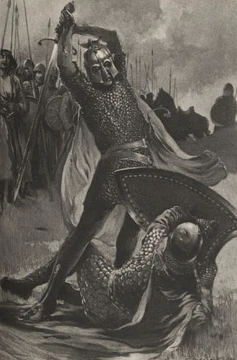
Conaire Mór
Legendary High King of Ireland bound by geasa, slain at Da Derga's Hostel.

Richard Webb · CC BY-SA 2.0
Conaire Mór (the great), son of Eterscél, was a High King of Ireland according to medieval Irish legend and historical tradition, active sometime during the 1st century BC or 1st century AD. He is a central figure in the Old Irish saga Togail Bruidne Dá Derga, which recounts his miraculous conception, his rise to kingship under a series of taboos (geasa), and his tragic death. His story is also recorded in the Lebor Gabála Érenn and other medieval sources.
Quick Facts
- Title
- High King of Ireland
- Reign
- 63–33 BC (Foras Feasa ar Éirinn)
- Predecessor
- Nuadu Necht
- Successor
- Lugaid Riab nDerg
- House
- Clanna Dedad
Facts from the source article.
Lore & Background
Conaire Mór was conceived when his mother, Mess Búachalla, was visited by Nemglan, who flew in through her skylight in the form of a bird. He was raised as the son of Eterscél. According to the Lebor Gabála Érenn, he succeeded Eterscél directly after a bull-feast: a bull was killed, a man ate its meat and drank its broth, and slept under incantations; the man saw a naked man coming to Tara with a stone in his sling. Meanwhile, Conaire, hunting birds, chased them into the sea, where they became armed men. Their leader, Nemglan, forbade him to hunt birds and told him to go naked to Tara to be made king, placing several geasa on his reign, including that he must not be preceded by three red men into the house of a red man. As he approached Tara, three kings met him with clothes, and he was made king.
Reader's Guide
Conaire Mór's significance lies in his role as the tragic hero of one of the finest Old Irish sagas, Togail Bruidne Dá Derga, which explores themes of fate, taboo, and the inevitable downfall of a king who breaks his geasa. His story is a key example of the Irish concept of geis (a sacred prohibition) and its power over a ruler's destiny. Historically, he is considered an ancestor of the Síl Conairi, a lineage that claimed descent from him in both Ireland and Scotland; the last Gaelic king of Scotland from this line was Alexander III of Scotland. The Lebor Gabála Érenn synchronises his reign with that of the Roman emperor Augustus and after the birth of Christ, while Geoffrey Keating's chronology dates his reign to 63–33 BC, and the Annals of the Four Masters to 110–40 BC. His legacy endures as a foundational figure in Irish legendary history and as a subject of scholarly study on early Irish literature and mythology.
Did You Know?
- He was made king after a bull-feast in which a sleeping man saw a naked man coming to Tara with a stone in his sling.
- His reign lasted either 30 or 70 years, depending on the source consulted.
- The last Gaelic king of Scotland from the line of Conaire Mór is generally considered to be Malcolm II or Alexander I, not Alexander III.
Divine Conception and Royal Bloodline
Conaire Mór's origins are steeped in the supernatural. His mother, Mess Búachalla, was of the royal house of Eochu Feidlech and Étaín, or alternatively of Eochu Airem and his daughter by Étaín. She was visited by Nemglan, who entered her skylight in the shape of a bird, and from this union Conaire was conceived. Though raised as the son of Eterscél, his true paternity was a matter of divine intervention rather than mortal union. Conaire belonged to the Clanna Dedad, the legendary royal family of the Érainn, tracing his descent through Íar mac Dedad. This lineage would prove consequential for generations, as his descendants in both Ireland and Scotland became known as the Síl Conairi, a dynasty whose reach extended across the Celtic world for centuries to come.
The Prophecy, the Geasa, and the Crowning
Conaire's path to the throne was sealed by a series of extraordinary events. Upon Eterscél's death, a bull-feast was held: a man ate his fill of the bull's meat, drank its broth, and slept while incantations were chanted over him. In his vision he saw a naked man approaching Tara with a stone in his sling. Meanwhile, young Conaire was hunting birds in his chariot and chased them into the sea, where they transformed into armed men — his father's bird troop, led by Nemglan. They forbade him from hunting birds and directed him to go naked to Tara to be crowned king. Nemglan also placed geasa upon his reign, including the prohibition against being preceded by three red men into the house of a red man. As Conaire neared Tara, three kings carried clothes to clothe him, and he was formally made High King of Ireland.
The Siege of Da Derga's Hostel
Conaire's reign, long and largely peaceful, ended in a catastrophe at Da Derga's Hostel. After already violating several of his geasa, he traveled south along the coast and was advised to lodge at the hostel. As he approached, three men in red on red horses arrived ahead of him, fulfilling the taboo Nemglan had set. The attackers were his three foster-brothers, sons of Dond Désa, whom he had exiled to Alba, now allied with the Briton king Ingcél Cáech and marauding across Ireland with a large band of followers. They besieged the hostel, three times attempting to burn it down, three times the flames were extinguished. Conaire, shielded by his champion Mac Cécht and the Ulster hero Conall Cernach, slew six hundred before reaching his weapons and another six hundred with them. When he begged for a drink, all the water had been spent on the fires. Mac Cécht rode across Ireland seeking a river that would yield water, returning just in time to see two men sever Conaire's head. He killed both, and the severed head drank the water and recited a poem praising Mac Cécht.
Chronology and Dynastic Legacy
Sources disagree on the length of Conaire's rule, giving either thirty or seventy years. The Lebor Gabála Érenn aligns his reign with the Roman emperor Augustus (27 BC to AD 14), placing him after the birth of Christ and making him contemporary with legendary provincial kings such as Conchobar mac Nessa, Cairbre Nia Fer, and Ailill mac Máta. Geoffrey Keating's Foras Feasa ar Éirinn dates his kingship to 63–33 BC, while the Annals of the Four Masters place it at 110–40 BC. Beyond chronology, Conaire's most enduring legacy is dynastic. As a descendant of Íar mac Dedad and a member of the Clanna Dedad, he fathered the Síl Conairi, a royal line that produced Gaelic kings in both Ireland and Scotland. The last Gaelic king of Scotland descended from Conaire Mór was Alexander III, a testament to the extraordinary longevity of his bloodline across the centuries.
Gallery
Frequently Asked Questions
Who is Conaire Mór?
Conaire Mór (meaning "the Great") was a legendary High King of Ireland from the Clanna Dedad dynasty, traditionally placed in the 1st century BC or AD. He is the protagonist of the Old Irish saga Togail Bruidne Dá Derga and also appears in the Lebor Gabála Érenn.
What are Conaire Mór's geasa and how do they shape his story?
Throughout his reign, Conaire was bound by a set of strict personal taboos (geasa) that governed his travel, behavior, and social interactions. The slow unraveling of these restrictions sets in motion the catastrophic final events of his saga.
Why is Conaire Mór significant in Irish legend?
As a named High King in the Lebor Gabála Érenn and an ancestor of the Síl Conairi line, he anchors a major dynastic thread in Irish tradition. His saga is also one of the key surviving Old Irish narrative texts, exploring the tension between a king's sacred obligations and his mortal vulnerability.
What is Conaire Mór's combat role in his saga?
While primarily a figure of kingship and taboo, his final confrontation at Da Derga's Hostel involves a violent siege and battle that destroys the stronghold. His death in that clash marks the end of a long reign, which sources variously place at thirty or seventy years.
More in Mythological swordfighters 1-18
Spotted an error? Know more?
Reader corrections go straight into our review queue. Suggest an edit · How this site is sourced