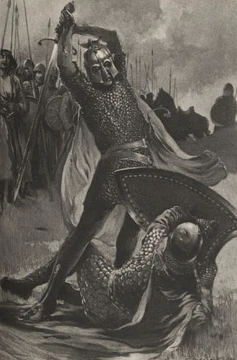
Beowulf (hero)
Legendary Geatish hero of the Old English epic.

Anonymous Unknown author · Public domain
Beowulf is a legendary Geatish hero and the central figure of the eponymous Old English epic poem, one of the oldest surviving pieces of English literature. He is known for his battles against the monster Grendel, Grendel's mother, and a dragon, and for his role as a king of the Geats.
Quick Facts
- Gender
- Male
- Occupation
- Warrior, Monarch
- Nationality
- Geatish
- Family
- Ecgtheow (father), / Hrethel (maternal grandfather), / Hygelac (maternal uncle, fl. 515)
Facts from the source article.
Lore & Background
Beowulf belonged to the people of the Wederas, a clan of the Geats. He was the son of Ecgþeow, a warrior of the Swedish Wægmundings who had slain Heaðolaf of the Wulfings and was banished. Ecgþeow married the daughter of the Geatish king Hreðel, and Beowulf grew up among the Geats. In his youth, he engaged in a swimming or rowing contest with Breca the Bronding, and the poet notes he was considered slothful or even cowardly as a youth.
Beowulf sailed to the Danes with fourteen warriors to aid King Hroðgar, whose hall Heorot was terrorized by Grendel. Beowulf fought Grendel with his bare hands, tearing off the beast's arm. Grendel fled to die in his bog. The next night, Grendel's mother arrived to avenge her son; Beowulf descended into the bog and killed her with an enchanted giant sword. After returning to Geatland, he took part in a raid against the Franks with King Hygelac, who died in the raid. Beowulf declined the throne in favor of the young prince Heardred, but after Heardred was killed in a Swedish invasion, Beowulf became king and later helped Eadgils gain the Swedish throne.
Beowulf ruled the Geats for 50 years until a dragon terrorized his realm after a thief stole a golden cup. Beowulf pursued the dragon to its lair at Hronessnæs, accompanied only by his young Swedish relative Wiglaf. Beowulf's sword broke, but with Wiglaf's aid he killed the dragon with his dagger. Mortally wounded by the dragon's poisonous bite, Beowulf named Wiglaf his heir. His body was burned on a funeral pyre and his ashes buried in a barrow by the sea.
Reader's Guide
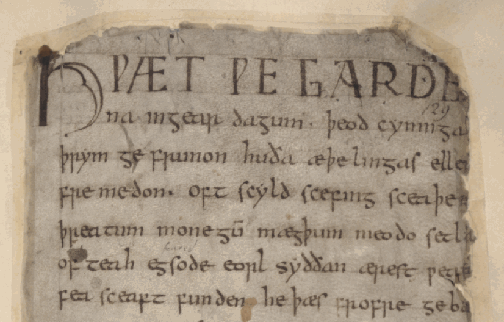
Beowulf is the central figure of the Old English epic poem that bears his name, one of the oldest surviving pieces of English literature. The poem's hero embodies the ideals of the warrior-king, facing supernatural foes and ultimately dying in defense of his people. The etymology of his name is debated: Henry Sweet proposed it means 'bee-wolf' or 'bee-hunter,' a kenning for 'bear'; Walter William Skeat suggested it derives from a term for 'woodpecker'; and editors of Bosworth's dictionary proposed it is a variant of 'beado-wulf' meaning 'war wolf.' Frederick Klaeber saw Beowulf as a continuation of the mythological figure Beow, a god associated with harvest and agriculture, with the fights against Grendel and the dragon representing seasonal struggles. Leonard Neidorf argued that the name Beowulf existed in heroic-legendary cycles before the poem was composed, based on a seventh-century usage of the name 'Biuuulf.' The poem's final word, 'lof-geornest' ('keenest to seek fame'), is two-edged, suggesting that while seeking fame is no shame for a hero, it may be possible to be too eager for it. Beowulf's legacy endures as a foundational work of English literature, shaping modern fantasy and heroic archetypes.
Did You Know?
- The name Beowulf may mean 'bee-wolf' or 'bee-hunter,' a kenning for 'bear,' according to philologist Henry Sweet.
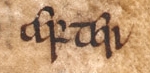
- The 1031 AD Liber Vitae records the name Biuuuwulf as belonging to a monk from Durham, also explained as meaning bee-wolf.
- Beowulf was considered slothful or even cowardly as a youth, according to the poem.
The Name and Its Many Roots
The name Bēowulf has generated centuries of scholarly debate. Henry Sweet, a Germanic philologist, argued it translates to "bee-wolf" or "bee-hunter," serving as a kenning for bear. This reading finds support in the 1031 Liber Vitae, which records a Durham monk named Biuuuwulf, and in the Domesday Book's entry for a man called Beulf. Walter William Skeat offered a different path, linking the name to Old Dutch biewolf, a term for the black woodpecker common in Norway and Sweden. He suggested the bird's fierce, fight-to-the-death temperament may have inspired the naming, though this theory ran afoul of Grimm's law and Skeat may have later recanted. Bosworth's dictionary editors proposed the name as a variant of beado-wulf, "war wolf," cognate with the Icelandic Bodulfr. Gregor Sarrazin theorized it was a mistranslation of the Norse Böðvarr, with -varr misread as vargr (wolf), while Sophus Bugge flipped the relationship, arguing Böðvarr Bjarki actually derived from Beowulf. Frederick Klaeber went further, seeing the hero as an outgrowth of the older mythological figure Beow, a harvest deity, with the Grendel fight encoding the spring struggle against the sea and the dragon battle serving as its autumnal echo.
The Monster in the Mead Hall
When the Danish court of King Hroðgar and his queen Wealhþeow was plagued by the monstrous Grendel, Beowulf departed Geatland with fourteen warriors to settle his father's debt. That first night, Grendel burst in, devoured one of the Geatish men, and seized Beowulf. Because no forged blade could pierce the creature, Beowulf wrestled it with his bare hands and ripped off its arm. Grendel crawled back to its bog to die, and the severed limb was mounted on the wall of Heorot. The following morning, a scop sang of the victory, drawing a parallel between Beowulf and the hero Sigmund. But the respite was brief. Grendel's mother came that next night to avenge her son and claim weregild, and because Beowulf was sleeping in a separate building, he could not intercept her. He resolved to descend into the bog and found her beside her son's corpse. There, with the help of an enchanted giant sword he seized from a plundered wooden chest in her lair, he finally killed her.
Fifty Years on the Throne
After returning to Geatland, Beowulf joined his king Hygelac on a raid against the Franks, an event likely rooted in genuine history. When Hygelac fell, Beowulf swam home in full armour. Queen Hygd then offered him the throne, but he deferred to the young prince Heardred. Heardred's reign was cut short when he sheltered two Swedish princes, Eadgils and Eanmund, who had fled their usurping uncle Onela. The resulting Swedish invasion killed Heardred, and Onela himself proclaimed Beowulf king. Beowulf then set about avenging his predecessor and restoring Eadgils to the Swedish throne. The slaying of Onela, though only briefly mentioned in the poem, appears extensively in Scandinavian sources as the Battle on the Ice of Lake Vänern, where Snorri Sturluson records Onela dying on his horse Raven and Eadgils claiming his helmet, Battle-boar. Beowulf then ruled the Geats for fifty years, until a thief stole a golden cup from a fire-breathing dragon's hoard, drawing the beast's wrath upon the kingdom. He pursued the monster into its lair at Hronessnæs, but only his young Swedish relative Wiglaf dared join him. Beowulf's sword broke, but Wiglaf managed to wound the dragon.
The Man Before the Myth
Beowulf belonged to the Wederas, a clan within the broader Geatish people. His father, Ecgþeow, was a warrior of the Swedish Wægmundings who had killed a man of the Wulfing clan. Unable to remain among his own people, Ecgþeow sought refuge with the Danish king Hroðgar, who paid the weregild and received oaths of loyalty. Ecgþeow then entered the service of the Geatish king Hreðel, married his daughter, and fathered Beowulf, who was raised among the Geats. In his youth, Beowulf engaged Breca the Bronding in a swimming or rowing contest whose outcome the poem leaves deliberately ambiguous. Yet the poet later remarks, in the second half of the epic, that Beowulf was regarded as slothful or even cowardly in his younger days. Leonard Neidorf has argued that the seventh-century attestation of the name Biuuulf, containing the element Beow which was no longer productive in contemporary naming, suggests that legends about this hero circulated well before the poem we possess was composed.
Gallery

Frequently Asked Questions
Who is Beowulf (hero)?
Beowulf is a Geatish warrior and later king who serves as the protagonist of the Old English epic poem bearing his name. He is celebrated for taking on three monstrous foes—Grendel, Grendel's mother, and a dragon—across the span of his life.
What are Beowulf (hero)'s powers and role?
The poem attributes to him extraordinary physical strength, allowing him to tear off Grendel's arm with bare hands and overpower the dragon in his final battle. Beyond combat, he rises to the Geatish throne and governs his people for fifty years, embodying the ideal of a warrior-king.
Why is Beowulf (hero) important to fans and scholars?
The poem is one of the oldest surviving works written in English, making Beowulf a foundational figure in Anglo-Saxon literature. His narrative has shaped how later generations imagine heroic swordfighters, monster-slaying quests, and the bittersweet arc of a warrior-king.
What weapons does Beowulf (hero) use in his swordfights?
Against Grendel's mother he wields a borrowed blade called Hrunting, and in the dragon fight he cuts the beast's neck with a giant sword he discovers in the monster's barrow. Notably, his most famous encounter—against Grendel itself—he fights entirely unarmed, relying on his bare hands.
More in Mythological swordfighters 1-18
Spotted an error? Know more?
Reader corrections go straight into our review queue. Suggest an edit · How this site is sourced