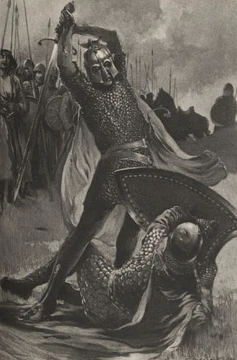
Rhydderch Hael
Ruler of Alt Clut, famed in Welsh and Latin tradition.

Rhydderch Hael (English: Rhydderch the Generous), also known as Riderch I of Alt Clut or Rhydderch of Strathclyde, was a ruler of Alt Clut, a Brittonic kingdom in the Hen Ogledd (the 'Old North') of Britain. He flourished from around 580 to approximately 614 and is one of the most famous kings in the Hen Ogledd, appearing frequently in later medieval works in Welsh and Latin.
- Also known as
- Riderch I of Alt Clut, Rhydderch of Strathclyde, Redrath
- Floruit
- 580 – c. 614
- Field
- Ruler of Alt Clut
- Nationality
- Brittonic (Hen Ogledd)
- Known for
- Appearing in Adomnán's Vita Sancti Columbae, the Historia Brittonum, Welsh Triads, and as owner of the magical sword Dyrnwyn
Lore & Background
Rhydderch appears in Adomnán's Vita Sancti Columbae, written around 700 AD, where he sends a secret message to Saint Columba asking him to prophesy the method of his death. The king is concerned he might die by an enemy's hand, but the saint tells him he will die at home in his bed. The description of his death is assumed to be accurate, as Adomnán was writing when Rhydderch's life was probably still well known.
In the 9th-century Historia Brittonum, Rhydderch is one of four Brythonic kings (along with Urien, Gwallog, and Morcant) named as fighting against Hussa of Bernicia. This is often interpreted as an alliance of Northern Brythonic kings, though it is not explicitly stated that they fought together. If they did, Rhydderch may have been present at the siege of Ynys Metcaut (Lindisfarne), where Urien was assassinated by Morcant. Later Welsh Triads, rather than any early source like the Annals Cambriae, link Rhydderch to the Battle of Arfderydd (dated 573 by the Annals), but the Annals themselves do not name him among the combatants.
In the Life of Saint Kentigern, Rhydderch is the royal patron of the saint, tied to the founding of Glasgow. One miracle involves saving Rhydderch's adulterous Queen Languoreth by rediscovering her lost ring. The coat of arms of Glasgow features a salmon with a ring in its mouth in reference to this story. Rhydderch also appears in several Welsh Triads and is the owner of one of the Thirteen Treasures of the Island of Britain: a magical sword called Dyrnwyn (white-hilt), which burst into flame when drawn by a well-born man.
Reader's Guide
Rhydderch Hael holds a significant place in the historical and legendary traditions of the Hen Ogledd. His appearance in Adomnán's Vita Sancti Columbae provides one of the earliest semi-historical references to a northern British king, and the prophecy of his peaceful death is considered reliable due to Adomnán's proximity to the events. The Historia Brittonum places him among a coalition of Brythonic kings opposing the Anglo-Saxon kingdom of Bernicia, suggesting his political importance in the late 6th century. The Battle of Arfderydd, possibly led by Rhydderch, is a key event in early British history, though details remain uncertain. Later medieval sources, including the Life of Saint Kentigern and the Welsh Triads, transformed Rhydderch into a legendary figure, associating him with the founding of Glasgow and the magical sword Dyrnwyn. His epithet 'Hael' (the Generous) is explained in the Triads through the sword's peculiar property: though it would grant any request, its fiery nature caused everyone to reject it, thus earning him his reputation for generosity. Rhydderch's legacy bridges historical record and myth, making him a central figure in the memory of the Old North.
Did You Know?
- Rhydderch sent a secret message to Saint Columba asking how he would die; the saint prophesied he would die in his bed.
- He is one of four Brythonic kings named in the Historia Brittonum as fighting against Hussa of Bernicia.
- The coat of arms of Glasgow features a salmon with a ring in its mouth, referencing a miracle in the Life of Saint Kentigern involving Rhydderch's queen.
Sovereign of the Old North
Rhydderch Hael, rendered in English as Rhydderch the Generous, ruled Alt Clut, a Brittonic kingdom situated in the Hen Ogledd or Old North of Britain. Active from roughly 580 until his death around 614, he is also known as Riderch I of Alt Clut, Rhydderch of Strathclyde, or by the name Redrath. His standing in the historical and literary record is extraordinary: he ranks among the most celebrated kings of the Hen Ogledd, an era when the northern Brittonic polities existed in a tense, shifting relationship with the expanding Anglo-Saxon kingdoms. His epithet 'Hael,' meaning generous, was so central to his identity that later Welsh tradition attempted to explain its origin through a specific narrative involving his legendary sword. Rhydderch's name recurs across multiple medieval Welsh and Latin texts spanning several centuries, indicating that his reputation endured long after his lifetime and that he occupied a foundational place in the collective memory of the northern Britons.
The Prophecy of St Columba
One of the most striking accounts of Rhydderch's life comes from Adomnán's Vita Sancti Columbae, composed around 700 AD. In this hagiographical text, the king is depicted sending a clandestine message to the great Irish saint, asking him to foretell the manner of his own death. Rhydderch's anxiety is palpable: he fears he will fall by the blade of one of his enemies. Columba, however, assures him that his end will come peacefully, in his own bed at home. Scholars generally regard this description of his death as historically reliable. Adomnán was writing at a time when Rhydderch's life was still within living memory, and it would have been unlikely for the hagiographer to attribute a fabricated prophecy to a saint of such stature. The episode reveals a king who, despite his martial reputation and political power, felt vulnerable enough to seek spiritual counsel in secret, and it provides a rare, intimate glimpse into the personal concerns of a sixth-century northern Brittonic ruler.
Wars and Alliances of the North
Rhydderch's military career is glimpsed through several later sources, each offering a fragment of a larger picture. In the ninth-century Historia Brittonum, he is named alongside Urien, Gwallog, and Morcant as Brythonic kings who fought against Hussa of Bernicia. While the text does not explicitly confirm they acted as a unified alliance, the grouping strongly suggests a coalition of northern Brittonic rulers resisting Anglo-Saxon expansion. If they did campaign together, Rhydderch may have been present at the siege of Ynys Metcaut, the Island of Lindisfarne, where Urien was treacherously killed by Morcant. The Annals Cambriae, in its earliest surviving twelfth-century copy of a presumed tenth-century original, dates the Battle of Arfderydd to 573 and may identify Rhydderch as the leader of the victorious force, though the combatants are not named in that manuscript. The thirteenth-century Black Book of Chirk preserves a tale of a military expedition by Clydno Eidyn and the Tri Hael—Rhydderch, Nudd Hael, and Mordaf Hael—to Gwynedd to avenge Elidir Mwynfawr, a story whose historical credibility is widely questioned.
Legend, Hagiography, and the Sword of Flame
Rhydderch's afterlife in the literary imagination is as rich as his historical footprint. In the Life of Saint Kentigern, he serves as the royal patron of the saint, tying his name to the very founding of Glasgow. A celebrated miracle in that text involves the saint saving Rhydderch's adulterous queen, Languoreth, from the king's wrath by recovering her lost ring from the mouth of a salmon, thereby proving her innocence. This episode is so embedded in Glasgow's identity that the city's coat of arms still features a salmon bearing a ring in its mouth. In Welsh mythological tradition, Rhydderch appears across multiple Triads, pointing to a once-widespread body of stories now largely lost. He is credited as the owner of Dyrnwyn, the white-hilted sword, one of the Thirteen Treasures of the Island of Britain. The Triads explain his epithet 'Hael' through this weapon: when a well-born man drew it, it blazed with flame from hilt to tip, and anyone who requested it would receive it—yet everyone rejected it because of its peculiar nature, making Rhydderch appear endlessly generous.
Frequently Asked Questions
Who is Rhydderch Hael?
Rhydderch Hael, meaning 'Rhydderch the Generous,' was a Brittonic king of Alt Clut (also called Strathclyde) in the Hen Ogledd, the Old North of Britain. He ruled roughly between 580 and 614 and became one of the most celebrated monarchs of that region in later Welsh and Latin literature.
What sword is associated with Rhydderch Hael?
He is traditionally identified as the owner of Dyrnwyn, a magical blade that features in Welsh legend. In the broader swordfighter canon, Dyrnwyn is the weapon most closely tied to his name, setting him apart among the Hen Ogledd's warrior-kings.
Which medieval texts mention Rhydderch Hael?
He surfaces in Adomnán's Vita Sancti Columbae, the Historia Brittonum, and the Welsh Triads, among other works. His repeated appearance across both Latin and Welsh traditions made him one of the best-attested kings of the Old North.
What does the epithet 'Hael' tell us about Rhydderch?
'Hael' translates to 'generous' or 'liberal,' pointing to a reputation for lavish hospitality and the free distribution of gifts. Within the warrior culture of the Hen Ogledd, that epithet marked him as a king who embodied the ideal of the magnanimous lord.
More in Mythological swordfighters 1-18
Spotted an error? Know more?
Reader corrections go straight into our review queue. Suggest an edit · How this site is sourced