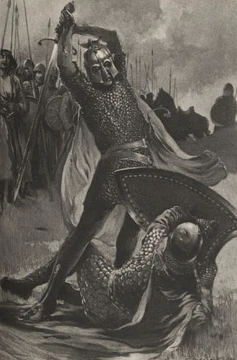
Caílte mac Rónáin
Close relative of Fionn, swift warrior and storyteller of the Fianna.

Caílte mac Rónáin (modern Irish: Caoilte) was a close relative of Fionn mac Cumhaill—often described as his son-in-law—and a warrior of the fianna in the Fenian Cycle of Irish mythology. He was known for his extraordinary speed, his ability to talk with animals, and his skill as a storyteller; several poems in the Fenian Cycle are credited to him. In the Middle Irish tale *Finn and Gráinne*, his lineage is given as the son of Oisgen or Conscen, who was the son of the Smith of Múscraige Dobrut, and himself a son of Cumall’s daughter.
Along with Oisín, Caílte is one of the few members of the fianna to survive the Battle of Gabhra, as recorded in *Cath Gabhra* (though other survivors are sometimes mentioned). Both appear as central figures in *Acallam na Senórach* (The Colloquy of the Ancients), where they live on into Christian times and tell stories of the fianna to Saint Patrick.
In another tale, the hero Cas Corach killed three werewolf-like creatures—the daughters of Airitech—who emerged from the Cave of Cruachan each Samhain to destroy sheep. Because the she-wolves loved music, Cas Corach played a harp to attract and distract them, persuading them to take human form, while Caílte assisted by throwing a spear that pierced all three, killing them.
Caílte loved Scathniamh, daughter of the god Bodb Dearg (son of the Dagda). The two were forced to part and never met again until Caílte was old and withered, one of the last survivors of the fianna.
The poem “The Hosting of the Sidhe” by W.B. Yeats characterizes Caílte.
- Field
- Irish mythology
- Nationality
- Irish
- Known for
- Remarkable speed, communication with animals, storytelling, surviving the Battle of Gabhra
Lore & Background
Caílte mac Rónáin was a close relative of Fionn mac Cumhaill—often described as his son-in-law—and a member of the fianna. In the short Middle Irish tale Finn and Gráinne, his ancestry is given as 'son of Oisgen or Conscen, the son of the Smith of Múscraige Dobrut; a son he of Cumall's daughter.' He is described as being able to run at remarkable speed and communicate with animals, and was a great storyteller. Some poems of the Fenian Cycle are attributed to Caílte.
According to Cath Gabhra (The Battle of Gabhra), Caílte and Oisín are among the few members of the Fianna to survive that final battle (though other survivors are sometimes mentioned). They are both central figures in the tale Acallam na Senórach (Colloquy of the Ancients), in which they survive into Christian times and recount tales of the Fianna to a recently arrived Saint Patrick. In Irish mythology, Cas Corach was a hero who killed three werewolf-like creatures, the daughters of Airitech who would come out of the Cave of Cruachan every year around Samhain and destroy sheep. The she-wolves liked music, so he aided in their slaying by playing a harp to attract and distract them and by persuading them to change to human form, while Caoilte assisted by casting a spear that penetrated all three, thereby killing them.
The 'Bodb Dearg', a god in Fianna time who is the son of the Dagda had a daughter called Scathniamh. She and Cailte loved each other. But they were forced to part from one another, and they never met again till the time Caoilte was old and withered, and one of the last that was left of the Fianna.
Reader's Guide
Caílte mac Rónáin is a significant figure in the Fenian Cycle of Irish mythology, primarily known as a nephew of the legendary hero Fionn mac Cumhaill and a member of the fianna. His importance lies in his role as a survivor: according to Cath Gabhra, he and Oisín are the only members of the Fianna to survive that final battle. This survival allows him to serve as a bridge between the pagan heroic age and the Christian era, as depicted in Acallam na Senórach, where he recounts the tales of the Fianna to Saint Patrick. His attributes—remarkable speed, ability to communicate with animals, and skill as a storyteller—distinguish him among the fianna. The attribution of some Fenian Cycle poems to Caílte further underscores his literary legacy. His adventures, such as slaying the werewolf-like daughters of Airitech with the aid of Cas Corach, and his tragic love for Scathniamh, daughter of the god Bodb Dearg, add depth to his character. The sword Cruadh-Chosgarach, the Hard Destroying One, is associated with him. Caílte's characterization also appears in the poem by W.B. Yeats, 'The Hosting of the Sidhe,' indicating his enduring cultural resonance.
Warrior, Runner, and Keeper of Stories
Caílte mac Rónáin (Modern Irish: Caoilte) occupied a distinctive place within the Fianna as a nephew of Fionn mac Cumhaill. His physical gifts set him apart: he could run at extraordinary speed and possessed the rare ability to communicate with animals, traits that made him a unique figure among the warrior band. Beyond his martial prowess, Caílte was renowned as a great storyteller, and several poems of the Fenian Cycle are attributed to him, suggesting his voice carried weight in the oral tradition. His weapon of choice was the sword Cruadh-Chosgarach, the Hard Destroying One, a name that hints at the brutal efficiency expected of a Fianna blade. His lineage, as recorded in the Middle Irish tale Finn and Gráinne, traces him to Oisgen (or Conscen), son of the Smith of Múscraige Dobrut, and to Cumall's daughter, grounding this mythic figure in a specific genealogical framework. His characterization also extends into later literary tradition, with W.B. Yeats giving him a role in the poem "The Hosting of the Sidhe."
The Last of the Fianna
The Battle of Gabhra stands as the defining cataclysm of the Fenian Cycle, and Caílte's role in its aftermath is perhaps his most significant narrative contribution. According to Cath Gabhra, he and Oisín alone survived that final devastating engagement, leaving the rest of the Fianna dead. This singular survival elevated both men into a kind of mythic witness, the last living threads connecting the ancient warrior world to the era that followed. Their story reaches its fullest expression in Acallam na Senórach, the Colloquy of the Ancients, in which the two aging survivors carry their memories into Christian times. There they encounter the recently arrived Saint Patrick and, in a remarkable act of cultural transmission, recount the deeds and legends of the Fianna to him. Caílte thus functions not merely as a warrior but as a living archive, a bridge between the pre-Christian heroic age and the Christian present, ensuring that the stories of the band he once belonged to were not lost to the passage of centuries.
The Slaying at Cruachan
One of the most vivid episodes associated with Caílte involves the slaying of three monstrous creatures at Cruachan. The daughters of Airitech, described as werewolf-like beings, emerged each year around the time of Samhain from the Cave of Cruachan to ravage and destroy flocks of sheep. Caílte enlisted the aid of the hero Cas Corach, whose strategy turned on the creatures' fondness for music. Cas played his harp to draw the she-wolves out and hold their attention, then persuaded them to shed their wolf forms and assume human shape. In that moment of vulnerability, Caílte hurled a spear that pierced all three bodies in a single strike, killing them outright. The episode blends elements of seasonal folklore, musical enchantment, and martial precision, and it positions Caílte as the decisive striker while Cas Corach provides the cunning and the lure. The annual Samhain timing ties the tale to the liminal boundary between worlds, a period when the veil between the human and the monstrous grows thin.
A Love Deferred by Centuries
Caílte's personal life is shadowed by a love story of extraordinary duration. Scathniamh, daughter of Bodb Dearg—a god of the Fianna era and son of the Dagda—shared a deep mutual affection with him. Yet circumstances tore them apart, and they were forced into separation. The cruelty of the tale lies in its timescale: they did not meet again until Caílte was old, withered, and among the very last remnants of the once-great Fianna. By the time their paths crossed once more, the years between their parting and reunion had consumed an entire epoch. The story carries a poignant weight, as their love is framed not by a single dramatic obstacle but by the slow, relentless passage of time itself. It also deepens Caílte's role as a survivor and witness; his enduring grief for Scathniamh becomes part of the emotional landscape he carries into his final days, making his eventual recounting of Fianna tales to Saint Patrick all the more charged with personal loss.
Frequently Asked Questions
Who is Caílte mac Rónáin?
Caílte mac Rónáin (Caoilte in modern Irish) is a swift warrior of the Fianna featured throughout the Fenian Cycle of Irish mythology. He is most commonly identified as Fionn mac Cumhaill's son-in-law and one of the hero's most loyal companions.
What are Caílte mac Rónáin's special abilities?
He is celebrated for his extraordinary speed in battle and his unique gift of conversing with animals. Beyond the sword, he is remembered as a gifted storyteller, with several Fenian Cycle poems attributed to his authorship.
What is Caílte mac Rónáin's lineage and connection to Fionn?
The Middle Irish tale Finn and Gráinne traces his parentage back through Cumall's daughter, making him a close kinsman of Fionn rather than a mere retainer. He is typically called Fionn's son-in-law and stands out as one of the very few Fianna to survive the Battle of Gabhra.
Why is Caílte mac Rónáin important in Irish mythology?
He functions as a narrative anchor for the Fenian Cycle, since multiple poems within it credit him as their composer. His blend of swordsmanship, animal-speech, and poetic voice sets him apart as a distinctive figure among the swordfighters of Irish legend.
More in Mythological swordfighters 1-18
Spotted an error? Know more?
Reader corrections go straight into our review queue. Suggest an edit · How this site is sourced