Oscar (Irish mythology)
Son of Oisín, grandson of Fionn, warrior of the Fianna.

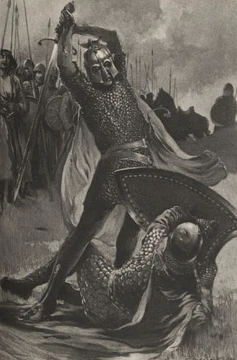
Anna1962 · CC BY-SA 4.0
Oscar (a name that may mean "deer friend" or "god friend") appears in the Fenian Cycle of Irish mythology. He is the son of Oisín and Niamh, making him the grandson of the great hero Fionn mac Cumhail. His siblings include a brother named Finn and a sister, Plúr na mBan. Although he might have been added to the cycle at a later time, Oscar became a well-liked character and features heavily in several later Fenian stories, where he serves his grandfather as a member of the fianna.
In the tale *Bruidhean Chaorthainn* (the Fairy Palace of the Quicken Trees), Oscar beheaded Sinsar, the King of the World, during a battle at the ford of the Shannon River. His death is recounted in *Cath Gabhra* (the Battle of Gabhra), which describes a fight between the increasingly corrupt Fianna and the army of the High King of Ireland, Cairbre Lifechair. Cairbre, aided by Fianna warriors who had defected to follow Goll mac Morna, delivers a fatal wound to Oscar with his spear or sword, but not before Oscar deals Cairbre his own death blow. Oscar's death marks the final collapse of the Fianna's strength.
A separate account, found in the 18th-century poem "The Lay of Oisin on the Land of the Young" attributed to Mícheál Coimín, says that Oisín and Niamh had a second son also named Oscar, born in Tír na nÓg. Together the couple had three children: the other son Finn, a daughter Plor na mBan, and this second Oscar.
- Father
- Oisín
- Mother
- Niamh
- Siblings
- Plúr na mBan, Finn
- Grandfather
- Fionn mac Cumhail
- Affiliation
- Fianna
- Notable deeds
- Swept off the head of Sinsar, King of the World; mortally wounded High King Cairbre Lifechair
Lore & Background
In the tale Bruidhean Chaorthainn (Fairy Palace of the Quicken Trees), Oscar swept off the head of Sinsar, the King of the World, in the battle on the ford of the Shannon River. His death is described in the story Cath Gabhra (The Battle of Gabhra), which pits the increasingly corrupt Fianna against the Army of the High King of Ireland, Cairbre Lifechair. Cairbre, aided by defected Fianna warriors loyal to Goll mac Morna, receives his death blow from Oscar, but mortally wounds him with his spear or sword as his final act.
Reader's Guide
Oscar's death causes Fionn to weep for the only time in his life, and serves as the final blow to the Fianna's strength. Though possibly a later addition to the cycle, Oscar was a popular character and appeared prominently in several later Fenian tales. His role in Cath Gabhra marks a turning point in the Fenian Cycle, symbolizing the decline of the Fianna. The account of Oisín having a second son named Oscar, born between him and Niamh in Tir na nÓg, occurs in the poem 'The Lay of Oisin on the Land of the Young', attributed to Mícheál Coimín in the 18th century.
Did You Know?
- Oscar's name may derive from oscara, meaning 'deer/god friend'.
- He is the brother of Plúr na mBan and Finn.
- Oscar's wife Malvina is a character invented by James Macpherson, not part of traditional Irish mythology.
- The claim that Oscar's death caused Fionn to weep for the only time in his life is a later romantic embellishment, not found in the earliest sources.
Lineage and Place in the Cycle
Oscar, whose name carries the meaning of a friend to deer or a friend to the gods, occupies a distinctive position within the Fenian Cycle of Irish mythology. He is the son of Oisín, himself the offspring of the great epic hero Fionn mac Cumhail, and his mother is Niamh. Together, Oisín and Niamh raised three children in the otherworldly realm of Tir na nÓg: Oscar, a brother named Finn, and a sister called Plúr na mBan. Oscar's bride is identified as Malvina. Though scholars note that Oscar may represent a later interpolation into the cycle rather than an original member of the fianna, he nonetheless became one of the most beloved figures in the tradition. He served his grandfather Fionn directly as a warrior among the fianna, and his prominence grew through several later Fenian tales that placed him at the center of dramatic action. The account of his birth and family is preserved in a poem titled "The Lay of Oisin on the Land of the Young," attributed to the eighteenth-century figure Mícheál Coimín.
The Slaying of Sinsar at the Shannon Ford
One of the most spectacular feats attributed to Oscar occurs in the tale known as Bruidhean Chaorthainn, which translates to "Fairy Palace of the Quicken Trees." In this narrative, Oscar faces Sinsar, who holds the extraordinary title of King of the World, in a fierce battle fought on the ford of the Shannon River. The confrontation is described in terms of extraordinary physical force: Oscar removed Sinsar's head in a single sweeping blow, an act that ended the life of a being of cosmic sovereignty. This episode places Oscar among the most formidable warriors in the entire Fenian tradition, capable of defeating not merely a rival chieftain but a figure who rules the world itself. The setting on the Shannon ford grounds the mythic encounter in a recognizable Irish landscape, while the opponent's title elevates the stakes to a universal level. Though the tale belongs to the broader cycle in which Oscar is sometimes considered a later addition, this particular story showcases why the character captured the imagination of audiences who continued to demand his presence in subsequent Fenian narratives.
The Battle of Gabhra and Oscar's Final Stand
The story of Oscar's death is told in Cath Gabhra, "The Battle of Gabhra," a narrative that sets the Fianna against the forces of Cairbre Lifechair, the High King of Ireland. By this point in the cycle, the Fianna are described as increasingly corrupt, and their numbers are further diminished when a faction of warriors defects to Cairbre's side under the leadership of Goll mac Morna. Despite these setbacks, Oscar rises to the occasion and delivers the fatal blow that kills Cairbre, striking down the very king who has come to destroy the company. Yet the victory is pyrrhic. In his final act, Cairbre mortally wounds Oscar with his steel chains, ensuring that the slayer of the High King will not survive the day. The exchange is one of mutual destruction: Oscar takes the king's life, and the king takes Oscar's in return. This moment crystallizes the tragic arc of the Fenian Cycle, where even the greatest warriors cannot escape the cycle of violence that ultimately consumes their company.
The Weeping of Fionn and the Fall of the Fianna
The death of Oscar carries a weight that no other event in the cycle quite matches. When the young warrior falls, his grandfather Fionn mac Cumhail weeps, and the texts emphasize that this is the only time in Fionn's entire life that he sheds tears. For a hero defined by stoic endurance and legendary prowess, this single act of grief marks an irreversible turning point. Oscar's death is explicitly described as the final blow to the strength of the Fianna, the last thread whose severing brings the company to its end. The emotional and narrative significance of this moment is compounded by the fact that Oscar may have been a later addition to the cycle, yet his loss is treated as the definitive catastrophe. The character's popularity in later Fenian tales, and the preservation of his family's story in the eighteenth-century poem attributed to Mícheál Coimín, testify to how deeply this figure resonated with audiences across centuries, even as the world of the fianna dissolved around him.
Gallery

Frequently Asked Questions
Who is Oscar in Irish mythology?
Oscar is a young warrior of the Fianna who appears throughout the Fenian Cycle of Irish legend. He is the grandson of the great hero Fionn mac Cumhail and the son of Oisín and the fairy Niamh.
What does the name Oscar mean in Irish mythology?
The name is generally interpreted as meaning either "deer friend" or "god friend," though scholars have not reached full consensus on which reading is original.
Who are Oscar's parents and siblings?
His father is the hero Oisín and his mother is Niamh, the fairy of the Land of Youth. He has a brother named Finn and a sister called Plúr na mBan.
What are Oscar's most famous feats in the Fenian stories?
In the tale Bruidhean Chaorthainn he cuts off the head of Sinsar, the King of the World. He also delivers a mortal wound to the High King Cairbre Lifechair in another Fenian narrative.
Why is Oscar considered an important figure even though he may be a later addition?
Although scholars suspect he was grafted into the cycle after the core Fionn tales were fixed, he quickly became one of the most popular characters. He features prominently in several later Fenian stories as a loyal member of his grandfather's band.
More in Mythological swordfighters 1-18
Spotted an error? Know more?
Reader corrections go straight into our review queue. Suggest an edit · How this site is sourced