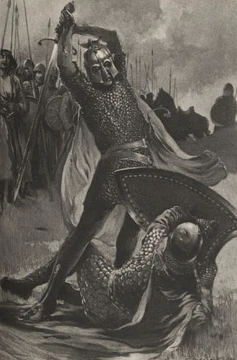
Accolon
Knight of Arthur's court and tragic lover of Morgan le Fay.

Accolon is a knight from King Arthur's court and a figure in Arthurian legend, known as the tragic lover of Morgan le Fay. He appears in stories tied to the Post-Vulgate Cycle, such as the French *Huth Merlin* (where he is called Accalon) and the Spanish adaptation *El Baladro del Sabe Merlin* (where he is Acalón). In Thomas Malory's *Le Morte d'Arthur*, he is named Sir Accolon.
In medieval literature, Accolon is Morgan le Fay's paramour. The Post-Vulgate *Suite de Merlin*, which Malory used as a source, says she loved him so intensely that she wanted to kill her husband, King Urien, and her brother, King Arthur, hoping to make Accolon king through magic, devilish aid, or the support of Britain's nobles. Malory describes their love as "oute of mesure," similar to Palamedes's love for Isolde or the many women who loved Lancelot.
Early in Malory's book, Accolon hunts with Arthur and Urien. They get lost chasing a white hart and camp in the woods. After boarding Morgan's enchanted boat, Accolon wakes up in a field, where Morgan gives him the real Excalibur—a sword Arthur had entrusted to her, but she keeps the scabbard herself. She orders him to use it in a duel against a mysterious swordsman, who is actually Arthur, wielding a fake Excalibur Morgan gave him. Neither recognizes the other. Accolon, with the real sword, nearly defeats Arthur. Arthur's sword breaks, and he realizes he was betrayed. He fights on with his shield until Accolon drops the sword, and Arthur recovers it. Arthur wounds Accolon mortally. Meanwhile, Morgan tries to kill the sleeping Urien but is stopped by their son Yvain. Arthur, recognizing Accolon, promises no punishment if he lives, but Accolon dies from his wound four days later.
Arthur sends Accolon's body to Morgan at Camelot, where she grieves deeply. In revenge, she steals Excalibur's scabbard—arguably more valuable than the sword—and throws it into an enchanted lake, losing it forever. Later, Morgan finds Arthur's knight Manassen, a good knight, about to be drowned by another knight for adultery. She saves Manassen and helps him drown his enemy.
In modern retellings, the duel appears in works like Mary Stewart's *The Last Enchantment* (1979) and Persia Woolley's *Queen of the Summer Stars* (1990). Anthony Dutton played Accolon in the 1979 TV series *The Legend of King Arthur*.
Quick Facts
- Series
- Matter of Britain
- First
- Post-Vulgate Suite de Merlin
- Occupation
- Knight
- Significant Other
- Morgan le Fay
Facts from the source article.
Lore & Background
Accolon is a paramour of Morgan le Fay, King Arthur's half-sister. As described in the Post-Vulgate Suite de Merlin, 'She loved him so madly that she desired to kill her husband [King Urien] and her brother [King Arthur], for she thought she could make Accolon king, either by the devil's help or by magic or by entreaty of the nobles of Great Britain.' Malory describes them loving each other 'out of measure.'
In Malory's book, Accolon hunts with Arthur and King Urien, becomes lost, and boards Morgan's fairy boat. Morgan gives him the magic sword Excalibur but keeps the scabbard herself, telling him to use it against a mysterious swordsman—actually Arthur, who wields a fake Excalibur. During the duel, Arthur's sword breaks; Accolon drops Excalibur, and Arthur recovers it. Arthur wounds Accolon mortally. Arthur assures Accolon he would not punish him if he lived, but Accolon dies from his wound.
Reader's Guide
Accolon's significance lies in his role as a central figure in one of the most dramatic betrayals in Arthurian legend, illustrating Morgan le Fay's ambition and magical manipulation. His duel with Arthur, where he wields the true Excalibur against the king's false sword, highlights themes of deception, loyalty, and the peril of misplaced trust. The episode has been adapted in numerous modern works, including Mary Stewart's The Last Enchantment, Persia Woolley's Queen of the Summer Stars, and Marion Zimmer Bradley's The Mists of Avalon, where Accolon becomes a pawn in Morgan's plan to restore pagan religion. His story also underscores the tragic consequences of love 'out of measure,' as Malory describes, and the enduring power of the Excalibur mythos. The ambiguity in some retellings—whether Morgan truly desires or merely uses Accolon—adds depth to his character as a love-struck knight caught in a web of magic and politics.
Did You Know?
- Accolon is referred to as Sir Accolon of Gaul in Thomas Malory's Le Morte d'Arthur.
- Morgan le Fay gave Accolon the real Excalibur to fight Arthur, who wielded a fake.
- Accolon died four days after being mortally wounded by Arthur.
- In Marion Zimmer Bradley's The Mists of Avalon, Accolon is the second son of Uriens and a knight loyal to Avalon.
The Love That Toppled Thrones
Accolon's narrative is fundamentally propelled by Morgan le Fay's consuming passion for him. In the Post-Vulgate Cycle source that Malory drew upon, her desire is so all-encompassing that she schemes to eliminate both her husband King Urien and her brother King Arthur, convinced she could install Accolon on the throne through diabolical assistance, sorcery, or political persuasion among Britain's nobility. Malory captures the ferocity of their mutual devotion, describing their love as exceeding all natural bounds—a quality he explicitly parallels with the passion binding Palamedes to Isolde. Accolon is identified as a knight of Gaul within Arthur's court, placing him simultaneously as the king's peer and his rival. The relationship exists within a volatile triangle: Morgan is Arthur's half-sister, Urien is her husband, and Accolon is the object of her longing. This configuration transforms a romantic attachment into a political conspiracy, setting the stage for one of Arthurian legend's most violent and consequential confrontations.
The Duel of Excalibur
The climactic confrontation between Accolon and Arthur unfolds under circumstances of mutual deception. After a hunting expedition with Arthur and Urien goes awry when they chase a white hart and become lost in the woods, the three men board Morgan's fairy vessel. Accolon awakens in a field where Morgan presents him with the genuine Excalibur—Arthur's own sword, previously entrusted to her—along with its magical scabbard. She instructs him to use it against a mysterious swordsman in his next encounter. When that swordsman proves to be Arthur, wielding what he believes is Excalibur but is actually a counterfeit Morgan provided, neither man recognizes the other. Accolon's superiority is absolute: the true blade and its invincibility-granting scabbard give him the decisive edge. Arthur's sword shatters mid-combat, and he realizes the betrayal. Yet rather than surrender, Arthur continues fighting with the remnants of his shield. In the final moment, Nimue the Lady of the Lake intervenes, using her magic to wrench Excalibur from Accolon's grip. Arthur seizes the scabbard and strikes a fatal blow.
Grief, Vengeance, and a Lasting Wound
Accolon's death does not end the reverberations of his story. Arthur, upon learning the full truth of Morgan's orchestration, promises Accolon that he will face no punishment should he survive. The knight lives only four more days before succumbing to his wound. His body is delivered to Morgan at Camelot, where her grief is profound and public. That sorrow curdles into calculated retribution: she steals Excalibur's protective scabbard—arguably the more powerful artifact of the pair—and casts it into an enchanted lake, removing it from the world permanently. Her vengeance extends further when she encounters Manassen, a knight facing execution by drowning for an alleged adultery charge. Learning he is Accolon's cousin, Morgan intervenes, rescues him, and even empowers him to drown his would-be executioner. These acts cement Accolon's death as a turning point in the Arthurian narrative, transforming a personal tragedy into a lasting wound in the fabric of Camelot's power and Arthur's own sovereignty.
Accolon in Modern Imagination
Accolon's duel with Arthur has proven remarkably durable in modern retellings. Mary Stewart's The Last Enchantment (1979) and Persia Woolley's Queen of the Summer Stars (1990) both incorporate the episode, while Anthony Dutton portrayed the character in the 1979 television series The Legend of King Arthur. John Steinbeck's 1976 Acts of King Arthur and His Noble Knights offers a pointed critique of Morgan, writing that she beguiled Accolon with promises and canceled his conscience with his lust. Marion Zimmer Bradley's The Mists of Avalon (1982) reimagines the conflict through a pagan lens, casting Accolon as Urien's second son and a loyal knight of Avalon whose death in combat with Arthur is part of a broader struggle between Celtic religion and Christianity; Ian Duncan played him in the 2000 TV adaptation. Fay Sampson's short story "Just Cause" reframes the entire episode through the eyes of Morgan's son Uwain, who is magically transformed into the white hart that lures the three kings to the fairy ship and who, alongside Morgan, seizes and disposes of the scabbard.
Frequently Asked Questions
Who is Accolon?
Accolon is a knight of King Arthur's court in Arthurian legend, best remembered as the tragic lover of Morgan le Fay. He appears across multiple medieval texts ranging from the Post-Vulgate Cycle through Malory's Le Morte d'Arthur.
What makes Accolon a notable swordfighter?
His defining combat is the duel against King Arthur, in which he fights wielding Excalibur itself. This clash places him at the very heart of the conflict between Arthur and Morgan le Fay.
Why is Accolon important in Arthurian legend?
He personifies the forbidden bond between a knight of the Round Table and the sorceress Morgan le Fay, turning personal passion into a direct threat to Arthur's rule. His story amplifies the tension between loyalty to the king and devotion to Morgan.
In which texts does Accolon appear?
He is found in the Post-Vulgate Cycle's Suite de Merlin, the French Huth Merlin (where he is called Accalon), the Spanish El Baladro del Sabe Merlin (as Acalón), and Thomas Malory's Le Morte d'Arthur (as Sir Accolon). His name shifts slightly across these versions.
More in Mythological swordfighters 1-18
Spotted an error? Know more?
Reader corrections go straight into our review queue. Suggest an edit · How this site is sourced