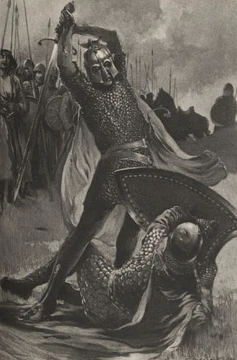
Witege
Warrior of Dietrich von Bern who betrayed him.

Witege (also known as Witige, Wittich, Wudga, Widia, Vidigoia, or Vidrik Verlandsson) is a figure appearing in several Germanic heroic legends, poems about Dietrich von Bern, and later Scandinavian ballads. He is portrayed as a warrior of Dietrich von Bern who later betrayed him to side with Dietrich's wicked uncle Ermenrich.
- Also known as
- Witige, Wittich, Wudga, Widia, Vidigoia, Vidrik Verlandsson
- Father
- Wayland the Smith
- Sword
- Mimung
- Horse
- Schimming (Schemming, Skemming)
- Field
- Heroic legend
- Known for
- Betrayal of Dietrich von Bern; slaying of young Nuotung; duel with Langben Rese/Risker
Lore & Background
In German legends, Witege was one of the warriors of Dietrich von Bern, but betrayed him and took instead the side of his wicked Uncle Ermenrich. In one of the Scandinavian ballads (TSB E 119), he won particular fame in his duel with Langben Rese/Risker (the giant Etgeir in the Þiðrekssaga). During the Middle Ages, he became the son of Wayland the Smith and Böðvildr, and this entitled him to carry a hammer and tongs in his coat of arms. Later the origin of his name 'Wayland's son' was forgotten, but the fame of the character prevailed. During the 16th and the 17th centuries, this led to the idea that his name 'Villandsson' referred to Villand Hundred in Skåne, and the hundred duly began to use his coat of arms as its own. Wudga wielded the sword Mimung, forged by his father, as was the helmet he wore. His mount was the stallion Schimming, one of the finest horses of its age.
Reader's Guide
Witege appears in multiple medieval sources, including the Old English poems Widsith and Waldere, the Middle High German Dietrich poems, and the Norse Þiðrekssaga. In Widsith, he appears together with his friend Háma (Heimir). In the Anglo-Saxon fragment Waldere, Wudga (Widia) is mentioned together with his father Wayland in a praise of Mimung. Partly on the basis of this allusion, Jennifer Lorden has argued that, although he is not named in the poem, the five allusive vignettes that comprise the first half of the Old English poem Deor trace the birth and career of Widia. In the so-called fantastical Dietrich poems, Witege is one of Dietrich von Bern's warriors. In Laurin, Witige accompanies Dietrich and is responsible for destroying the dwarf King Laurin's rose garden. In Virginal, Witige, together with Heime, is one of the warriors who saves Dietrich from captivity in the hands of giants. In the 'historical' poems, Witege has betrayed Dietrich and joined his wicked Uncle Ermenrich. No surviving poem relates the story of how Witege came to betray Dietrich; it is merely assumed as the situation from which the poems begin. In the Rabenschlacht, Witege reluctantly kills the two sons of Etzel and Dietrich's brother Diether when he is forced to fight them. He is then pursued into the sea by a vengeful Dietrich, but saved by a mermaid. Witege probably has a historic basis in either the Gothic national hero Vidigoia, or in Vitiges, a king of the Ostrogoths.
Did You Know?
- Witege's sword Mimung was forged by his father Wayland the Smith.
- During the 16th and 17th centuries, Villand Hundred in Skåne adopted Witege's coat of arms as its own.
- Witege's horse Schimming was one of the finest horses of its age.
More in Mythological swordfighters 1-18
Spotted an error? Know more?
Reader corrections go straight into our review queue. Suggest an edit · How this site is sourced